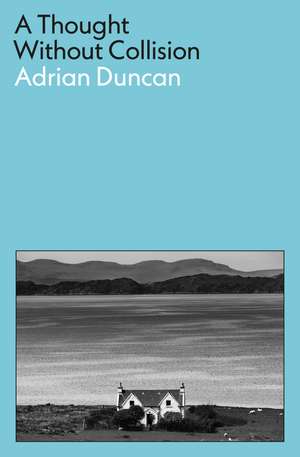
A Thought Without Collision
Autor Adrian Duncanen Limba Engleză Paperback – 13 aug 2026
Preț: 74.71 lei
Preț vechi: 92.73 lei
-19% Nou
Puncte Express: 112
Carte disponibilă
Livrare economică 12-26 noiembrie
Livrare express 28 octombrie-03 noiembrie pentru 37.23 lei
Livrare prin curier în România Termenul estimat este afișat lângă disponibilitate.
Transport gratuit de la 400.00 lei Plată online sau ramburs, în funcție de opțiunile comenzii.
Retur gratuit în 14 zile Comandă securizată și suport în română.
Specificații
ISBN-13: 9781805221975
ISBN-10: 1805221973
Pagini: 224
Dimensiuni: 126 x 196 x 14 mm
Greutate: 0.2 kg
Ediția:Main
Editura: Profile
Colecția Tuskar Rock
Locul publicării:London, United Kingdom
ISBN-10: 1805221973
Pagini: 224
Dimensiuni: 126 x 196 x 14 mm
Greutate: 0.2 kg
Ediția:Main
Editura: Profile
Colecția Tuskar Rock
Locul publicării:London, United Kingdom
Notă biografică
Adrian Duncan is an Irish artist and writer. His debut novel Love Notes from a German Building Site won the 2019 John McGahern Book Prize. His second novel A Sabbatical in Leipzig (2020) was shortlisted for the Kerry Novel of the Year. His collection of short stories Midfield Dynamo was published in 2021 and longlisted for the Edge Hill Prize. His third novel, The Geometer Lobachevsky, was published in April 2022.
Recenzii
A brilliant interrogation of philosophy and wonder ... In Duncan's fiction, the Irish realist tradition converges with a cerebral European mode
A tender examination of our relationships to one another and the world around us ... layered with complexity
Adrian Duncan's account of a mathematical prodigy and the characters who shape her life is for me his best work yet. The dual timelines build into a compelling enquiry into how we perceive and affect the world that we pass through. It's very moving, very funny, and it will make your brain dance
I was so impressed and moved by this novel. With formal innovation and elegant, blistering prose, Duncan offers a different model of novelistic causality, with characters that feel alive in their vivid and quiet complexity
The book is an elegant rarity in contemporary fiction: a novel in which form, voice, style and story are inseparable from each other.
Praise for Adrian Duncan
One of the most important and intriguing writers working now
Uncanny, strange and exquisite, akin to the fictions of László Krasznahorkai
I was so impressed and moved by this novel. A Thought Without Collision manages to seamlessly intersperse fascinating passages of mathematical philosophy with encounters of profound human tenderness, asking questions of what, exactly, it is that makes us human: the messy, tearaway nature of our thoughts? Our yearning for sense-making? Or the uncontrollable and yet transformative points of connection between us? With formal innovation and elegant, blistering prose, Duncan offers a different model of novelistic causality, with characters that feel alive in their vivid and quiet complexity
A tender examination of our relationships to one another and the world around us ... layered with complexity
Adrian Duncan's account of a mathematical prodigy and the characters who shape her life is for me his best work yet. The dual timelines build into a compelling enquiry into how we perceive and affect the world that we pass through. It's very moving, very funny, and it will make your brain dance
I was so impressed and moved by this novel. With formal innovation and elegant, blistering prose, Duncan offers a different model of novelistic causality, with characters that feel alive in their vivid and quiet complexity
The book is an elegant rarity in contemporary fiction: a novel in which form, voice, style and story are inseparable from each other.
Praise for Adrian Duncan
One of the most important and intriguing writers working now
Uncanny, strange and exquisite, akin to the fictions of László Krasznahorkai
I was so impressed and moved by this novel. A Thought Without Collision manages to seamlessly intersperse fascinating passages of mathematical philosophy with encounters of profound human tenderness, asking questions of what, exactly, it is that makes us human: the messy, tearaway nature of our thoughts? Our yearning for sense-making? Or the uncontrollable and yet transformative points of connection between us? With formal innovation and elegant, blistering prose, Duncan offers a different model of novelistic causality, with characters that feel alive in their vivid and quiet complexity