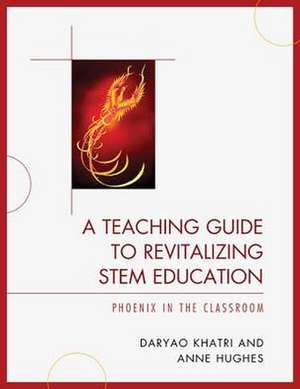
A Teaching Guide to Revitalizing STEM Education: Phoenix in the Classroom
Autor Daryao Khatrien Limba Engleză Paperback – 13 noi 2012
By reading and using A Teaching Guide to Revitalizing STEM Education, educators will rediscover how to streamline the subject matter- math, physics, statistics, and organic chemistry-by eliminating unnecessary difficulties and distractions from course textbooks. A useful guide for both high school teachers and postsecondary faculty, this book explains how to organize, arrange, and streamline STEM content so that it is approachable, understandable, and applicable for students. Likewise, this guide discusses important classroom management skills and pedagogical techniques that will help students master these critical subjects. Providing and explaining over a dozen lesson plans, A Teaching Guide to Revitalizing STEM Education will encourage educators to effectively optimize the recent emphases on science, technology, engineering, and math education.
Preț: 292.22 lei
Preț vechi: 394.55 lei
-26%
Puncte Express: 438
Preț estimativ în valută:
51.67€ • 60.97$ • 45.25£
51.67€ • 60.97$ • 45.25£
Carte tipărită la comandă
Livrare economică 14-28 aprilie
Specificații
ISBN-13: 9781610484480
ISBN-10: 1610484487
Pagini: 117
Dimensiuni: 206 x 276 x 12 mm
Greutate: 0.32 kg
Editura: Bloomsbury Publishing
Colecția R&L Education
Locul publicării:New York, United States
ISBN-10: 1610484487
Pagini: 117
Dimensiuni: 206 x 276 x 12 mm
Greutate: 0.32 kg
Editura: Bloomsbury Publishing
Colecția R&L Education
Locul publicării:New York, United States
Cuprins
Acknowledgments
IntroductionRevolutionizing Stem Teaching: A Guide to Parallel Course Design and Delivery
Chapter 1Pedagogical Principles and Course Streamlining
Chapter 2:Organization, Definitions, and Common Features
Chapter 3:First Day of the Class
Chapter 4Arithmetic Operations with Mixed Numerals: Basic Math
Chapter 5Percents: Basic Math
Chapter 6Solving Simultaneous Equations Using the Elimination Method: Determinants and Matrices in Matrix Algebra
Chapter 7Three Coordinate Systems: Calculus and Mathematical Physics
Chapter 8Horizontal and Vertical Linear Motions: College Physics I
Chapter 9An Application of Newton's Second Law of Motion: College Physics I
Chapter 10Hydrogen Spectral Lines in Visible, Ultraviolet, and Infrared Spectrums: College Physics II
Chapter 11Simple Vector Operations: Physics, Mathematics, and Engineering
Chapter 12Frequencies, Percents, Histograms, and Polygons: Statistics
Chapter 13Mean, Median, and Mode: Measures of Central Tendency in Statistics
Chapter 14Measures of Variability/Dispersion-Calculating the Range and the Standard Deviation: Mathematics and Statistics
Chapter 15The Correlated "t" Test: Statistics
Chapter 16Concepts and Skills Review: Organic Chemistry I
Chapter 17Skills and Concepts for Molecular Geometry: Organic Chemistry I
Chapter 18Molecular Geometry and Electron Domain Geometry: Organic Chemistry I
Chapter 19Nomenclature: The System of Naming Hydrocarbons: Organic Chemistry I
Conclusion
About the Authors
IntroductionRevolutionizing Stem Teaching: A Guide to Parallel Course Design and Delivery
Chapter 1Pedagogical Principles and Course Streamlining
Chapter 2:Organization, Definitions, and Common Features
Chapter 3:First Day of the Class
Chapter 4Arithmetic Operations with Mixed Numerals: Basic Math
Chapter 5Percents: Basic Math
Chapter 6Solving Simultaneous Equations Using the Elimination Method: Determinants and Matrices in Matrix Algebra
Chapter 7Three Coordinate Systems: Calculus and Mathematical Physics
Chapter 8Horizontal and Vertical Linear Motions: College Physics I
Chapter 9An Application of Newton's Second Law of Motion: College Physics I
Chapter 10Hydrogen Spectral Lines in Visible, Ultraviolet, and Infrared Spectrums: College Physics II
Chapter 11Simple Vector Operations: Physics, Mathematics, and Engineering
Chapter 12Frequencies, Percents, Histograms, and Polygons: Statistics
Chapter 13Mean, Median, and Mode: Measures of Central Tendency in Statistics
Chapter 14Measures of Variability/Dispersion-Calculating the Range and the Standard Deviation: Mathematics and Statistics
Chapter 15The Correlated "t" Test: Statistics
Chapter 16Concepts and Skills Review: Organic Chemistry I
Chapter 17Skills and Concepts for Molecular Geometry: Organic Chemistry I
Chapter 18Molecular Geometry and Electron Domain Geometry: Organic Chemistry I
Chapter 19Nomenclature: The System of Naming Hydrocarbons: Organic Chemistry I
Conclusion
About the Authors
Recenzii
This latest book by Khatri and Hughes utilizes their student-friendly inductive pedagogical techniques in its design. Their recent innovation of presenting problems in parallel is revolutionary, in my opinion. In terms of achieving high retention and successes for students in STEM disciplines, this book can change the teaching landscape forever....I highly recommend this book for everyone teaching a STEM discipline at the high school and college levels. The book contains examples of instructional material for a number of STEM disciplines designed in parallel using the inductive and student-friendly pedagogical techniques. Using these approaches, I have been able to complete entire math courses in less than the prescribed time-frames-and still have all my students with me, and succeeding.
Organic chemistry has always been a bear with students, who drop out and fail at alarming rates. About four years ago, I had a serious discussion with Dr. Khatri, one of the co-authors of this book, about possible reasons for these rates. We have been working on this problem for over three years, and we have actually found a solution to it.
After transposing the course, designing it in parallel, and using the student-friendly inductive approach to teaching, we have completely reversed the failing rate of students. We have achieved a retention and success rate of nearly 85% in organic chemistry I. This is a change from a 35-40% retention and success rate over a period of decades. I do highly recommend this book to everyone teaching chemistry in general-and organic chemistry, in particular-to review this book and use the examples provided as a guide to design their own courses. The use of exit questions and priming homework originated through our work in transposing the organic chemistry course. They are very powerful strategies for achieving high student retention and success rates.
I know that I am not the only student who truly appreciated your making the effort over the past several years to re-evaluate and perfect your teaching methods....It is apparent that you have taken the time to learn how to teach.
Organic chemistry has always been a bear with students, who drop out and fail at alarming rates. About four years ago, I had a serious discussion with Dr. Khatri, one of the co-authors of this book, about possible reasons for these rates. We have been working on this problem for over three years, and we have actually found a solution to it.
After transposing the course, designing it in parallel, and using the student-friendly inductive approach to teaching, we have completely reversed the failing rate of students. We have achieved a retention and success rate of nearly 85% in organic chemistry I. This is a change from a 35-40% retention and success rate over a period of decades. I do highly recommend this book to everyone teaching chemistry in general-and organic chemistry, in particular-to review this book and use the examples provided as a guide to design their own courses. The use of exit questions and priming homework originated through our work in transposing the organic chemistry course. They are very powerful strategies for achieving high student retention and success rates.
I know that I am not the only student who truly appreciated your making the effort over the past several years to re-evaluate and perfect your teaching methods....It is apparent that you have taken the time to learn how to teach.