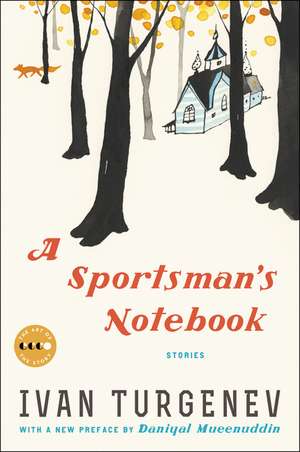
A Sportsman's Notebook
Autor Ivan Turgeneven Limba Engleză Paperback – 7 ian 2020
A Sportsman’s Notebook, Ivan Turgenev’s first literary masterpiece, is a sweeping portrayal of the magnificent nineteenth–century Russian countryside and the harsh lives of those who inhabited it. In a powerful and gripping series of sketches, a hunter wanders through the vast landscape of steppe and forest in search of game, encountering a varied cast of peasants, landlords, bailiffs, overseers, horse traders, and merchants. He witnesses both feudal tyranny and the submission of the tyrannized, against a backdrop of the sublime and pitiless terrain of rural Russia.
These exquisitely rendered stories, now with a stirring introduction from Daniyal Mueenuddin, were not only universally popular with the reading public but, through the influence they exerted on important members of the Tsarist bureaucracy, contributed to the major political event of mid–nineteenth–century Russia: the Great Emancipation of the serfs in 1861. Rarely has a book that offers such undiluted literary pleasure also been so strong a force for significant social change, one that continues to speak to readers centuries later.
Preț: 103.14 lei
Preț vechi: 129.17 lei
-20%
Puncte Express: 155
Carte indisponibilă temporar
Doresc să fiu notificat când acest titlu va fi disponibil:
Se trimite...
Specificații
ISBN-13: 9780062968470
ISBN-10: 0062968475
Pagini: 416
Dimensiuni: 143 x 204 x 27 mm
Greutate: 0.33 kg
Editura: Harpercollins
ISBN-10: 0062968475
Pagini: 416
Dimensiuni: 143 x 204 x 27 mm
Greutate: 0.33 kg
Editura: Harpercollins
V-ar putea interesa
-
 Love Me TenderJane FeaverPreț: 107.78 lei
 -
 The Handmaid's TaleMargaret AtwoodPreț: 160.87 lei
 -
 BloodrootAmy GreenePreț: 129.34 lei
 -
 Forgotten LandMax Egremont-34%Preț: 71.63 lei107.99 lei
 -
 The Cairo TrilogyNaguib MahfouzPreț: 327.24 lei
 -
 Stolen HorsesDan O’BrienPreț: 116.51 lei
 -
 A Mind At PeaceAhmet Hamdi TanpinarPreț: 145.05 lei
 -
 Some Desperate GloryMax Egremont-19%Preț: 87.61 lei107.84 lei
 -
 Siegfried SassoonMax Egremont-32%Preț: 73.83 lei108.40 lei
 -
 Six Metres of PavementFarzana DoctorPreț: 138.72 lei
 -
 The Edge Of EdenHelen BenedictPreț: 59.14 lei
 -
 Fathers and SonsIvan Sergeyevich TurgenevPreț: 36.35 lei
Recenzii
"The character depictions are marked by their warmth and fondness...Re-reading this book made me happy in that simple yet rare way that one is lifted up by sincerity, probity and kindness." — Wall Street Journal
Notă biografică
Ivan Sergeyevich Turgenev was born in 1818 in the Province of Orel, and suffered during his childhood from a tyrannical mother. After the family had moved to Moscow in 1827 he entered Petersburg University where he studied philosophy. When he was nineteen he published his first poems and, convinced that Europe contained the source of real knowledge, went to the University of Berlin. After two years he returned to Russia and took his degree at the University of Moscow. In 1843 he fell in love with Pauline Garcia-Viardot, a young Spanish singer, who influenced the rest of his life; he followed her on her singing tours in Europe and spent long periods in the French house of herself and her husband, both of whom accepted him as a family friend. He sent his daughter by a sempstress to be brought up among the Viardot children. After 1856 he lived mostly abroad, and he became the first Russian writer to gain a wide reputation in Europe; he was a well-known figure in Parisian literary circles, where his friends included Flaubert and the Goncourt brothers, and an honorary degree was conferred on him at Oxford. His series of six novels reflect a period of Russian life from 1830s to the 1870s: they are Rudin (1855), A House of Gentlefolk (1858), On the Eve (1859; a Penguin Classic), Fathers and Sons (1861), Smoke (1867) and Virgin Soil (1876). He also wrote plays, which include the comedy A Month in the Country; short stories and Sketches from a Hunter’s Album (a Penguin Classic); and literary essays and memoirs. He died in Paris in 1883 after being ill for a year, and was buried in Russia.
Descriere
Descriere de la o altă ediție sau format:
These stories of the 19th-century Russian rural landscape and the difficult life of those who inhabited it were universally popular with the reading public at large and contributed in no small measure to the emancipation of the serfs in 1861.
These stories of the 19th-century Russian rural landscape and the difficult life of those who inhabited it were universally popular with the reading public at large and contributed in no small measure to the emancipation of the serfs in 1861.