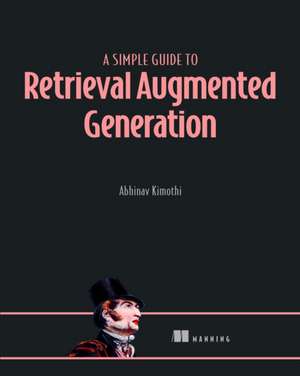
A Simple Guide to Retrieval Augmented Generation
Autor Abhinav Kimothen Limba Engleză Paperback – 25 iul 2025
Ceea ce diferențiază A Simple Guide to Retrieval Augmented Generation de documentația tehnică standard sau de tutorialele fragmentate de pe internet este rigoarea structurii și orientarea imediată către implementare. În timp ce documentația oficială a diverselor biblioteci se concentrează pe sintaxă, Abhinav Kimothi construiește o punte între teoria modelelor de limbaj mari (LLM) și nevoia critică a companiilor de a interoga date proprii, evitând halucinațiile specifice modelelor standard. Apreciem în mod deosebit progresia logică a materialului. Observăm că autorul nu se limitează la prezentarea conceptului de RAG (Retrieval Augmented Generation), ci ghidează cititorul prin arhitecturi complexe: de la pipeline-ul de indexare pentru crearea bazelor de cunoștințe, până la faza de generare contextuală. Pe linia practică a volumului Building Applications with Large Language Models, dar cu un focus specific și aprofundat pe tehnologiile de recuperare a datelor, această lucrare devine un manual de referință pentru dezvoltarea sistemelor RAG moderne. Merită menționat că textul acoperă și aspectele de RAGOps, esențiale pentru menținerea performanței în producție, și explorează variante avansate, precum RAG-ul multimodal care procesează imagini și foi de calcul. Stilul este tehnic și pragmatic, bazat pe exemple Python clare, facilitând utilizarea unor instrumente precum LangChain. Abordarea este una modulară, permițând inginerilor să înțeleagă nu doar cum să construiască un sistem, ci și cum să îl evalueze din punctul de vedere al acurateței și relevanței, elemente vitale într-un mediu de business.
Preț: 269.42 lei
Preț vechi: 336.77 lei
-20%
Carte disponibilă
Livrare economică 17-31 iulie
Livrare express 03-09 iulie pentru 47.61 lei
Specificații
ISBN-10: 1633435857
Pagini: 256
Dimensiuni: 185 x 231 x 19 mm
Greutate: 0.35 kg
Editura: Manning Publications
V-ar putea interesa
-
 Using Artificial Intelligence Absolute Beginner's GuideMichael Miller-20%Preț: 189.01 lei236.26 lei
 -
 Writing AI Prompts For DummiesStephanie Diamond-20%Preț: 97.46 lei121.82 lei
 -
 Coding with AI For DummiesChris Minnick-20%Preț: 140.68 lei175.85 lei
 -
 Business Writing with AI For DummiesSheryl Lindsell-Roberts-20%Preț: 139.68 lei174.60 lei
 -
 Artificial Intelligence For DummiesJohn Paul MuellerPreț: 138.25 lei
 -
 Generative AI For DummiesPam BakerPreț: 136.92 lei
 -
 ChatGPT For DummiesPam Baker-20%Preț: 96.56 lei120.70 lei
 -
 Machine Learning For DummiesJohn Paul Mueller-20%Preț: 147.53 lei184.42 lei
 -
 Agentic AI For DummiesPam Baker-20%Preț: 143.73 lei179.66 lei
 -
 The Essential Book of AIAnne Rooney-20%Preț: 71.24 lei89.04 lei
 -
 -36%Preț: 48.46 lei75.78 lei
 -
 MongoDB in Action, Third EditionArek Borucki-20%Preț: 341.25 lei426.56 lei
 -
 Effective Conversational AIAndrew Freed-20%Preț: 369.59 lei461.98 lei
 -
 Hugging Face in ActionWei-Meng Lee-20%Preț: 270.46 lei338.07 lei
 -
 Introduction to Generative AIMaggie Engler-20%Preț: 364.26 lei455.32 lei
 -
 Mastering AIJeremy Kahn-20%Preț: 67.31 lei84.14 lei
 -
 How to Make AI UsefulMagnus Reiner-12%Preț: 81.09 lei92.64 lei
 -
 The PlayStation 2 Collector's GuideMathieu Manent-20%Preț: 128.17 lei160.22 lei
 -
 Metaphor: ReFantazio Official Strategy GuideFuture Press-20%Preț: 354.55 lei443.18 lei
 -
 HBR Guide to Generative AI for ManagersElisa Farri-20%Preț: 100.63 lei125.80 lei
De ce să citești această carte
Recomandăm această carte inginerilor de date și managerilor tehnici care doresc să depășească limitările modelelor AI standard prin integrarea datelor proprii. Veți câștiga o înțelegere clară a întregului flux RAG, de la baze de date vectoriale la agenți inteligenți, totul susținut de cod Python practic. Este resursa ideală pentru a transforma un LLM generic într-un instrument specializat pe nevoile specifice ale afacerii dumneavoastră.