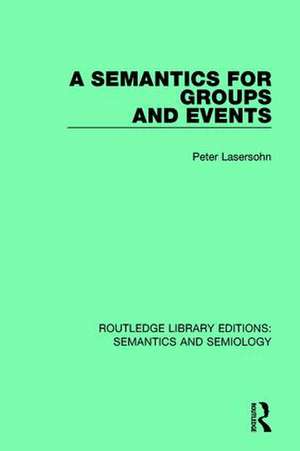
A Semantics for Groups and Events: Routledge Library Editions: Semantics and Semiology
Autor Peter Lasersohnen Limba Engleză Paperback – 27 feb 2018

Preț: 383.66 lei
Puncte Express: 575
Carte tipărită la comandă
Livrare economică 27 noiembrie-11 decembrie
Livrare prin curier în România Termenul estimat este afișat lângă disponibilitate.
Transport gratuit de la 400.00 lei Plată online sau ramburs, în funcție de opțiunile comenzii.
Retur gratuit în 14 zile Comandă securizată și suport în română.
Specificații
ISBN-13: 9781138691797
ISBN-10: 1138691798
Pagini: 156
Ilustrații: Illustrations, black and white
Dimensiuni: 156 x 234 x 9 mm
Greutate: 0.28 kg
Ediția:1
Editura: Taylor & Francis
Colecția Routledge
Seria Routledge Library Editions: Semantics and Semiology
Locul publicării:Oxford, United Kingdom
ISBN-10: 1138691798
Pagini: 156
Ilustrații: Illustrations, black and white
Dimensiuni: 156 x 234 x 9 mm
Greutate: 0.28 kg
Ediția:1
Editura: Taylor & Francis
Colecția Routledge
Seria Routledge Library Editions: Semantics and Semiology
Locul publicării:Oxford, United Kingdom
Cuprins
Preface; Chapter I: Adverbial Modification and the Interpretation of Distributive Predicates; 0. A few preliminaries 1. The distributive-collective dichotomy 2. "Intrinsic" distributives and collectives 3. Distributive predication as predication on groups 4. Group-sensitive adverbials 5.Conjoining collective and distributive verb phrases; Chapter II: Group Action and Spatio-Temporal Proximity; 0. Introduction 1. Vagueness and Ambiguity 2. The "proximity" uses if group-sensitive adverbials 3. Semantic effects of adverbial position 4. Quantifier scope 5. Event structure and group action 6. Fragment 2 7. Examples 8. Locative and temporal readings 9. Adjectival and object-oriented readings 10. Distributive predicates revisited 11. Conclusion; Chapter III: The Algebra of Groups and the Algebra of Events; 0. Introduction: Tightening up the model 1. The algebra of groups 2. A note on respectively constructions 3.Committees, etc. 4. The algebra of events as a semilattice 5. Restricting the structure of events 6. Unaugmented and augmented frames; Chapter IV: Quantifiers. Group-Level Properties and Agreement; 0. Are quantifiers sensitive to event structure? 1. Different types of group-level events 2. Event-sensitive quantification 3. Additivity, inclusion and exclusion 4. An argument-restriction account of agreement 5. Some problems 6. Agreement and the inclusion/exclusion distinction 7. Distributive determiners and plural agreement 8. Fewer than two and more than one 9. Remaining problems; References
Descriere
First published in 1990, this dissertation presents an event-based model-theoretic semantics for plural expressions in English. The author defends against counterarguments the hypothesis that distributive predicates are predicates of groups, and not just individuals. By defining the collective/distributive distinction in terms of event structure, he solves formal problems with previous group-level analyses. The author notes that certain adverbials have a systematic ambiguity between a reading indicating collective action, and readings indicating spatial or temporal proximity; the event-based definition of collective action makes possible a parallel treatment of these readings.