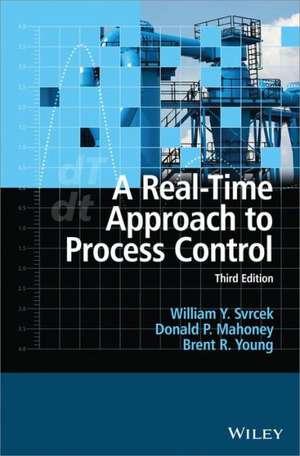
A Real-Time Approach to Process Control
Autor Brent R. Young, Donald P. Mahoney, William Y. Svrceken Limba Engleză Paperback – 7 feb 2014
In writing this book the authors' have focused exclusively on the vast majority of chemical engineering students who need a basic understanding of practical process control for their industrial careers. Traditionally process control has been taught using non-intuitive and highly mathematical techniques (Laplace and frequency-domain techniques). Aside from being difficult to master in a one-semester course, the traditional approach is of limited use for more complex process control problems encountered in the chemical processing industries. When designing and analyzing multi-loop control systems today, industry practitioners employ both steady-state and dynamic simulation-based methodologies. These 'real time' methods have now all but replaced the traditional approach.
A Real Time Approach to Process Control provides the student with both a theoretical and practical introduction to this increasingly important approach. Assuming no prior knowledge of the subject, this text introduces all of the applied fundamentals of process control from instrumentation to process dynamics, PID loops and tuning, to distillation, multi-loop and plant-wide control. In addition, students come away with a working knowledge of the three most popular dynamic simulation packages. The text carefully balances theory and practice by offering students readings and lecture materials along with hands-on workshops that provide a 'virtual' process on which to experiment and from which to learn modern, real time control strategy development.
Features:
* The first and only textbook to use a completely real time approach.
* Gives students the opportunity to understand and use HYSYS software.
* Carefully designed workshops (tutorials) have been included to allow students to practice and apply the theory.
* Includes many worked examples and student problems.
VISIT THE AUTHORS' WEBSITE: www.ench.ucalgary.ca/ realtime
Preț: 355.98 lei
Preț vechi: 444.98 lei
-20%
Puncte Express: 534
Carte disponibilă
Livrare economică 06-20 noiembrie
Livrare express 23-29 octombrie pentru 40.59 lei
Livrare prin curier în România Termenul estimat este afișat lângă disponibilitate.
Transport gratuit de la 400.00 lei Plată online sau ramburs, în funcție de opțiunile comenzii.
Retur gratuit în 14 zile Comandă securizată și suport în română.
Specificații
ISBN-13: 9781119993889
ISBN-10: 1119993881
Pagini: 368
Dimensiuni: 170 x 244 x 20 mm
Greutate: 0.63 kg
Ediția:3. Auflage
Editura: John Wiley & Sons, Inc.
ISBN-10: 1119993881
Pagini: 368
Dimensiuni: 170 x 244 x 20 mm
Greutate: 0.63 kg
Ediția:3. Auflage
Editura: John Wiley & Sons, Inc.
V-ar putea interesa
-
 Unit Operations of Chemical Engineering (Int'l Ed)Warren McCabe-25%Preț: 395.05 lei526.87 lei
 -
 Chemical Engineering Design: SI EditionRay Sinnott-29%Preț: 496.63 lei698.51 lei
 -
 -32%Preț: 2609.47 lei3862.30 lei
 -
 -9%Preț: 1248.28 lei1371.74 lei
 -
 Extractive Metallurgy of CopperMark E. Schlesinger-25%Preț: 1105.08 lei1478.78 lei
 -
 -23%Preț: 901.21 lei1170.41 lei
 -
 Process Dynamics, Modeling, and ControlBabatunde Ogunnaike-24%Preț: 1759.02 lei2309.64 lei
 -
 Introduction to Real-Time Computing for Mechanical Engineers, AnJoseph L. Garbini-16%Preț: 518.06 lei617.19 lei
 -
 Sabiston Textbook of Surgery: The Biological Basis of Modern Surgical PracticeDouglas Scott Tyler-29%Preț: 1168.66 lei1644.95 leiRecomandat
 -
 DiffusionE. L. Cussler-19%Preț: 611.38 lei754.79 lei
 -
 The Rotary Cement KilnKurt E. Peray-8%Preț: 678.82 lei737.85 lei
 -
 Manufacturing Process Validation: Concepts, Tools, and Industrial ApplicationsArturo Realyvásquez-Vargas-8%Preț: 442.51 lei481.00 lei
 -
 Understanding Process Dynamics and ControlCostas Kravaris-9%Preț: 835.70 lei918.35 lei
 -
 Advanced Optimization for Process Systems EngineeringIgnacio E. Grossmann-9%Preț: 639.67 lei702.93 lei
 -
 -19%Preț: 455.11 lei561.87 lei
 -
 Process Dynamics and Control, 4th EMEA EditionDale E. Seborg-19%Preț: 419.65 lei518.08 lei
 -
 -11%Preț: 674.61 lei758.00 lei
 -
 -23%Preț: 660.63 lei857.96 lei
 -
 Practical Process Control Design with Industrial ApplicationsAlan M Kugelman-23%Preț: 969.06 lei1258.52 lei
 -
 Introduction to Chemical Reactor AnalysisR.E. Hayes-15%Preț: 549.68 lei646.69 lei
 -
 Process Control: Problems, Techniques and ApplicationsSamuel P. Werther-27%Preț: 1165.46 lei1585.77 lei
 -
 Physical Chemical & Biological Treatment Processes for Water & WastewaterDr Tushar Kanti Sen-27%Preț: 2072.89 lei2823.92 lei
 -
 Robust and Adaptive ControlEugene LavretskyPreț: 533.14 lei
 -
 Data Analytics for Process EngineersDaniela GalatroPreț: 300.87 lei
 -
 -11%Preț: 481.24 lei540.71 lei
 -
 Advanced Chemical Process ControlMorten Hovd-14%Preț: 698.21 lei811.88 lei
 -
 -5%Preț: 835.52 lei879.50 lei
 -
 Advanced Control Methods for Industrial ProcessesPablo A. López-Pérez-23%Preț: 698.89 lei907.65 lei
Textul de pe ultima copertă
Throughout the chemical industry, ever more emphasis is being placed upon extracting increasingly greater value from existing plant equipment. Improved process control is almost unique in its ability to deliver substantial operational improvements with little, or no additional, capital investment. As such, process control has rapidly become one of the most important and sought-after skills within the chemical industry. The industry needs graduates educated and trained in the latest and most relevant skills, as its practitioners rely heavily on commercially available process simulation tools and hands-on, time-based control strategy development techniques. A Real-Time Approach to Process Control brings together introductory process control education and real industry practice. While avoiding the use of complex and highly mathematical techniques, this text focuses instead on the more practical and applied time-domain techniques derived from modern process simulation. Assuming no prior knowledge of process control, this text provides both a theoretical and practical introduction to this increasingly important area. The use of computers in process control is a central theme running throughout this text, and their use in simulations and the software is carefully introduced. The reader will gain a thorough understanding of instrumentation, process design versus controllability trade-offs, control loop configurations and tuning, and practical techniques for the control of vessels, distillation columns and basic plant-wide control considerations. A Real-Time Approach to Process Control:
* Is an applied introduction to the theory and practice of modern process control.
* Avoids the use of complex mathematics, focusing instead on real-time systems.
* Introduces dynamic simulation software and enables the reader to understand how and why it is used.
* Includes many examples and carefully designed workshops, providing hands-on experience.
* Has its own Web site at http: //www.ench.ucalgary.ca/ real-time.
This essential introduction to modern process control is suitable for students taking process control courses, as well as engineers interested in learning more about real-time systems and applications of dynamic simulation software.
* Is an applied introduction to the theory and practice of modern process control.
* Avoids the use of complex mathematics, focusing instead on real-time systems.
* Introduces dynamic simulation software and enables the reader to understand how and why it is used.
* Includes many examples and carefully designed workshops, providing hands-on experience.
* Has its own Web site at http: //www.ench.ucalgary.ca/ real-time.
This essential introduction to modern process control is suitable for students taking process control courses, as well as engineers interested in learning more about real-time systems and applications of dynamic simulation software.
Notă biografică
William Y. Svrcek, Department of Chemical and Petroleum Engineering, University of Calgary, Canada
Donald P. Mahoney, Chemical Industry Business Solutions, SAP AG, USA
Brent R. Young, Department of Chemical and Materials Engineering, University of Auckland, New Zealand
Donald P. Mahoney, Chemical Industry Business Solutions, SAP AG, USA
Brent R. Young, Department of Chemical and Materials Engineering, University of Auckland, New Zealand
Cuprins
Author Biographies xi Foreword and Endorsements xiii
Preface xv
Acknowledgements xvii
1 A Brief History of Process Control and Process Simulation 1
1.1 Process Control 1
1.2 Process Simulation 5
References 11
2 Process Control Hardware Fundamentals 15
2.1 Control System Components 15
2.2 Primary Elements 16
2.3 Final Control Elements 33
References 53
3 Fundamentals of Single-Input/Single-Output Systems 55
3.1 Open Loop Control 55
3.2 Disturbances 56
3.3 Feedback Control - Overview 57
3.4 Feedback Control - A Closer Look 60
3.5 Process Attributes - Capacitance and Dead Time 66
3.6 Process Dynamic Response 74
3.7 Process Modelling and Simulation 76
References 93
4 Basic Control Modes 95
4.1 On-Off Control 95
4.2 Proportional (P-Only) Control 97
4.3 Integral (I-Only) Control 102
4.4 Proportional Plus Integral (PI) Control 105
4.5 Derivative Action 107
4.6 Proportional Plus Derivative (PD) Controller 108
4.7 Proportional Integral Derivative (PID) Control 111
4.8 Digital Electronic Controller Forms 112
4.9 Choosing the Correct Controller 112
4.10 Controller Hardware 114
References 117
5 Tuning Feedback Controllers 119
5.1 Quality of Control and Optimization 119
5.2 Tuning Methods 123
References 132
6 Advanced Topics in Classical Automatic Control 133
6.1 Cascade Control 133
6.2 Feedforward Control 137
6.3 Ratio Control 140
6.4 Override Control (Auto Selectors) 142
6.5 Split Range Control 147
References 149
7 Common Control Loops 151
7.1 Flow Loops 151
7.2 Liquid Pressure Loops 153
7.3 Liquid Level Control 155
7.4 Gas Pressure Loops 165
7.5 Temperature Control Loops 166
7.6 Pump Control 172
7.7 Compressor Control 172
7.8 Boiler Control 179
References 182
8 Distillation Column Control 185
8.1 Basic Terms 185
8.2 Steady-State and Dynamic Degrees of Freedom 186
8.3 Control System Objectives and Design Considerations 188
8.4 Methodology for Selection of a Controller Structure 190
8.5 Level, Pressure, Temperature and Composition Control 192
8.6 Optimizing Control 199
Section Sidestream 199
8.7 Distillation Control Scheme Design Using Steady-State Models 204
8.8 Distillation Control Scheme Design Using Dynamic Models 212
References 213
9 Using Steady-State Methods in a Multi-loop Control Scheme 215
9.1 Variable Pairing 215
9.2 The Relative Gain Array 216
9.3 Niederlinski Index 220
9.4 Decoupling Control Loops 220
9.5 Tuning the Controllers for Multi-loop Systems 222
9.6 Practical Examples 222
9.7 Summary 232
References 232
10 Plant-Wide Control 233
10.1 Short-Term versus Long-Term Control Focus 233
10.2 Cascaded Units 235
10.3 Recycle Streams 236
10.4 General Considerations for Plant-Wide Control 241
References 242
11 Advanced Process Control 245
11.1 Advanced Process Control 245
11.2 Model Predictive Control 246
11.3 Dynamic Matrix Control 249
11.4 General Considerations for Model Predictive Control Implementation 253
References 254
Appendix A P&ID Symbols 257
Appendix B Glossary of Terms 261
Appendix C New Capabilities with Control Technology Hardware and Software 267
Workshop 1 Learning through Doing 279
Workshop 2 Feedback Control Loop Concepts 283
Workshop 3 Process Capacity and Dead Time 289
Workshop 4 Feedback Control 295
Workshop 5 Controller Tuning for Capacity and Dead Time Processes 303
Workshop 6 Topics in Advanced Control 311
Workshop 7 Distillation Control 321
Workshop 8 Plant Operability and Controllability 333
Index
Preface xv
Acknowledgements xvii
1 A Brief History of Process Control and Process Simulation 1
1.1 Process Control 1
1.2 Process Simulation 5
References 11
2 Process Control Hardware Fundamentals 15
2.1 Control System Components 15
2.2 Primary Elements 16
2.3 Final Control Elements 33
References 53
3 Fundamentals of Single-Input/Single-Output Systems 55
3.1 Open Loop Control 55
3.2 Disturbances 56
3.3 Feedback Control - Overview 57
3.4 Feedback Control - A Closer Look 60
3.5 Process Attributes - Capacitance and Dead Time 66
3.6 Process Dynamic Response 74
3.7 Process Modelling and Simulation 76
References 93
4 Basic Control Modes 95
4.1 On-Off Control 95
4.2 Proportional (P-Only) Control 97
4.3 Integral (I-Only) Control 102
4.4 Proportional Plus Integral (PI) Control 105
4.5 Derivative Action 107
4.6 Proportional Plus Derivative (PD) Controller 108
4.7 Proportional Integral Derivative (PID) Control 111
4.8 Digital Electronic Controller Forms 112
4.9 Choosing the Correct Controller 112
4.10 Controller Hardware 114
References 117
5 Tuning Feedback Controllers 119
5.1 Quality of Control and Optimization 119
5.2 Tuning Methods 123
References 132
6 Advanced Topics in Classical Automatic Control 133
6.1 Cascade Control 133
6.2 Feedforward Control 137
6.3 Ratio Control 140
6.4 Override Control (Auto Selectors) 142
6.5 Split Range Control 147
References 149
7 Common Control Loops 151
7.1 Flow Loops 151
7.2 Liquid Pressure Loops 153
7.3 Liquid Level Control 155
7.4 Gas Pressure Loops 165
7.5 Temperature Control Loops 166
7.6 Pump Control 172
7.7 Compressor Control 172
7.8 Boiler Control 179
References 182
8 Distillation Column Control 185
8.1 Basic Terms 185
8.2 Steady-State and Dynamic Degrees of Freedom 186
8.3 Control System Objectives and Design Considerations 188
8.4 Methodology for Selection of a Controller Structure 190
8.5 Level, Pressure, Temperature and Composition Control 192
8.6 Optimizing Control 199
Section Sidestream 199
8.7 Distillation Control Scheme Design Using Steady-State Models 204
8.8 Distillation Control Scheme Design Using Dynamic Models 212
References 213
9 Using Steady-State Methods in a Multi-loop Control Scheme 215
9.1 Variable Pairing 215
9.2 The Relative Gain Array 216
9.3 Niederlinski Index 220
9.4 Decoupling Control Loops 220
9.5 Tuning the Controllers for Multi-loop Systems 222
9.6 Practical Examples 222
9.7 Summary 232
References 232
10 Plant-Wide Control 233
10.1 Short-Term versus Long-Term Control Focus 233
10.2 Cascaded Units 235
10.3 Recycle Streams 236
10.4 General Considerations for Plant-Wide Control 241
References 242
11 Advanced Process Control 245
11.1 Advanced Process Control 245
11.2 Model Predictive Control 246
11.3 Dynamic Matrix Control 249
11.4 General Considerations for Model Predictive Control Implementation 253
References 254
Appendix A P&ID Symbols 257
Appendix B Glossary of Terms 261
Appendix C New Capabilities with Control Technology Hardware and Software 267
Workshop 1 Learning through Doing 279
Workshop 2 Feedback Control Loop Concepts 283
Workshop 3 Process Capacity and Dead Time 289
Workshop 4 Feedback Control 295
Workshop 5 Controller Tuning for Capacity and Dead Time Processes 303
Workshop 6 Topics in Advanced Control 311
Workshop 7 Distillation Control 321
Workshop 8 Plant Operability and Controllability 333
Index
Descriere
Descriere de la o altă ediție sau format:
This third edition presents a theoretical and practical introduction to this increasingly important approach to process control. Assuming no prior knowledge, the text covers the applied fundamentals of process control, from instrumentation to process dynamics, PID loops, and tuning to distillation, multi-loop, and plant-wide control.
This third edition presents a theoretical and practical introduction to this increasingly important approach to process control. Assuming no prior knowledge, the text covers the applied fundamentals of process control, from instrumentation to process dynamics, PID loops, and tuning to distillation, multi-loop, and plant-wide control.