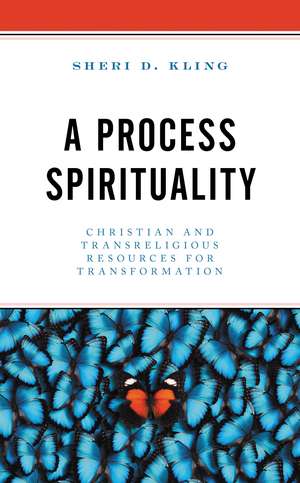
A Process Spirituality: Christian and Transreligious Resources for Transformation
Autor Sheri D. Klingen Limba Engleză Hardback – 8 iul 2020
Preț: 526.89 lei
Preț vechi: 792.23 lei
-33%
Puncte Express: 790
Preț estimativ în valută:
93.18€ • 107.56$ • 80.53£
93.18€ • 107.56$ • 80.53£
Carte tipărită la comandă
Livrare economică 01-15 mai
Specificații
ISBN-13: 9781793630421
ISBN-10: 1793630429
Pagini: 296
Ilustrații: 2 tables;
Dimensiuni: 160 x 229 x 27 mm
Greutate: 0.59 kg
Editura: Bloomsbury Publishing
Colecția Lexington Books
Locul publicării:New York, United States
ISBN-10: 1793630429
Pagini: 296
Ilustrații: 2 tables;
Dimensiuni: 160 x 229 x 27 mm
Greutate: 0.59 kg
Editura: Bloomsbury Publishing
Colecția Lexington Books
Locul publicării:New York, United States
Cuprins
List of Tables
Preface
Acknowledgments
Part One Fragmentation
1A House Divided
2Integrating Resources
Part Two Integration: Theoretical, Empirical, Practical
3Theoretical: An Integrated, Relational Cosmos
4Empirical: An Integrated, Relational Psyche
5Practical: The Integrative Power of Dreams
6Synthesis
Part Three Transformation
7Construction
8Transformation
References
Index
About the Author
Preface
Acknowledgments
Part One Fragmentation
1A House Divided
2Integrating Resources
Part Two Integration: Theoretical, Empirical, Practical
3Theoretical: An Integrated, Relational Cosmos
4Empirical: An Integrated, Relational Psyche
5Practical: The Integrative Power of Dreams
6Synthesis
Part Three Transformation
7Construction
8Transformation
References
Index
About the Author
Recenzii
In this bold book, Sheri Kling offers an integrative vision for a better future. Incorporating psychology, philosophy, religion, and more, Kling weaves together a proposal to overcome division and confusion. This book is for those who want to united deep thinking and open living for real transformation!
Christianity is at a crossroads. Perhaps this is fitting for a religion whose central symbol is the cross. In the United States, more people than ever before report being religiously unaffiliated, especially young people. At the same time, more people are identifying as "spiritual but not religious." Sheri Kling's AProcess Spirituality is indeed a resource for effecting the much needed transformation of the Christian religion so that it might better address the pluralistic spiritual needs of our age. With help from Whitehead, Jung, and feminist theology, Kling brilliantly diagnoses the cosmological and psychological underpinnings of the modern world view, clearing the way for a renewed appreciation of the embodied and imaginative dimensions of human spirituality.This is not just another theoretical framework, however; Kling also shares well-developed practical methods for the cultivation of dreams and healing encounters with the divine that, God willing, will help revitalize Christian spiritual life by welcoming the followers of Jesus into the more relational, inclusive, and human mode of existence that, it is safe to say, he originally intended.
This is an exquisite text joining mind, body, and spirit. Within its pages, we find wisdom to guide our personal lives as well as our lives as planetary citizens. Twenty-first century wholeness and healing must embrace conscious and unconscious, analytic thinking and dream work, and tradition and novelty. Sheri Kling provides an integrative path toward the healing we seek for ourselves and our communities. In a time in which theologians, psychologists, and philosophers often think small, Kling provides a large vision of the human adventure, capable of inspiring us to take responsibility for our own healing as well as the healing of our communities.
Reading through the pages of Kling's inspiring book, I found myself digging into this remarkable treasure chest that she has opened, with valuable insights from Whitehead and Jung, dreams and religious tradition, all working together to produce something truly wonderful. Here is a work well worth reading, and then reading again!
Kling's "process spirituality" is based on Alfred North Whitehead's cosmology and Carl Jung's psychology. Jung's psychology, she holds, "is to the human psyche as Whitehead's metaphysics is to the cosmos." Her aim is to construct a spirituality that is robust, liberative, and transformative, helping us overcome modern fragmentation and that will produce more joy, more love, more compassion, and more wholeness for those who embrace it." Central to her program is the use of Whitehead and Jung in the service of dream work. Whereas she considers her project deeply Christian, she also calls it transreligious, because it is based on the "capacity for spirituality in every individual." Kling's Process Spirituality should become a path-breaking book.
This is a book with an important message for our time, written with great compassion and insight into the contemporary religious situation. We need religion, says Sheri Kling, but the old symbols and ideas of religion no longer work. Contemporary people need to be shown how to connect with them in new ways. To this end, she suggests we construct an experiential bridge to religion. Kling uses the religious philosophy of A.N. Whitehead and the spiritual psychology of C.G. Jung as our guides. She argues that Whitehead and Jung can be compellingly combined to achieve the task of religious renewal that neither system can achieve in isolation. The way forward, she indicates, is to connect the metaphysical with the ground of human experience. A Process Spirituality is as convincing as it is refreshing.
Christianity is at a crossroads. Perhaps this is fitting for a religion whose central symbol is the cross. In the United States, more people than ever before report being religiously unaffiliated, especially young people. At the same time, more people are identifying as "spiritual but not religious." Sheri Kling's AProcess Spirituality is indeed a resource for effecting the much needed transformation of the Christian religion so that it might better address the pluralistic spiritual needs of our age. With help from Whitehead, Jung, and feminist theology, Kling brilliantly diagnoses the cosmological and psychological underpinnings of the modern world view, clearing the way for a renewed appreciation of the embodied and imaginative dimensions of human spirituality.This is not just another theoretical framework, however; Kling also shares well-developed practical methods for the cultivation of dreams and healing encounters with the divine that, God willing, will help revitalize Christian spiritual life by welcoming the followers of Jesus into the more relational, inclusive, and human mode of existence that, it is safe to say, he originally intended.
This is an exquisite text joining mind, body, and spirit. Within its pages, we find wisdom to guide our personal lives as well as our lives as planetary citizens. Twenty-first century wholeness and healing must embrace conscious and unconscious, analytic thinking and dream work, and tradition and novelty. Sheri Kling provides an integrative path toward the healing we seek for ourselves and our communities. In a time in which theologians, psychologists, and philosophers often think small, Kling provides a large vision of the human adventure, capable of inspiring us to take responsibility for our own healing as well as the healing of our communities.
Reading through the pages of Kling's inspiring book, I found myself digging into this remarkable treasure chest that she has opened, with valuable insights from Whitehead and Jung, dreams and religious tradition, all working together to produce something truly wonderful. Here is a work well worth reading, and then reading again!
Kling's "process spirituality" is based on Alfred North Whitehead's cosmology and Carl Jung's psychology. Jung's psychology, she holds, "is to the human psyche as Whitehead's metaphysics is to the cosmos." Her aim is to construct a spirituality that is robust, liberative, and transformative, helping us overcome modern fragmentation and that will produce more joy, more love, more compassion, and more wholeness for those who embrace it." Central to her program is the use of Whitehead and Jung in the service of dream work. Whereas she considers her project deeply Christian, she also calls it transreligious, because it is based on the "capacity for spirituality in every individual." Kling's Process Spirituality should become a path-breaking book.
This is a book with an important message for our time, written with great compassion and insight into the contemporary religious situation. We need religion, says Sheri Kling, but the old symbols and ideas of religion no longer work. Contemporary people need to be shown how to connect with them in new ways. To this end, she suggests we construct an experiential bridge to religion. Kling uses the religious philosophy of A.N. Whitehead and the spiritual psychology of C.G. Jung as our guides. She argues that Whitehead and Jung can be compellingly combined to achieve the task of religious renewal that neither system can achieve in isolation. The way forward, she indicates, is to connect the metaphysical with the ground of human experience. A Process Spirituality is as convincing as it is refreshing.