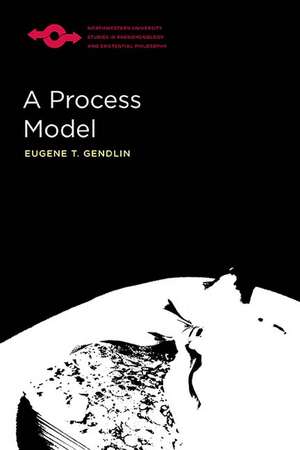
A Process Model: Studies in Phenomenology and Existential Philosophy
Autor Eugene Gendlin Contribuţii de Robert A. Parkeren Limba Engleză Paperback – 15 noi 2017
Eugene T. Gendlin (1926–2017) is increasingly recognized as one of the seminal thinkers of our era. Carrying forward the projects of American pragmatism and continental philosophy, Gendlin created an original form of philosophical psychology that brings new understandings of human experience and the life-world, including the “hard problem of consciousness.”
A Process Model, Gendlin’s magnum opus, offers no less than a new alternative to the dualism of mind and body. Beginning with living process, the body’s simultaneous interaction and identity with its environment, Gendlin systematically derives nonreductive concepts that offer novel and rigorous ways to think from within lived precision. In this way terms such as body, environment, time, space, behavior, language, culture, situation, and more can be understood with both great force and great subtlety.
Gendlin’s project is relevant to discussions not only in philosophy but in other fields in which life process is central—including biology, environmental management, environmental humanities, and ecopsychology. It provides a genuinely new philosophical approach to complex societal challenges and environmental issues.
A Process Model, Gendlin’s magnum opus, offers no less than a new alternative to the dualism of mind and body. Beginning with living process, the body’s simultaneous interaction and identity with its environment, Gendlin systematically derives nonreductive concepts that offer novel and rigorous ways to think from within lived precision. In this way terms such as body, environment, time, space, behavior, language, culture, situation, and more can be understood with both great force and great subtlety.
Gendlin’s project is relevant to discussions not only in philosophy but in other fields in which life process is central—including biology, environmental management, environmental humanities, and ecopsychology. It provides a genuinely new philosophical approach to complex societal challenges and environmental issues.
Din seria Studies in Phenomenology and Existential Philosophy
-
 Preț: 278.54 lei
 -
 Preț: 297.68 lei
 -
 Preț: 146.90 lei
 -
 Preț: 342.70 lei
 -
 Preț: 263.56 lei
 -
 Preț: 217.25 lei
 -
 Preț: 264.87 lei
 -
 Preț: 185.69 lei
 -
 Preț: 219.04 lei
 -
 Preț: 274.76 lei
 -
 Preț: 197.88 lei
 -
 Preț: 259.60 lei
 -
 Preț: 222.89 lei
 -
 Preț: 188.03 lei
 -
 Preț: 269.09 lei
 -
 Preț: 270.77 lei
 - 18%
 Preț: 793.48 lei
 -
 Preț: 223.69 lei
 -
 Preț: 246.51 lei
 -
 Preț: 167.69 lei
 -
 Preț: 237.07 lei
 -
 Preț: 142.36 lei
 -
 Preț: 171.95 lei
 -
 Preț: 221.35 lei
 -
 Preț: 225.43 lei
 -
 Preț: 216.86 lei
 -
 Preț: 190.50 lei
 -
 Preț: 250.90 lei
 -
 Preț: 235.32 lei
 -
 Preț: 196.94 lei
 -
 Preț: 281.04 lei
 - 18%
 Preț: 754.56 lei
 -
 Preț: 180.82 lei
 -
 Preț: 268.25 lei
 -
 Preț: 167.25 lei
 -
 Preț: 275.57 lei
 -
 Preț: 244.23 lei
 -
 Preț: 145.47 lei
 - 14%
 Preț: 246.92 lei
 - 19%
 Preț: 537.07 lei
 -
 Preț: 184.65 lei
 -
 Preț: 229.94 lei
 -
 Preț: 144.38 lei
Preț: 231.53 lei
Puncte Express: 347
Carte tipărită la comandă
Livrare economică 26 noiembrie-10 decembrie
Livrare express 22-28 octombrie pentru 43.68 lei
Livrare prin curier în România Termenul estimat este afișat lângă disponibilitate.
Transport gratuit de la 400.00 lei Plată online sau ramburs, în funcție de opțiunile comenzii.
Retur gratuit în 14 zile Comandă securizată și suport în română.
Specificații
ISBN-13: 9780810136199
ISBN-10: 0810136198
Pagini: 304
Dimensiuni: 152 x 229 x 20 mm
Greutate: 0.4 kg
Editura: Northwestern University Press
Colecția Northwestern University Press
Seria Studies in Phenomenology and Existential Philosophy
ISBN-10: 0810136198
Pagini: 304
Dimensiuni: 152 x 229 x 20 mm
Greutate: 0.4 kg
Editura: Northwestern University Press
Colecția Northwestern University Press
Seria Studies in Phenomenology and Existential Philosophy
V-ar putea interesa

Notă biografică
EUGENE T. GENDLIN (1926–2017) received his Ph.D. in philosophy from the University of Chicago and taught there from 1964 to 1995. He was honored four times by the American Psychological Association for his development of Experiential Psychotherapy. He was awarded the 2007 Viktor Frankl prize by the city of Vienna and the Viktor Frankl Family Foundation. He is the author of a number of books, including Focusing, Experiencing and the Creation of Meaning, and Focusing-Oriented Psychotherapy.
ROBERT A. PARKER is a psychologist and Focusing-Oriented Psychotherapist at the Focusing Institute.
ROBERT A. PARKER is a psychologist and Focusing-Oriented Psychotherapist at the Focusing Institute.
Cuprins
Foreword by Rob Parker
Acknowledgments
Introduction by Eugene Gendlin and David Young
Prefatory Note
Chapter I: Body-Environment (B-En)
Chapter II: Functional Cycle (Fucy)
Chapter III: An Object
Some Motivations and Powers of the Model So Far
Chapter IV: The Body and Time
Chapter IV-A: A Different Concept of the Body, Not a Machine
a) The body (when a process stops) is what continues; it is the other process
b) There is only the whole implying
c) The body is the subprocesses; they are body-en #2 and #3 all the way in
d-1) Symbolic functions of the body
d-2) Some requirements for our further concept formation
e) Everything by everything (evev)
f) Focaling
g-1) Relevance
g-2) Old and new models: some contrasts
h-1) Crossing, metaphor, law of occurring
h-2) Degrees of freedom
h-3) Schematized by schematizing (sbs)
h-4) The two directions of sbs
Chapter IV-B: Time: En#2 and En#3, Occurring and Implying
Chapter V: Evolution, Novelty, and Stability
Chapter V-A: Intervening Events
Chapter V-B: Stability: The Open Cycle
Chapter VI: Behavior
Chapter VI-A: Behavior and Perception
Chapter VI-B: The Development of Behavior Space
a) Motivation
b) Cross-contextual formation
c) Behavior space
c-1) Had space
c-2) Had space-and-time
c-3) Two open cycle sectors
d) Pyramiding
e) Object formation: Objects fall out
Appendix to Chapter VI
f) Resting perception, impact perception, and perceiving behind one’s back
f-1) Resting perception
f-2) Impact perception
f-3) Perception behind one’s back
g) Relevanting
h) Juncturing
i) Compression
j) “Breaking back” to a more primitive level
k) Behavioral body-development
l) Habit
m) Kination: Imagination and felt sense
Chapter VII: Culture, Symbol, and Language
Chapter VII-A: Symbolic Process
a) Bodylooks
b) The dance
d) Doubling
e) Expression
f) The new kind of CF
g) Pictures
h) Seens and heards
i) Action
j) Universals (kinds)
j-1) Separate senses
j-2) Kinds
j-3) Three universals
j-4) The pre-formed implicit (type a)
k) Action and gesturing
l) Slotted rituals
m) Making and images
n) Fresh formation of sequences and tools
o) Schematic terms: Meshed; implicit functioning; held; reconstituted
o-1) Meshed
o-2) Implicit Functioning
o-3) Held
o-4) Reconstituting
Chapter VII-B: Protolanguage
a) Internal space
b) The FLIP
c) The order
d) Absent context in this present context
e) Crossing of clusters and so-called “conventional” symbols; exactly why they are no longer iconic of the body in each situation, and how they are nevertheless organic rather than arbitrary: The internal relations of protolinguistic symbols
f) Language formation: Two kinds of crossing
f-1) The mediate carrying forward, what language use is
f-2) Collecting context(s), the formation of kinds
f-3) Lateral crossing and collective crossing
f-4) Word-formation
f-5) Short units
f-6) The context of a word; collected contexts and interaction contexts
f-7) Syntax
f-8) Language use; novel situations
f-9) Discursive use versus art; re-eveving versus re-recognition
f-10) New expression
f-11) Fresh sentences
f-12) Deliberate
f-13) More than one context; human time and space
g) When is the FLIP? Cessation of sound-formation in language use
Appendix to f: Details do not drop out; universals are not empty commonalities
Chapter VIII: Thinking with the Implicit
a) Introduction
b) Direct referent and felt shift
c) The new kind of sequence
d) Relevance and perfect feedback object
e) Schematic of the new carrying forward and the new space
f) Rapid statements of points that instance direct referent formation
f-1) How an VIII-sequence makes changes in the VII-context
f-2) Any VII-sequence from the direct referent is like a new “first” sequence in relation to the VII-context
f-3) “Monad”
f-4) VII-statements from a direct referent instance that direct referent.
f-5) The new “universality” of the direct referent
f-6) The old universality of VII is implicit also
f-7) The whole VII-complexity, not just the collected kinds, is carried forward and universalized in the new way; we can now derive the IOFI principle
f-8) The direct referent, and the new universalized complexity, was not there before direct referent formation; the direct referent is not a “reflecting upon” what was there before
(“from 1/2 to 2”)
f-9) Direct context crossing makes novelty but still instances the lack
f-10) Many words, like “direction,” are used in an IOFI way in VIII
Appendix to VIII: Monads and Diafils
Monads
Diafils
Conclusion and Beginning
Notes
References
Index
Acknowledgments
Introduction by Eugene Gendlin and David Young
Prefatory Note
Chapter I: Body-Environment (B-En)
Chapter II: Functional Cycle (Fucy)
Chapter III: An Object
Some Motivations and Powers of the Model So Far
Chapter IV: The Body and Time
Chapter IV-A: A Different Concept of the Body, Not a Machine
a) The body (when a process stops) is what continues; it is the other process
b) There is only the whole implying
c) The body is the subprocesses; they are body-en #2 and #3 all the way in
d-1) Symbolic functions of the body
d-2) Some requirements for our further concept formation
e) Everything by everything (evev)
f) Focaling
g-1) Relevance
g-2) Old and new models: some contrasts
h-1) Crossing, metaphor, law of occurring
h-2) Degrees of freedom
h-3) Schematized by schematizing (sbs)
h-4) The two directions of sbs
Chapter IV-B: Time: En#2 and En#3, Occurring and Implying
Chapter V: Evolution, Novelty, and Stability
Chapter V-A: Intervening Events
Chapter V-B: Stability: The Open Cycle
Chapter VI: Behavior
Chapter VI-A: Behavior and Perception
Chapter VI-B: The Development of Behavior Space
a) Motivation
b) Cross-contextual formation
c) Behavior space
c-1) Had space
c-2) Had space-and-time
c-3) Two open cycle sectors
d) Pyramiding
e) Object formation: Objects fall out
Appendix to Chapter VI
f) Resting perception, impact perception, and perceiving behind one’s back
f-1) Resting perception
f-2) Impact perception
f-3) Perception behind one’s back
g) Relevanting
h) Juncturing
i) Compression
j) “Breaking back” to a more primitive level
k) Behavioral body-development
l) Habit
m) Kination: Imagination and felt sense
Chapter VII: Culture, Symbol, and Language
Chapter VII-A: Symbolic Process
a) Bodylooks
b) The dance
d) Doubling
e) Expression
f) The new kind of CF
g) Pictures
h) Seens and heards
i) Action
j) Universals (kinds)
j-1) Separate senses
j-2) Kinds
j-3) Three universals
j-4) The pre-formed implicit (type a)
k) Action and gesturing
l) Slotted rituals
m) Making and images
n) Fresh formation of sequences and tools
o) Schematic terms: Meshed; implicit functioning; held; reconstituted
o-1) Meshed
o-2) Implicit Functioning
o-3) Held
o-4) Reconstituting
Chapter VII-B: Protolanguage
a) Internal space
b) The FLIP
c) The order
d) Absent context in this present context
e) Crossing of clusters and so-called “conventional” symbols; exactly why they are no longer iconic of the body in each situation, and how they are nevertheless organic rather than arbitrary: The internal relations of protolinguistic symbols
f) Language formation: Two kinds of crossing
f-1) The mediate carrying forward, what language use is
f-2) Collecting context(s), the formation of kinds
f-3) Lateral crossing and collective crossing
f-4) Word-formation
f-5) Short units
f-6) The context of a word; collected contexts and interaction contexts
f-7) Syntax
f-8) Language use; novel situations
f-9) Discursive use versus art; re-eveving versus re-recognition
f-10) New expression
f-11) Fresh sentences
f-12) Deliberate
f-13) More than one context; human time and space
g) When is the FLIP? Cessation of sound-formation in language use
Appendix to f: Details do not drop out; universals are not empty commonalities
Chapter VIII: Thinking with the Implicit
a) Introduction
b) Direct referent and felt shift
c) The new kind of sequence
d) Relevance and perfect feedback object
e) Schematic of the new carrying forward and the new space
f) Rapid statements of points that instance direct referent formation
f-1) How an VIII-sequence makes changes in the VII-context
f-2) Any VII-sequence from the direct referent is like a new “first” sequence in relation to the VII-context
f-3) “Monad”
f-4) VII-statements from a direct referent instance that direct referent.
f-5) The new “universality” of the direct referent
f-6) The old universality of VII is implicit also
f-7) The whole VII-complexity, not just the collected kinds, is carried forward and universalized in the new way; we can now derive the IOFI principle
f-8) The direct referent, and the new universalized complexity, was not there before direct referent formation; the direct referent is not a “reflecting upon” what was there before
(“from 1/2 to 2”)
f-9) Direct context crossing makes novelty but still instances the lack
f-10) Many words, like “direction,” are used in an IOFI way in VIII
Appendix to VIII: Monads and Diafils
Monads
Diafils
Conclusion and Beginning
Notes
References
Index
Recenzii
"This book is a masterful contribution to its field, both highly original and qualitatively sound. Moreover, it is a pivotal work in the large oeuvre of its author, a world-known figure in a number of fields in academia and in the many practice fields he has touched.” —Mary Jeanne Larrabe, editor of An Ethic of Care: Feminist and Interdisciplinary Perspectives
Descriere
This is Gendlin's masterwork, his summa, and brings together all the strands in his richly arrayed thought. By any standard, it is a major work of original thought and is likely to become his most famous single text.