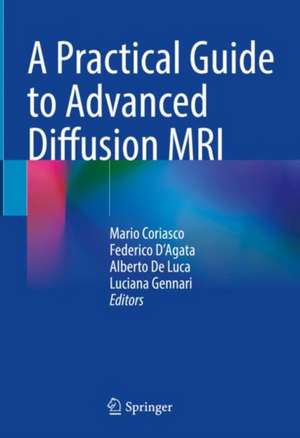
A Practical Guide to Advanced Diffusion MRI
Editat de Mario Coriasco, Federico D'Agata, Alberto De Luca, Luciana Gennarien Limba Engleză Hardback – 28 dec 2024
Pregătirea pentru examenul de specialitate în radiologie sau pentru certificările europene de neuroimagistică necesită o înțelegere profundă a tehnicilor avansate de difuzie, dincolo de simpla interpretare vizuală. În acest context, A Practical Guide to Advanced Diffusion MRI, editată de Mario Coriasco și echipa sa, se poziționează ca un instrument clinic esențial pentru tranziția de la teorie la practica de zi cu zi în departamentul de rezonanță magnetică. Ne-a atras atenția rigoarea cu care sunt tratate protocoalele de achiziție, volumul fiind conceput special pentru a ajuta rezidenții și tehnicienii să optimizeze parametrii de secvență și să elimine artefactele comune. Structura volumului este una progresivă și schematică: după o trecere în revistă a principiilor fizice, capitolele avansează rapid către Diffusion Tensor Imaging (DTI) și tehnici de Fiber Tracking. Un element distinctiv al acestei ediții 2025 este includerea unui atlas MRI al substanței albe umane, care servește drept referință anatomică indispensabilă în timpul procesării datelor. Clinicienii care folosesc Diffusion Tensor Imaging de Wim Van Hecke ca referință vor găsi aici un complement practic axat pe fluxul de lucru, care pune accent pe utilizarea software-urilor actuale pentru prezentarea și printarea rezultatelor. Această lucrare continuă efortul didactic început de Mario Coriasco în Elementi di risonanza magnetica, unde autorul a urmărit clarificarea conceptelor fundamentale de rezonanță magnetică. Dacă lucrarea anterioară punea bazele teoretice, noul ghid practic de la Springer plonjează direct în aplicațiile avansate, oferind tutoriale cu seturi de date reale. Este o resursă echilibrată, unde cele 100 de ilustrații (majoritatea color) transformă complexitatea tehnicilor de difuzie într-un proces vizual ușor de parcurs.
Preț: 1075.41 lei
Preț vechi: 1132.01 lei
-5%
Carte disponibilă
Livrare economică 16-30 noiembrie
Specificații
ISBN-10: 3031703367
Pagini: 196
Ilustrații: Approx. 250 p. 100 illus., 80 illus. in color.
Dimensiuni: 183 x 260 x 16 mm
Greutate: 0.56 kg
Ediția:2025
Editura: Springer
Locul publicării:Cham, Switzerland
V-ar putea interesa
-
 Lange Q&A MRI Examination, First EditionBarry Southers-37%Preț: 348.26 lei555.21 lei
 -
 Handbook of MRI ScanningGeraldine Burghart-29%Preț: 340.80 lei478.88 lei
 -
 Magnetic Resonance Imaging: Physical and Biological PrinciplesStewart C. Bushong-5%Preț: 562.53 lei592.13 lei
 -
 Duke Review of MRI Physics: Case Review SeriesWells Mangrum-26%Preț: 399.56 lei539.45 lei
 -
 Diffusion MRI of the BreastMami Iima-27%Preț: 652.36 lei897.87 lei
 -
 Fundamentals of Body MRIChristopher G. Roth-27%Preț: 654.26 lei896.97 lei
 -
 Sectional Anatomy by MRI and CTMark W. Anderson-28%Preț: 1839.99 lei2555.55 lei
 -
 Obstetric Imaging: Fetal Diagnosis and CareJoshua A. Copel-27%Preț: 1769.94 lei2417.89 leiRecomandat
 -
 Kern's Cardiac Catheterization HandbookPaul Sorajja-27%Preț: 396.20 lei545.02 leiRecomandat
 -
 MRI in PracticeCatherine Westbrook-5%Preț: 401.58 lei422.71 lei
 -
 MRI in PracticeCatherine Westbrook-5%Preț: 313.63 lei330.14 lei
 -
 Diagnostic MRI in Dogs and CatsWilfried Mai-9%Preț: 2488.91 lei2735.06 lei
 -
 The Physics of Clinical MR Taught Through ImagesVal M. Runge-5%Preț: 623.08 lei655.87 lei
 -
 Pocket Atlas of Radiographic PositioningTorsten Bert MöllerPreț: 437.56 lei
 -
 -5%Preț: 1067.90 lei1124.10 lei
 -
 -5%Preț: 390.44 lei410.99 lei
 -
 Diffusion-Weighted MR Imaging of the BrainToshio Moritani-5%Preț: 1257.85 lei1324.05 lei
 -
 7.0 Tesla MRI Brain White Matter AtlasZang-Hee Cho-5%Preț: 1894.18 lei1993.87 lei
 -
 Clinical MR ImagingPeter Reimer-5%Preț: 1400.83 lei1474.56 lei
De ce să citești această carte
Recomandăm această lucrare radiologilor aflați în formare și tehnicienilor care doresc să stăpânească protocoalele DWI și DTI. Cititorul câștigă acces la metodologii clare pentru reducerea timpului de achiziție fără a sacrifica rezoluția, plus un atlas de substanță albă extrem de util în planificarea preoperatorie sau în cercetarea clinică. Este un ghid practic care transformă teoria difuziei în pași de lucru aplicabili imediat.
Despre autor
Mario Coriasco este un specialist recunoscut în domeniul imagisticii prin rezonanță magnetică, fiind implicat activ în educația medicală și formarea tehnicienilor radiologi. Experiența sa academică este reflectată în publicații care urmăresc simplificarea conceptelor fizice complexe pentru aplicații clinice directe. Alături de co-editorii Federico D'Agata, Alberto De Luca și Luciana Gennari, Coriasco a contribuit semnificativ la literatura de specialitate, anterior publicând lucrări fundamentale precum „Elementi di risonanza magnetica”, menite să sprijine abordarea inițială a studenților și profesioniștilor în utilizarea tehnologiilor RM moderne.
Descriere scurtă
The contents are presented in concisely and schematically, and are enriched by a wealth of black and white as well as colored pictures and tables, making this an invaluable and easy-to-consult clinical tool. The main acquisition protocols are presented and explained in detail: how to optimize the best sequence parameters, balancing quality of the images and acquisition time, reducing or eliminating the most common artefacts. Further, it presents the main software available, with detailed descriptions on how to use it to process, present and print the results. Examples and tutorials using real-world datasets complete the book.
Cuprins
Notă biografică
Qualified as a radiographer in 1995, he graduated in Medical Radiology Techniques in 2006. He worked as a radiographer in the Radiology Department of the University of Turin, then in the Unit of Interventional Cardiology of the same University, and since 2001 he has worked in the Neuroradiology of the Neuroscience Department of the Turin University, as a radiographer, CT and MR-technologist. He has extensive experience of advanced image processing in the magnetic resonance, in particular PWI, DTI, 1H-MRS, and in fMRI experiments in pathological conditions and in research applications. He was Adjunct Professor at the University of Genova, teaching Advanced MR techniques in a 1st level master's in MR (2015-2016). Now he's Adjunct professor at the Turin University, teaching MR techniques at the Bachelor's Degree of Medical Radiology Technician and Radiologic Techniques at the Bachelor's Degree of Neurophisyopathology Techician. Author of many publications edited on national and international revues, he published books on digital imaging in medical radiology and on magnetic resonance, both adopted as a reference text by a number of universities.
Federico D'Agata
After completing an MSc in Physics (Nuclear and Subnuclear) with a thesis titled "Tests for Drift Chambers for the CMS Experiment," and an MSc in Psychology (Sciences of Mind) with a thesis titled "Social Emotions: An Effective Connectivity Study," Federico D'Agata earned a PhD in Experimental Neuroscience from the University of Turin, Italy. His doctoral dissertation was "Cerebellar Functions: Insights from Behavioral, Structural, and Functional Neuroimaging Studies in Healthy and Medical Conditions". He is the author and co-author of national and international publications, scientific articles, and monographs on MRI. Since 2022, he has been an associate professor in Applied Physics at the Department of Neurosciences "Rita Levi Montalcini" of the University of Turin.
Alberto De Luca
Alberto De Luca is an assistant professor at UMC Utrecht (the Netherlands) focusing on the development and application of (diffusion) MRI methods for neuroimaging. Since the completion of his PhD in Bioengineering at the University of Padova (Italy), he has been passionate to understand the potential and caveats of diffusion MRI to study brain organization, performing broad spectrum research in this field (e.g., acquisition design, optimization, development of quantification methods, fiber tractography and clinical translation). He is the author and co-author of several scientific publications and book chapters on diffusion MRI, and has been awarded competitive grants (e.g., European Research Council) to advance his research on brain fiber characterization and its clinical applications.
Luciana Gennari
Qualified as a radiographer in1990, Luciana Gennari became a tutor in 2007 in the Neuroscience Department. She works mainly in Magnetic Resonance Imaging and she has taken on the role of Primary Technologist in many research projects. She received a master degree in Specialist in equipment optimization and development, sequences and MRI study techniques in 2022 from the University of Florence. She is an Adjunct Professor at the University of Milano-Bicocca with extensive experience in MRI advanced techniques and post processing. She is the author of ten publications edited ion national and international reviews.