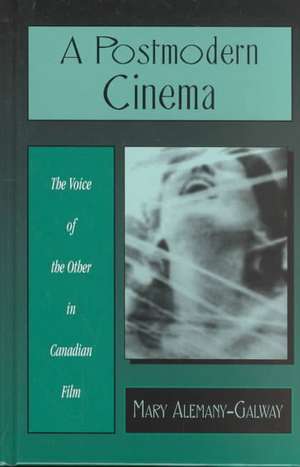
A Postmodern Cinema: The Voice of the Other in Canadian Film
Autor Mary Alemany-Galwayen Limba Engleză Hardback – 20 mar 2002
Preț: 553.70 lei
Preț vechi: 836.58 lei
-34%
Puncte Express: 831
Preț estimativ în valută:
98.06€ • 114.52$ • 85.18£
98.06€ • 114.52$ • 85.18£
Carte tipărită la comandă
Livrare economică 21 februarie-07 martie
Preluare comenzi: 021 569.72.76
Specificații
ISBN-13: 9780810840980
ISBN-10: 0810840987
Pagini: 261
Dimensiuni: 145 x 225 x 24 mm
Greutate: 0.5 kg
Editura: Bloomsbury Publishing
Colecția Scarecrow Press
Locul publicării:New York, United States
ISBN-10: 0810840987
Pagini: 261
Dimensiuni: 145 x 225 x 24 mm
Greutate: 0.5 kg
Editura: Bloomsbury Publishing
Colecția Scarecrow Press
Locul publicării:New York, United States
V-ar putea interesa
-
 Speaking of Monsters: A Teratological AnthologyCaroline Joan S. Picart-15%Preț: 676.64 lei796.06 lei
 -
 The Insider's Guide to Independent Film DistributionStacey Parks-5%Preț: 236.56 lei248.15 lei
 -
 The Films of Steven SpielbergCharles L. P. Silet-31%Preț: 365.69 lei532.46 lei
 -
 John WayneAissa WaynePreț: 136.64 lei
 -
 Preț: 370.26 lei
 -
 -17%Preț: 319.24 lei384.85 lei
 -
 Preț: 274.31 lei
 -
 Contemporary Erotic CinemaDouglas Keesey-32%Preț: 79.96 lei117.35 lei
 -
 Preț: 125.62 lei
Cuprins
Chapter 1 1. Toward a Postmodern Film Theory
Chapter 2 2. The Importance of Eisenstein's Theories to Postmodernism
Chapter 3 3. Bazin: Phenomenology and Postmodernism
Chapter 4 4. Metz: Structuralist Film Theory in the Light of Poststructuralism
Chapter 5 5. The Turning Point to Postmodernism: The New Novel and Last Year at Marienbad
Chapter 6 6. Canadian Film History and Canadian Identity: Realism, Modernism, and Postmodernism
Chapter 7 7. Jesus of Montreal
Chapter 8 8. I've Heard the Mermaids Singing
Chapter 9 9. Family Viewing
Chapter 10 10. Life Classes
Chapter 11 11. Conclusion
Chapter 2 2. The Importance of Eisenstein's Theories to Postmodernism
Chapter 3 3. Bazin: Phenomenology and Postmodernism
Chapter 4 4. Metz: Structuralist Film Theory in the Light of Poststructuralism
Chapter 5 5. The Turning Point to Postmodernism: The New Novel and Last Year at Marienbad
Chapter 6 6. Canadian Film History and Canadian Identity: Realism, Modernism, and Postmodernism
Chapter 7 7. Jesus of Montreal
Chapter 8 8. I've Heard the Mermaids Singing
Chapter 9 9. Family Viewing
Chapter 10 10. Life Classes
Chapter 11 11. Conclusion
Recenzii
...[has] much to offer...[raises] important questions about theorizing the spectator in the context of a national cinema at a time when the spread of multiculturalism and globalization is placing enormous pressure on traditional ideas of national identity.
See the films. Read the book.
See the films. Read the book.