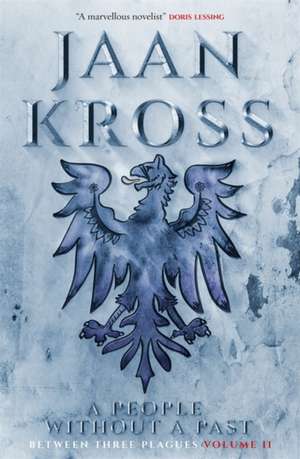
A People without a Past: Between Three Plagues Volume 2
Autor Jaan Krossen Limba Engleză Paperback – 8 mar 2018
The year is 1563, and by any account Balthasar Russow can be said to have risen in the world. Fresh from his studies in the German town of Stetten, he has assumed the role as pastor of Tallinn's Holy Ghost Church. Moreover, he is betrothed to a maiden of the town - much to the chagrin of her father, who has no wish to welcome peasant stock to the family when there is no shortage of upstanding young German men - and is poised to begin the chronicle that will ensure his everlasting fame.
But tribulations still await the now not-quite-young Pastor - Livonia is still plagued by foreign powers, with Tallinn braced to withstand a prolonged Muscovite siege. And he will discover that marriage is a often a battlefield in itself.
Translated from the Estonian by Merike Beecher
Preț: 60.14 lei
Preț vechi: 80.16 lei
-25%
Puncte Express: 90
Carte disponibilă
Livrare economică 02-16 noiembrie
Livrare express 16-22 octombrie pentru 44.06 lei
Livrare prin curier în România Termenul estimat este afișat lângă disponibilitate.
Transport gratuit de la 400.00 lei Plată online sau ramburs, în funcție de opțiunile comenzii.
Retur gratuit în 14 zile Comandă securizată și suport în română.
Specificații
ISBN-13: 9781784299545
ISBN-10: 1784299545
Pagini: 432
Dimensiuni: 128 x 198 x 30 mm
Greutate: 0.3 kg
Editura: Quercus Books
Colecția MacLehose Press
Locul publicării:London, United Kingdom
ISBN-10: 1784299545
Pagini: 432
Dimensiuni: 128 x 198 x 30 mm
Greutate: 0.3 kg
Editura: Quercus Books
Colecția MacLehose Press
Locul publicării:London, United Kingdom
V-ar putea interesa
-
 Trematon CastleGarry WingetPreț: 78.83 lei
 -
 The Exploits & Adventures of Miss Alethea DarcyElizabeth AstonPreț: 130.97 lei
 -
 Blossoms and ShadowsLian Hearn-24%Preț: 61.69 lei80.67 lei
 -
 Shaka the GreatWalton Golightly-25%Preț: 81.19 lei108.47 lei
 -
 The Liar's DaughterLaurie Graham-20%Preț: 82.48 lei103.02 lei
 -
 Preț: 235.23 lei
 -
 The Pearl DiverJeff TalarigoPreț: 119.77 lei
 -
 The Fall and Rise of Lucy CharltonElizabeth Gill-18%Preț: 59.02 lei72.12 lei
 -
 The Walls of ByzantiumJames Heneage-24%Preț: 61.06 lei80.31 lei
 -
 The Return of John MacnabAndrew Greig-26%Preț: 68.78 lei92.71 lei
 -
 -25%Preț: 69.81 lei93.33 lei
 -
 The Eye of CallanishMoyra CaldecottPreț: 106.73 lei
 -
 Legacy of BloodAlex Connor-17%Preț: 60.05 lei72.74 lei
 -
 The Czar's MadmanJaan Kross-20%Preț: 114.17 lei141.89 lei
 -
 Preț: 186.88 lei
 -
 Wikmans ZöglingeJaan KrossPreț: 194.79 lei
Recenzii
He's a marvellous novelist - his scope and depth make him a world writer - and they should just hurry up and give him the Nobel.
He deserved a Nobel prize and would probably have got it had he written in any other language but Estonian.
He's almost alone in writing in the older European tradition of the large-scale historical novel. I'd argue that Kross is heir to the 'great' Russo-European 19th century novelists; his fiction has Tolstoyan sweep. On reading him, moreover, we rediscover that Estonia was always resolutely in Europe and not some obscure outpost this side of the Urals.
No stranger to oppression himself, Kross writes about it with a poignancy devoid of anger.
He deserved a Nobel prize and would probably have got it had he written in any other language but Estonian.
He's almost alone in writing in the older European tradition of the large-scale historical novel. I'd argue that Kross is heir to the 'great' Russo-European 19th century novelists; his fiction has Tolstoyan sweep. On reading him, moreover, we rediscover that Estonia was always resolutely in Europe and not some obscure outpost this side of the Urals.
No stranger to oppression himself, Kross writes about it with a poignancy devoid of anger.