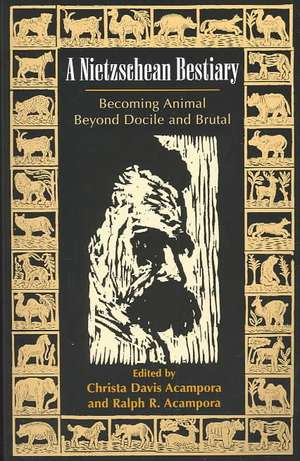
A Nietzschean Bestiary: Becoming Animal Beyond Docile and Brutal
Editat de Christa Davis Acampora, Ralph R. Acampora Contribuţii de Babette Babbich, Debra Bergoffen, Thomas H. Brobjer, Daniel Conway, Brian Crowley, Brian Domino, Peter Groff, Jennifer Ham, Lawrence Hatab, Kathleen Marie Higgins, Vanessa Lemm, Paul S. Loeb, Nickolas Pappas, Richard Perkins, Gerd Schank, Alan D. Schrift, Gary Shapiro, Tracey Stark, Charles S. Taylor, Jami Weinstein, Martha Kendal Woodruffen Limba Engleză Paperback – 22 noi 2003
Preț: 359.02 lei
Preț vechi: 516.43 lei
-30%
Puncte Express: 539
Carte disponibilă
Livrare economică 16-30 mai
Specificații
ISBN-13: 9780742514270
ISBN-10: 0742514277
Pagini: 344
Dimensiuni: 144 x 226 x 24 mm
Greutate: 0.52 kg
Ediția:New.
Editura: Bloomsbury Publishing
Colecția Rowman & Littlefield
Locul publicării:New York, United States
ISBN-10: 0742514277
Pagini: 344
Dimensiuni: 144 x 226 x 24 mm
Greutate: 0.52 kg
Ediția:New.
Editura: Bloomsbury Publishing
Colecția Rowman & Littlefield
Locul publicării:New York, United States
Cuprins
Chapter 1 Introduction Chapter 2 Nietzsche's Feral Philosophy: Thinking Through an Animal Imaginary Part 3 Part I: On "Lowly" Origins Chapter 4 Ape"Who Is Zarathustra's Ape?" Chapter 5 Camel"A Sketch (Riß) of the Camel in Zarathustra" Chapter 6 Polyp"Polyp Man" Part 7 Part II: Zarathustra's Animals Chapter 8 Dog "Dogs, Domestication, And The Ego" Chapter 9 Spider"Arachnophobe Or Arachnophile?: Nietzsche And His Spiders" Chapter 10 Snake"The Eternal-Serpentine" Chapter 11 Bird"The Halcyon Tone As Birdsong" Chapter 12 Cow "Even Better Than a Cow, O Zarathustra!" Chapter 13 Ass"Nietzsche and the Mystery of the Ass" Part 14 Part III: Beasts of Prey Chapter 15 Lion"Zarathustra's Laughing Lions" Chapter 16 Blonde Beast"Nietzsche's 'Blond Beast': On the Recuperation of a Nietzschean Metaphor" Chapter 17 Beasts of Prey"How We Became What We Are: Tracking the 'Beasts of Prey'" Part 18 Part IV: Human Animals (Unter, Halb, and Über) Chapter 19 Woman "Women as Predatory Animals, or Why Nietzsche Philosoph
Recenzii
A truly felicitous collection of outstanding essays by some of the most distinguished scholars of Nietzsche. The essays explore and develop a previously underrated dimension that is nevertheless absolutely critical to Nietzsche's enterprise.
This bestiary is a real find, a welcome collection of essays that ingeniously combines careful and insightful interpretations of Nietzsche on animality with detailed and often brilliant analyses of his reliance on images of animals as figures of philosophical thought. The scholarship is first-rate, the scope of the collection, exhaustive. A major contribution to Nietzsche studies that forcefully challenges the widely held belief that Nietzsche's 'animal imaginary' serves merely to decorate the conceptual substance of his thought.
A powerful and innovative collection. . . . Nietzsche once claimed that every word, every punctuation mark, every trope in his writing was there for a purpose. The authors in the wonderful collection collectively show that this same precise concern extends to his choice of animals-his bestiary. Each of the essays illuminates Nietzsche's philosophy as a whole and from the point of view of one of Nietzsche's 'right' animals. We are thus led both to deeper understanding of Nietzsche's thought as a whole as well as of particular aspects of it.
A Nietzschean Bestiary gathers an extremely rich and wide range of excellent contributions. From such key Nietzschean issues as self-overcoming to the creative positing of new values, the essays demonstrate the remarkable mutability of our so-called 'second natures,' which wittingly or not, have become 'part and parcel of our flesh and blood'"
It is eloquent testimony to the richness of the topic that so many distinguished commentators have been induced to contribute to this superb work. These essays on Nietzsche's beasts constitute an enormous fund of intellectual biodiversity in which Nietzsche enthusiasts of all stripes will delight.
The editors have put together one of the richest and most stimulating collections of essays on Nietzsche to be published in a long while. It provides a set of fresh and novel perspectives on the hugely important and fertile topic of Nietzsche's animals which will be of interest to readers across a wide range of disciplines.
Students of Nietzsche's philosophy will owe a considerable debt of gratitude to this anthology. Recommended.
These timely essays are well-written and richly suggestive, opening up fresh lines of Nietzsche interpretation and exploration. They utilize Nietzsche's texts creatively, and draw on perspectives in the secondary literature that until now have been somewhat fragmented and submerged. In sum, this scholarship synthesizes an enormous range of pertinent material into a satisfying thematic collection that should appeal to a wide range of readers. This compelling account of Nietzsche's philosophy demonstrates that contemporary Nietzsche commentary is both vibrant and innovative.
This bestiary is a real find, a welcome collection of essays that ingeniously combines careful and insightful interpretations of Nietzsche on animality with detailed and often brilliant analyses of his reliance on images of animals as figures of philosophical thought. The scholarship is first-rate, the scope of the collection, exhaustive. A major contribution to Nietzsche studies that forcefully challenges the widely held belief that Nietzsche's 'animal imaginary' serves merely to decorate the conceptual substance of his thought.
A powerful and innovative collection. . . . Nietzsche once claimed that every word, every punctuation mark, every trope in his writing was there for a purpose. The authors in the wonderful collection collectively show that this same precise concern extends to his choice of animals-his bestiary. Each of the essays illuminates Nietzsche's philosophy as a whole and from the point of view of one of Nietzsche's 'right' animals. We are thus led both to deeper understanding of Nietzsche's thought as a whole as well as of particular aspects of it.
A Nietzschean Bestiary gathers an extremely rich and wide range of excellent contributions. From such key Nietzschean issues as self-overcoming to the creative positing of new values, the essays demonstrate the remarkable mutability of our so-called 'second natures,' which wittingly or not, have become 'part and parcel of our flesh and blood'"
It is eloquent testimony to the richness of the topic that so many distinguished commentators have been induced to contribute to this superb work. These essays on Nietzsche's beasts constitute an enormous fund of intellectual biodiversity in which Nietzsche enthusiasts of all stripes will delight.
The editors have put together one of the richest and most stimulating collections of essays on Nietzsche to be published in a long while. It provides a set of fresh and novel perspectives on the hugely important and fertile topic of Nietzsche's animals which will be of interest to readers across a wide range of disciplines.
Students of Nietzsche's philosophy will owe a considerable debt of gratitude to this anthology. Recommended.
These timely essays are well-written and richly suggestive, opening up fresh lines of Nietzsche interpretation and exploration. They utilize Nietzsche's texts creatively, and draw on perspectives in the secondary literature that until now have been somewhat fragmented and submerged. In sum, this scholarship synthesizes an enormous range of pertinent material into a satisfying thematic collection that should appeal to a wide range of readers. This compelling account of Nietzsche's philosophy demonstrates that contemporary Nietzsche commentary is both vibrant and innovative.