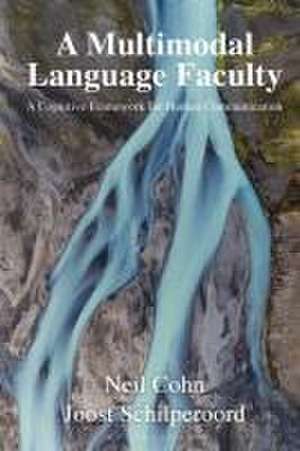
A Multimodal Language Faculty: A Cognitive Framework for Human Communication
Autor Dr Neil Cohn, Joost Schilperoorden Limba Engleză Hardback – 13 iun 2024
This book posits a bold reorganization of the structures of language, and heralds a reconsideration of its guiding assumptions. Human expressive behaviors like speaking, signing, and drawing may seem distinct, but they decompose into similar cognitive building blocks which coalesce in emergent states from a singular multimodal communicative architecture. This cognitive model accounts for unimodal and multimodal expression across all of our modalities, providing a "grand unified theory" that incorporates insights from formal linguistics, cognitive semantics, metaphor theory, Peircean semiotics, sign language, gesture, visual language, psycholinguistics, and cognitive neuroscience. Such a perspective reconfigures how we understand linguistic structure, diversity, universals, innateness, relativity, and evolution. A Multimodal Language Faculty directly confronts centuries-old notions of language and offers a compelling reimagination of what language is and how it works.
Preț: 617.88 lei
Preț vechi: 960.53 lei
-36%
Puncte Express: 927
Carte tipărită la comandă
Livrare economică 07-21 decembrie
Livrare prin curier în România Termenul estimat este afișat lângă disponibilitate.
Transport gratuit pentru acest produs Plată online sau ramburs, în funcție de opțiunile comenzii.
Retur gratuit în 14 zile Comandă securizată și suport în română.
Specificații
ISBN-13: 9781350402416
ISBN-10: 1350402419
Pagini: 352
Ilustrații: 83 bw illus
Dimensiuni: 162 x 236 x 26 mm
Greutate: 0.68 kg
Editura: Bloomsbury Publishing
Colecția Bloomsbury Academic
Locul publicării:London, United Kingdom
ISBN-10: 1350402419
Pagini: 352
Ilustrații: 83 bw illus
Dimensiuni: 162 x 236 x 26 mm
Greutate: 0.68 kg
Editura: Bloomsbury Publishing
Colecția Bloomsbury Academic
Locul publicării:London, United Kingdom
Cuprins
List of Figures
List of Tables
Part I: Foundations
1. Reimagining Language
Part II. Modalities
2. What is a Modality?
3. Interfacing Between Modalities
Part III: Meaning
4. Conceptual Structures for Multiple Modalities
5. Multimodal Semantic Interactions
Part IV: Grammar
6. The Complexity Hierarchy
7. Interactions Between Combinatorial Schemas
Part V: Multimodality
8. Unimodal Expressions in a Multimodal Model
9. Independent Multimodal Interactions
10. Substitutive Multimodal Interactions
Part VI: A Multimodal Language Faculty
11. Consequences of a Multimodal Language Faculty
12. Evolution of a Multimodal Language Faculty
13. Towards a Multimodal Linguistics
References
Index
List of Tables
Part I: Foundations
1. Reimagining Language
Part II. Modalities
2. What is a Modality?
3. Interfacing Between Modalities
Part III: Meaning
4. Conceptual Structures for Multiple Modalities
5. Multimodal Semantic Interactions
Part IV: Grammar
6. The Complexity Hierarchy
7. Interactions Between Combinatorial Schemas
Part V: Multimodality
8. Unimodal Expressions in a Multimodal Model
9. Independent Multimodal Interactions
10. Substitutive Multimodal Interactions
Part VI: A Multimodal Language Faculty
11. Consequences of a Multimodal Language Faculty
12. Evolution of a Multimodal Language Faculty
13. Towards a Multimodal Linguistics
References
Index
Recenzii
Cohn and Schilperoord propose a true paradigm shift in how language should be understood and studied. The authors boldly re-imagine the nature of language and re-frame its scientific study by including the full range of human expressive potential. A "must read" for language scientists!
This exciting book reformulates central problems in the structure of language, giving a coherent account of how sound, gesture, and graphic marks allow us to communicate. Building on Cohn's foundational studies of comics and Schilperoord's studies of time in language, it will captivate and edify specialists and linguistics newbies alike.
Beautifully written, this revolutionary book provides a significant step in re-shaping our notion of human language faculty, its uniqueness and evolution by shifting it from an amodal to a multimodal one - where speech, writing, gesture, sign, graphics and drawings are conceived as expressive behaviors of one cognitive and communicative system.
A Multimodal Language Faculty, the product of two decades of research, unites all human expression under the umbrella of multimodal language. Especially innovative and insightful is the embrace of artistic expression (music, dance, and visual art) as emanating from the same uniquely human ability as language.
Linguistics has been rattling the bars of its monomodal cage for some time. Now it's out. Cohn and Schilperoord's unified framework for vocal, bodily, and graphic modalities reconfigures linguistics as essentially multimodal from the ground up, effectively capturing a far broader range of actual human communicative behaviour and cognition.
With its extensive and original attention to multimodality, i.e., the simultaneous mixing of different semiotic, communicative systems, this important book integrates modern linguistic and cognitive perspectives with innovating analyses of especially visual modes of expression, revealing significant structural analogies between these. A significant accomplishment.
This exciting book reformulates central problems in the structure of language, giving a coherent account of how sound, gesture, and graphic marks allow us to communicate. Building on Cohn's foundational studies of comics and Schilperoord's studies of time in language, it will captivate and edify specialists and linguistics newbies alike.
Beautifully written, this revolutionary book provides a significant step in re-shaping our notion of human language faculty, its uniqueness and evolution by shifting it from an amodal to a multimodal one - where speech, writing, gesture, sign, graphics and drawings are conceived as expressive behaviors of one cognitive and communicative system.
A Multimodal Language Faculty, the product of two decades of research, unites all human expression under the umbrella of multimodal language. Especially innovative and insightful is the embrace of artistic expression (music, dance, and visual art) as emanating from the same uniquely human ability as language.
Linguistics has been rattling the bars of its monomodal cage for some time. Now it's out. Cohn and Schilperoord's unified framework for vocal, bodily, and graphic modalities reconfigures linguistics as essentially multimodal from the ground up, effectively capturing a far broader range of actual human communicative behaviour and cognition.
With its extensive and original attention to multimodality, i.e., the simultaneous mixing of different semiotic, communicative systems, this important book integrates modern linguistic and cognitive perspectives with innovating analyses of especially visual modes of expression, revealing significant structural analogies between these. A significant accomplishment.