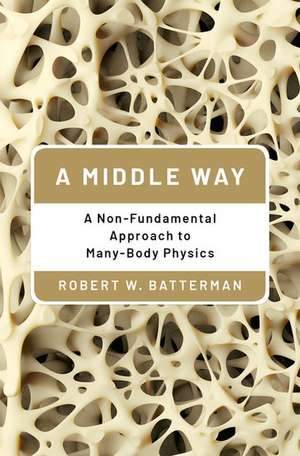
A Middle Way: A Non-Fundamental Approach to Many-Body Physics
Autor Robert W. Battermanen Limba Engleză Hardback – 29 sep 2021
Preț: 523.24 lei
Preț vechi: 733.44 lei
-29%
Puncte Express: 785
Carte tipărită la comandă
Livrare economică 20 noiembrie-01 decembrie
Livrare prin curier în România Termenul estimat este afișat lângă disponibilitate.
Transport gratuit pentru acest produs Plată online sau ramburs, în funcție de opțiunile comenzii.
Retur gratuit în 14 zile Comandă securizată și suport în română.
Specificații
ISBN-13: 9780197568613
ISBN-10: 0197568610
Pagini: 190
Dimensiuni: 241 x 165 x 19 mm
Greutate: 0.43 kg
Editura: Oxford University Press
Colecția OUP USA
Locul publicării:New York, United States
ISBN-10: 0197568610
Pagini: 190
Dimensiuni: 241 x 165 x 19 mm
Greutate: 0.43 kg
Editura: Oxford University Press
Colecția OUP USA
Locul publicării:New York, United States
Recenzii
unique and Impressive
Robert W. Batterman's A Middle Way: A Non-Fundamental Approach to Many-Body Physics is an extraordinarily insightful book, far-reaching in its scope and significance, interdisciplinary in character due to connections made between physics, materials science andengineering, and biology, and groundbreaking in the sense that it reflects on important scientific domains that are mostly absent from current literature.
Robert W. Batterman's A Middle Way: A Non-Fundamental Approach to Many-Body Physics is an extraordinarily insightful book, far-reaching in its scope and significance, interdisciplinary in character due to connections made between physics, materials science andengineering, and biology, and groundbreaking in the sense that it reflects on important scientific domains that are mostly absent from current literature.
Notă biografică
Robert W. Batterman is Distinguished Professor of Philosophy at the University of Pittsburgh. Prior to his arrival in Pittsburgh, he was the Rotman Canada Research Chair in Philosophy of Science at the University of Western Ontario. He is a Fellow of the Royal Society of Canada. He is the author of The Devil in the Details: Asymptotic Reasoning in Explanation, Reduction, and Emergence (Oxford, 2002) and editor of The Oxford Handbook of Philosophy of Physics (2013). He works in the philosophy of physics and philosophy of applied mathematics, focusing primarily upon the area of condensed matter broadly construed. His research interests include the foundations of statistical physics, materials science, dynamical systems and chaos, asymptotic reasoning, mathematical idealizations, explanation, reduction, and emergence.
Cuprins
- Contents
- Preface
- 1. Introduction
- 1.1 Philosophy and Foundational Problems
- 1.2 Autonomy and Fundamentality
- 1.3 Two-ish Senses of Fundamental
- 1.4 Hydrodynamic Methods: A First Pass
- 1.5 Representative Volume Elements
- 1.6 Fluctuation and Dissipation
- 1.7 Preview of Upcoming Chapters
- 2. Autonomy
- 2.1 Pegs and Boards
- 2.2 How to Answer (AUT)
- 2.2.1 Multiple Realizability? Really?
- 2.2.2 Universality
- 2.2.3 Renormalization Group
- 2.3 Generalizations
- 2.3.1 Multi-scale Modeling of Materials
- 2.4 A Brief Thought Experiment
- 2.5 Conclusion
- 3. Hydrodynamics
- 3.1 Conserved Quantities and Transport
- 3.1.1 Spin Diffusion Equations
- 3.2 Correlation Functions
- 3.3 Linear Response
- 3.4 Conclusion
- 4. Brownian Motion
- 4.1 Introduction
- 4.2 The Hydrodynamic Equation
- 4.3 Effective Viscosity in Brownian Contexts
- 4.3.1 Summary: An Answer to (AUT)
- 4.4 Brownian Motion and the F-D Theorem
- 4.5 Conclusion
- 5. From Brownian Motion to Bending Beams
- 5.1 Introduction
- 5.2 Bulk Properties of Heterogeneous Systems
- 5.3 Conclusion
- 6. An Engineering Approach
- 6.1 Introduction
- 6.2 Schwinger's Engineering Approach
- 6.3 Order Parameters, Mesoscales, Correlations
- 6.4 Multiscale Modeling in Biology
- 6.4.1 Modeling Bone Fracture
- 6.5 Conclusion
- 7. The Right Variables and Natural Kinds
- 7.1 Introduction
- 7.2 Woodward on Variable Choice
- 7.3 The Right (Mesoscale) Variables
- 7.4 Another Minimal Model Example
- 7.4.1 The Model: Lattice Gas Automaton
- 7.5 Conclusion
- 8. Conclusions
- 8.1 Foundational Problems vs. Methodology
- 8.2 Autonomy and Heterogeneity
- 8.3 Brownian Motion and the F-D Theorem
- 8.4 A Middle-Out/Engineering Methodology
- 8.5 A Physical Argument for the Right Variables