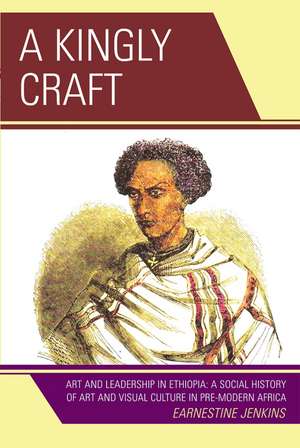
A Kingly Craft: Art and Leadership in Ethiopia
Autor Earnestine Jenkinsen Limba Engleză Paperback – 8 feb 2008
Focusing on manuscripts comissioned by members of an influential dynasty in the province of Shewa, the book draws attention to the relationship between art and patronage. Shewan leaders commissioned books with illustrations that were increasingly narrative and secular, visually documenting historical events, everyday life at court, and the portrayal of political concepts. This analysis also explores how local leaders in an independent African kingdom used art to establish links with a glorious past, thereby legitimizing their authority and preserving their great deeds for the future.
Preț: 259.21 lei
Preț vechi: 359.45 lei
-28%
Puncte Express: 389
Carte tipărită la comandă
Livrare economică 13-27 noiembrie
Livrare prin curier în România Termenul estimat este afișat lângă disponibilitate.
Transport gratuit de la 400.00 lei Plată online sau ramburs, în funcție de opțiunile comenzii.
Retur gratuit în 14 zile Comandă securizată și suport în română.
Specificații
ISBN-13: 9780761838890
ISBN-10: 0761838899
Pagini: 115
Dimensiuni: 153 x 232 x 12 mm
Greutate: 0.25 kg
Editura: Bloomsbury Publishing
Colecția University Press of America
Locul publicării:New York, United States
ISBN-10: 0761838899
Pagini: 115
Dimensiuni: 153 x 232 x 12 mm
Greutate: 0.25 kg
Editura: Bloomsbury Publishing
Colecția University Press of America
Locul publicării:New York, United States
V-ar putea interesa
-
 Question of ManhoodEarnestine JenkinsPreț: 258.82 lei
 -
 Question of ManhoodEarnestine JenkinsPreț: 278.62 lei
 -
 Preț: 257.45 lei
 -
 Shakespeare's Macbeth for KidsBrendan P KelsoPreț: 111.18 lei
 -
 -23%Preț: 2003.11 lei2601.43 lei
 -
 -15%Preț: 470.52 lei553.55 lei
 -
 The New Vienna School of Art HistoryIan Verstegen-25%Preț: 576.73 lei766.22 lei
 -
 Objects of DesireRebecca MorsePreț: 313.15 lei
 -
 Preț: 176.58 lei
 -
 Naturally Hypernatural I: Concepts of NatureSabine Flach-8%Preț: 468.74 lei509.50 lei
 -
 Preț: 88.19 lei
 -
 An Artist's LifeEleanora Antinova-17%Preț: 117.46 lei142.02 lei
 -
 The World of MuchaHiroshi Unno-23%Preț: 179.50 lei232.23 lei
 -
 Abdias Nascimento: A Panamefrican ArtistAdriano PedrosaPreț: 454.73 lei
 -
 Arnulf Rainer, Emilio Vedova: Ora!Fabrizio GazzarriPreț: 387.03 lei
 -
 Donatello: In TuscanyFrancesco CagliotiPreț: 130.71 lei
Cuprins
Part 1 List of Illustrations
Chapter 2 Introduction: The Political and Visual Culture in Eighteenth Century Shewa: Chiefs, Patronage, and Early Images of Authority
Chapter 3 Eighteenth Century Political Culture in Shewan Province: Chiefs, Wars, and Conquests
Chapter 4 Shewa's First Patron of the Arts: Amha Iyasus and His Miracles of Mary Manuscript
Chapter 5 Ruler and Saint: Asfa Wassan and Holy Man, Takla Haymanot: Secular Themes in Late Eighteenth Century Manuscript Painting
Part 6 The Ninteenth Century: King Sahle Selassie and the Court Art Tradition
Chapter 7 King Sahle Selassie and the Infrastructure of Patronage in Early Nineteenth Century Shewa
Chapter 8 Painting Authority: A Double Portrait, Shared Power: the 'Queen Mother' and the King
Chapter 9 Sahle Selassie Iconography, and the Ideal King: King David as a Model of Christian Leadership
Chapter 10 A 'Killer of Heathens' and a Leader of Men: Sahle Selassie the Christian Warrior King
Chapter 11 Duty and Leisure: King Sahle Selassie at Court
Chapter 12 On a Patriarchal Note: Painting History and Honoring the Father in Sahle Selassie's Prayer Book
Chapter 13 Coda: The Cultural Legacy of the 'House of Shewa'
Part 14 Bibliography
Part 15 Index
Chapter 2 Introduction: The Political and Visual Culture in Eighteenth Century Shewa: Chiefs, Patronage, and Early Images of Authority
Chapter 3 Eighteenth Century Political Culture in Shewan Province: Chiefs, Wars, and Conquests
Chapter 4 Shewa's First Patron of the Arts: Amha Iyasus and His Miracles of Mary Manuscript
Chapter 5 Ruler and Saint: Asfa Wassan and Holy Man, Takla Haymanot: Secular Themes in Late Eighteenth Century Manuscript Painting
Part 6 The Ninteenth Century: King Sahle Selassie and the Court Art Tradition
Chapter 7 King Sahle Selassie and the Infrastructure of Patronage in Early Nineteenth Century Shewa
Chapter 8 Painting Authority: A Double Portrait, Shared Power: the 'Queen Mother' and the King
Chapter 9 Sahle Selassie Iconography, and the Ideal King: King David as a Model of Christian Leadership
Chapter 10 A 'Killer of Heathens' and a Leader of Men: Sahle Selassie the Christian Warrior King
Chapter 11 Duty and Leisure: King Sahle Selassie at Court
Chapter 12 On a Patriarchal Note: Painting History and Honoring the Father in Sahle Selassie's Prayer Book
Chapter 13 Coda: The Cultural Legacy of the 'House of Shewa'
Part 14 Bibliography
Part 15 Index
Recenzii
Jenkin's analysis of the thirty images she utilizes is meticulous and thorough, and clearly demonstrates her argument that Shewa's rulers influenced the production of illuminated manuscripts, particularly with regard to the inclusion of secular imagery and unique aspects of their lives and courts.. A Kingly Craft will certainly be of interest to Ethiopianists, particularly those in the field of history or visual culture..Jenkins's in-depth analysis of individual images is excellent, and her argument regarding Shewan rulers' impact on the increasing use of secular imagery in Ethiopian painting is convincing and well supported.
This study is well-written, interesting, and epistemologically important. Jenkins' analyses and arguments are informed, interesting, sometimes provocative, and often fun to read.
This study is well-written, interesting, and epistemologically important. Jenkins' analyses and arguments are informed, interesting, sometimes provocative, and often fun to read.