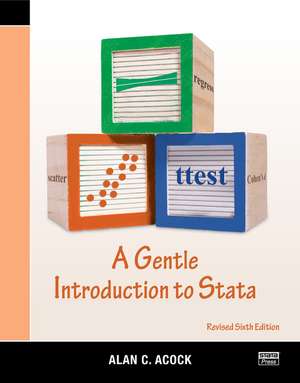
A Gentle Introduction to Stata, Revised Sixth Edition
Autor Alan C. Acocken Limba Engleză Paperback – 19 ian 2023
Acock assumes that the user is not familiar with any statistical software. This assumption of a blank slate is central to the structure and contents of the book. Acock starts with the basics; for example, the part of the book that deals with data management begins with a careful and detailed example of turning survey data on paper into a Stata-ready dataset. When explaining how to go about basic exploratory statistical procedures, Acock includes notes that will help the reader develop good work habits. This mixture of explaining good Stata habits and explaining good statistical habits continues throughout the book.
Acock is quite careful to teach the reader all aspects of using Stata. He covers data management, good work habits (including the use of basic do-files), basic exploratory statistics (including graphical displays), and analyses using the standard array of basic statistical tools (correlation, linear and logistic regression, and parametric and nonparametric tests of location and dispersion). He also successfully introduces some more advanced topics such as multiple imputation and multilevel modeling in a very approachable manner. Acock teaches Stata commands by using the menus and dialog boxes while still stressing the value of Stata commands and do-files. In this way, he ensures that all types of users can build good work habits. Each chapter has exercises that the motivated reader can use to reinforce the material.
The tone of the book is friendly and conversational without ever being glib or condescending. Important asides and notes about terminology are set off in boxes, which makes the text easy to read without any convoluted twists or forward referencing. Rather than splitting topics by their Stata implementation, Acock arranges the topics as they would appear in a basic statistics textbook; graphics and postestimation are woven into the material naturally. Real datasets, such as the General Social Surveys from 2002, 2006, and 2016, are used throughout the book.
The focus of the book is especially helpful for those in the behavioral and social sciences because the presentation of basic statistical modeling is supplemented with discussions of effect sizes and standardized coefficients. Various selection criteria, such as semipartial correlations, are discussed for model selection. Acock also covers a variety of commands available for evaluating reliability and validity of measurements.
The revised sixth edition is fully up to date for Stata 17, including updated discussion and images of Stata's interface and modern command syntax. In addition, examples include new features such as the table command and collect suite for creating and exporting customized tables as well as the option for creating graphs with transparency.
Preț: 491.31 lei
Preț vechi: 534.03 lei
-8%
Puncte Express: 737
Carte disponibilă
Livrare economică 14-28 noiembrie
Livrare express 03-07 noiembrie pentru 63.70 lei
Livrare prin curier în România Termenul estimat este afișat lângă disponibilitate.
Transport gratuit pentru acest produs Plată online sau ramburs, în funcție de opțiunile comenzii.
Retur gratuit în 14 zile Comandă securizată și suport în română.
Specificații
ISBN-13: 9781597183673
ISBN-10: 1597183679
Pagini: 566
Dimensiuni: 189 x 246 x 37 mm
Greutate: 1.21 kg
Ediția:6
Editura: Stata Press
Colecția Stata Press
ISBN-10: 1597183679
Pagini: 566
Dimensiuni: 189 x 246 x 37 mm
Greutate: 1.21 kg
Ediția:6
Editura: Stata Press
Colecția Stata Press
Public țintă
Academic, Postgraduate, Professional Practice & Development, and Undergraduate AdvancedCuprins
Getting started Entering data Preparing data for analysis Working with commands, do-files, and results Descriptive statistics and graphs for one variable Statistics and graphs for two categorical variables Tests for one or two means Bivariate correlation and regression Analysis of variance Multiple regression Logistic regression Measurement, reliability, and validity Structural equation and generalized structural equation modeling Working with missing values—multiple imputation An introduction to multilevel analysis Item response theory (IRT) What’s next? Glossary of acronyms Glossary of mathematical and statistical symbols References
Notă biografică
Alan Acock is a sociologist and a University Distinguished Professor Emeritus in the School of Social and Behavioral Health Sciences at Oregon State University. He held the Knudson Chair in Family Research and was also recognized as the Alumni Distinguished Professor based on his work with students. He is the author of Discovering Structural Equation Modeling Using Stata, Revised Edition. He has published more than 150 articles in leading journals across the social and behavioral sciences, including Structural Equation Modeling, Psychological Bulletin, Multivariate Behavioral Research,Journal of Gerontology, Journal of Adolescence, American Journal of Public Health, American Sociological Review, Journal of Marriage and Family, Social Forces, Drug and Alcohol Dependence, Educational and Psychological Measurement, Journal of Politics, Prevention Science, American Journal of Preventive Medicine, and many others. With this broad experience, Acock brings examples from a variety of disciplines.
Descriere
Ready to learn Stata? The revised edition of Stata Press' long-time best seller, 'A Gentle Introduction to Stata' is now available and fully updated for Stata 17.