A Field Guide to the Information Commons
Autor Charles Forrest, Martin Halberten Limba Engleză Paperback – 19 feb 2009
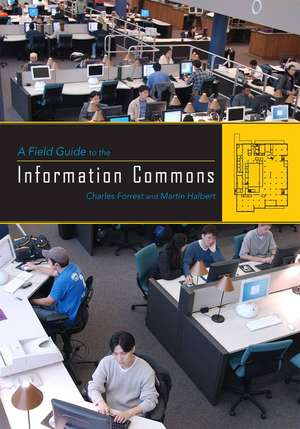
Technology has enabled new forms of information-seeking behavior and scholarship, causing a renovation of libraries that revisits the idea of the "commons"-a public place that is free to be used by everyone. A Field Guide to the Information Commons describes the emergence, growth, and adoption of the concept of the information commons in libraries. This book includes a variety of contributed articles, and descriptive, structured entries for various information commons in libraries across the country and around the world.
Preț: 511.69 lei
Preț vechi: 697.85 lei
-27%
Puncte Express: 768
Carte tipărită la comandă
Livrare economică 08-22 iunie
Specificații
ISBN-13: 9780810861008
ISBN-10: 0810861003
Pagini: 214
Dimensiuni: 180 x 256 x 13 mm
Greutate: 0.46 kg
Ediția:New.
Editura: Bloomsbury Publishing
Colecția Scarecrow Press
Locul publicării:New York, United States
ISBN-10: 0810861003
Pagini: 214
Dimensiuni: 180 x 256 x 13 mm
Greutate: 0.46 kg
Ediția:New.
Editura: Bloomsbury Publishing
Colecția Scarecrow Press
Locul publicării:New York, United States


Recenzii
Information commons is an emerging library service model that encompasses the new ways libraries are providing access to information resources, joining collaborative service programs, and redesigning space to support changing user behaviors and patterns of learning. Part 1 offers contributed articles on topics such as the history of information commons in academic libraries, barriers to working and learning, and technology. Part 2, "The Field Guide," consists of structured entries for information commons in 29 institutions around the world, with statistics and information on purpose, services, software, print resources, staff, funding or budget, publicity, and evaluation.
The breadth of topics covered in this guide is admirable: from the history of information commons to their architectural development, to in-depth information about specific information commons projects. Furthermore, the text is well laid out and information is easy to find.
A consistent format throughout the field guide enables one to compare and contrast features, while the narratives in the first part of the book provide support and guidance in the research of these implementations. This is a valuable resource for any academic library seeking to enhance, implement, or improve an information commons.
The breadth of topics covered in this guide is admirable: from the history of information commons to their architectural development, to in-depth information about specific information commons projects. Furthermore, the text is well laid out and information is easy to find.
A consistent format throughout the field guide enables one to compare and contrast features, while the narratives in the first part of the book provide support and guidance in the research of these implementations. This is a valuable resource for any academic library seeking to enhance, implement, or improve an information commons.