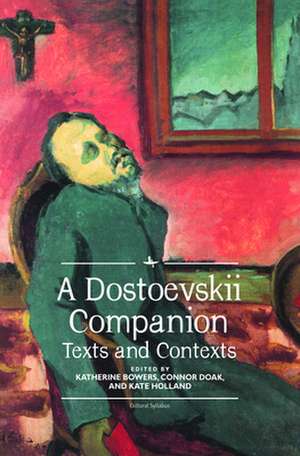
A Dostoevskii Companion: Texts and Contexts
Editat de Katherine Bowers, Connor Doak, Kate Hollanden Limba Engleză Hardback – 9 noi 2018
Preț: 809.92 lei
Preț vechi: 1051.85 lei
-23%
Puncte Express: 1215
Carte tipărită la comandă
Livrare economică 09-23 iunie
Specificații
ISBN-13: 9781618117267
ISBN-10: 1618117262
Pagini: 556
Dimensiuni: 156 x 234 x 34 mm
Greutate: 0.95 kg
Editura: Academic Studies Press
Colecția Academic Studies Press
Locul publicării:Boston, MA, United States
ISBN-10: 1618117262
Pagini: 556
Dimensiuni: 156 x 234 x 34 mm
Greutate: 0.95 kg
Editura: Academic Studies Press
Colecția Academic Studies Press
Locul publicării:Boston, MA, United States
Cuprins
Acknowledgments
How to Use this Book
Note on Translation, Transliteration, and Referencing
Timeline of Dostoevskii’s Life and Works
Biography and Context
Chapter 1: The Early Dostoevskii
Introduction
“A Noble Vocation” (2012) by Robert Bird
The Ribbon Theft Incident from Confessions (1789) by Jean-Jacques Rousseau
A Son’s Revenge from The Robbers (1781) by Friedrich Schiller
First Glimpse of Udolpho (1794) by Ann Radcliffe
The House of Monsieur Grandet in Eugénie Grandet (1833) by Honoré de Balzac
Little Nell in The Old Curiosity Shop (1841) by Charles Dickens
The Overcoat (1842) by Nikolai Gogol′
Poor Folk (1846) by Fedor Dostoevskii
First Night from “White Nights” (1848) by Fedor Dostoevskii
Letter to Gogol′ (1847) by Vissarion Belinskii
Three Documents from the Petrashevskii Trial (1849)
The Mock Execution: Letter to Mikhail Dostoevskii, December 22, 1849 by Fedor Dostoevskii
Chapter 2: Dostoevskii and His Contemporaries
Introduction
A Review of The Double (1846) by Vissarion Belinskii
Thoughts on The Double (1847) by Valerian Maikov
The Row with Turgenev: Letter to Apollon Maikov, August 16, 1867 by Fedor Dostoevskii
The Caricature of Turgenev in Demons (1872) by Fedor Dostoevskii
Reaction to Demons: Letter to Mariia Miliutina, December 3, 1872 by Ivan Turgenev
“Landowners’ Literature”: Letter to Nikolai Strakhov, May 18, 1871 by Fedor Dostoevskii
Thoughts on Anna Karenina (1877) by Fedor Dostoevskii
Tiny Alterations of Consciousness (1890) by Lev Tolstoy
From A Cruel Talent (1882) by Nikolai Mikhailovskii
Tolstoy and Dostoevskii (1902) by Dmitrii Merezhkovskii
The Root and the Flower: Dostoevskii and Turgenev (1993) by Robert Louis Jackson
Poetics
Chapter 3: Aesthetics
Introduction
Mr. —bov and the Question of Art (1861) by Fedor Dostoevskii
The Defense of the Ideal: Letter to Apollon Maikov, December 11, 1868 by Fedor Dostoevskii
Apropos of the Exhibition (1873) by Fedor Dostoevskii
Poet of the Underground (1875) by Fedor Dostoevskii
Dmitrii Karamazov on Beauty (1878) by Fedor Dostoevskii
Two Kinds of Beauty (1966) by Robert Louis Jackson
Dostoevskii’s Fantastic Pages (2006) by Vladimir Zakharov
Chapter 4: Characters
Introduction
Makar Devushkin (2009) by Carol Apollonio
Underground Man (1963) by Mikhail Bakhtin
Raskol′nikov (2002) by Konstantine Klioutchkine
Myshkin (1998) by Liza Knapp
Nastas′ia Filippovna (2004) by Sarah J. Young
Stavrogin (1969) by Joseph Frank
Fedor Karamazov (2003) by Deborah A. Martinsen
Ivan Karamazov and Smerdiakov (1992) by Harriet Murav
Alesha Karamazov (1977) by Valentina Vetlovskaia
Chapter 5: The Novel
Introduction
A Novel of Disintegration from the Notebooks for The Adolescent (1874) by Fedor Dostoevskii
An Exceptional Family from The Adolescent (1875) by Fedor Dostoevskii
Remaking the Noble Family Novel (2013) by Kate Holland
A New Kind of Hero (1963) by Mikhail Bakhtin
“Chronicle Time” in Dostoevskii (1979) by Dmitrii Likhachev
The Narrator of The Idiot (1981) by Robin Feuer Miller
Sideshadowing in Dostoevskii’s Novels (1994) by Gary Saul Morson
The Plot of Crime and Punishment (2016) by Robert L. Belknap
Chapter 6: From Journalism to Fiction
Introduction
Feuilleton, April 22, 1847 by Fedor Dostoevskii
The Petersburg Feuilletons (1979) by Joseph Frank
Dostoevskii’s “Vision on the Neva” (1979) by Joseph Frank
Excerpts from the Notebooks for The Idiot (1867) by Fedor Dostoevskii
Nastas′ia Filippovna’s History from The Idiot (1869) by Fedor Dostoevskii
Ol′ga Umetskaia and The Idiot (2017) by Katherine Bowers
Two Suicides from A Writer’s Diary (1876) by Fedor Dostoevskii
From “The Meek One: A Fantastic Story” (1876) by Fedor Dostoevskii
A Case Study: October, November, December 1876 (2013) by Kate Holland
A Writer’s Diary as a Historical Phenomenon (2004) by Igor′ Volgin
A Writer’s Diary, April 1877 issue in full
Themes
Chapter 7: Captivity, Free Will, and Utopia
Introduction
Dostoevskii’s Prison Years (2013) by James P. Scanlan
Prison Life: Letter to Mikhail Dostoevskii, February 22, 1854 by Fedor Dostoevskii
The Prison from Notes from the House of the Dead (1862) by Fedor Dostoevskii
The Eagle from Notes from the House of the Dead (1862) by Fedor Dostoevskii
Dostoevskii Responds to the Censorship Committee (1986) by Joseph Frank
Vera Pavlovna’s Fourth Dream from What Is to Be Done? (1863) by Nikolai Chernyshevskii
The Prison of Utopia (1986) by Joseph Frank
The Crystal Palace from Notes from Underground (1864) by Fedor Dostoevskii
Twice Two from Notes from Underground (1864) by Fedor Dostoevskii
Philosophical Pro et Contra in Part I of Crime and Punishment (1981) by Robert Louis Jackson
Meta-utopia (1981) by Gary Saul Morson
A Note on His Wife’s Death (1864) by Fedor Dostoevskii
The Speech at the Stone from Brothers Karamazov (1880) by Fedor Dostoevskii
Ode to Joy (2004) by Robert Louis Jackson
Chapter 8: Dostoevskii’s Others
Introduction
Portrait of Alei in Notes from the House of the Dead (1862) by Fedor Dostoevskii
Portrait of Isai Fomich in Notes from the House of the Dead (1862) by Fedor Dostoevskii
The Jewish Question (1877) by Fedor Dostoevskii
Christians, Muslims, and Jews in Notes from the House of the Dead (2008) by Susan McReynolds
From “A Few Words about George Sand” (1876) by Fedor Dostoevskii
From “About Women Again” (1876) by Fedor Dostoevskii
The Woman Question in Crime and Punishment (1994) by Nina Pelikan Straus
The Mothers Karamazov (2009) by Carol Apollonio
Chapter 9: Russia
Introduction
Fellow Convicts from Notes from the House of the Dead (1862) by Fedor Dostoevskii
After the Emancipation (1860) by Fedor Dostoevskii
Going Beyond Theory (1862) by Fedor Dostoevskii
Dostoevskii and the Slavophiles (2003) by Sarah Hudspith
The Coming Apocalypse from the Notebooks for Demons (1870) by Fedor Dostoevskii
Peasant Marei (1876) by Fedor Dostoevskii
Pushkin Speech (1880) by Fedor Dostoevskii
Chapter 10: God
Introduction
A Confession of Faith: Letter to Natal′ia Fonvizina, early March 1854 by Fedor Dostoevskii
Myshkin and Rogozhin Exchange Crosses in The Idiot (1869) by Fedor Dostoevskii
Dostoevskii’s Religious Thought (1903) by Lev Shestov
On the Grand Inquisitor (1921) by Nikolai Berdiaev
Hagiography in Brothers Karamazov (1985) by Nina Perlina
On the Koranic Motif in The Idiot and Demons (2012) by Diane Oenning Thompson
From Dostoevskii’s Religion (2005) by Steven Cassedy
Index
How to Use this Book
Note on Translation, Transliteration, and Referencing
Timeline of Dostoevskii’s Life and Works
Biography and Context
Chapter 1: The Early Dostoevskii
Introduction
“A Noble Vocation” (2012) by Robert Bird
The Ribbon Theft Incident from Confessions (1789) by Jean-Jacques Rousseau
A Son’s Revenge from The Robbers (1781) by Friedrich Schiller
First Glimpse of Udolpho (1794) by Ann Radcliffe
The House of Monsieur Grandet in Eugénie Grandet (1833) by Honoré de Balzac
Little Nell in The Old Curiosity Shop (1841) by Charles Dickens
The Overcoat (1842) by Nikolai Gogol′
Poor Folk (1846) by Fedor Dostoevskii
First Night from “White Nights” (1848) by Fedor Dostoevskii
Letter to Gogol′ (1847) by Vissarion Belinskii
Three Documents from the Petrashevskii Trial (1849)
The Mock Execution: Letter to Mikhail Dostoevskii, December 22, 1849 by Fedor Dostoevskii
Chapter 2: Dostoevskii and His Contemporaries
Introduction
A Review of The Double (1846) by Vissarion Belinskii
Thoughts on The Double (1847) by Valerian Maikov
The Row with Turgenev: Letter to Apollon Maikov, August 16, 1867 by Fedor Dostoevskii
The Caricature of Turgenev in Demons (1872) by Fedor Dostoevskii
Reaction to Demons: Letter to Mariia Miliutina, December 3, 1872 by Ivan Turgenev
“Landowners’ Literature”: Letter to Nikolai Strakhov, May 18, 1871 by Fedor Dostoevskii
Thoughts on Anna Karenina (1877) by Fedor Dostoevskii
Tiny Alterations of Consciousness (1890) by Lev Tolstoy
From A Cruel Talent (1882) by Nikolai Mikhailovskii
Tolstoy and Dostoevskii (1902) by Dmitrii Merezhkovskii
The Root and the Flower: Dostoevskii and Turgenev (1993) by Robert Louis Jackson
Poetics
Chapter 3: Aesthetics
Introduction
Mr. —bov and the Question of Art (1861) by Fedor Dostoevskii
The Defense of the Ideal: Letter to Apollon Maikov, December 11, 1868 by Fedor Dostoevskii
Apropos of the Exhibition (1873) by Fedor Dostoevskii
Poet of the Underground (1875) by Fedor Dostoevskii
Dmitrii Karamazov on Beauty (1878) by Fedor Dostoevskii
Two Kinds of Beauty (1966) by Robert Louis Jackson
Dostoevskii’s Fantastic Pages (2006) by Vladimir Zakharov
Chapter 4: Characters
Introduction
Makar Devushkin (2009) by Carol Apollonio
Underground Man (1963) by Mikhail Bakhtin
Raskol′nikov (2002) by Konstantine Klioutchkine
Myshkin (1998) by Liza Knapp
Nastas′ia Filippovna (2004) by Sarah J. Young
Stavrogin (1969) by Joseph Frank
Fedor Karamazov (2003) by Deborah A. Martinsen
Ivan Karamazov and Smerdiakov (1992) by Harriet Murav
Alesha Karamazov (1977) by Valentina Vetlovskaia
Chapter 5: The Novel
Introduction
A Novel of Disintegration from the Notebooks for The Adolescent (1874) by Fedor Dostoevskii
An Exceptional Family from The Adolescent (1875) by Fedor Dostoevskii
Remaking the Noble Family Novel (2013) by Kate Holland
A New Kind of Hero (1963) by Mikhail Bakhtin
“Chronicle Time” in Dostoevskii (1979) by Dmitrii Likhachev
The Narrator of The Idiot (1981) by Robin Feuer Miller
Sideshadowing in Dostoevskii’s Novels (1994) by Gary Saul Morson
The Plot of Crime and Punishment (2016) by Robert L. Belknap
Chapter 6: From Journalism to Fiction
Introduction
Feuilleton, April 22, 1847 by Fedor Dostoevskii
The Petersburg Feuilletons (1979) by Joseph Frank
Dostoevskii’s “Vision on the Neva” (1979) by Joseph Frank
Excerpts from the Notebooks for The Idiot (1867) by Fedor Dostoevskii
Nastas′ia Filippovna’s History from The Idiot (1869) by Fedor Dostoevskii
Ol′ga Umetskaia and The Idiot (2017) by Katherine Bowers
Two Suicides from A Writer’s Diary (1876) by Fedor Dostoevskii
From “The Meek One: A Fantastic Story” (1876) by Fedor Dostoevskii
A Case Study: October, November, December 1876 (2013) by Kate Holland
A Writer’s Diary as a Historical Phenomenon (2004) by Igor′ Volgin
A Writer’s Diary, April 1877 issue in full
Themes
Chapter 7: Captivity, Free Will, and Utopia
Introduction
Dostoevskii’s Prison Years (2013) by James P. Scanlan
Prison Life: Letter to Mikhail Dostoevskii, February 22, 1854 by Fedor Dostoevskii
The Prison from Notes from the House of the Dead (1862) by Fedor Dostoevskii
The Eagle from Notes from the House of the Dead (1862) by Fedor Dostoevskii
Dostoevskii Responds to the Censorship Committee (1986) by Joseph Frank
Vera Pavlovna’s Fourth Dream from What Is to Be Done? (1863) by Nikolai Chernyshevskii
The Prison of Utopia (1986) by Joseph Frank
The Crystal Palace from Notes from Underground (1864) by Fedor Dostoevskii
Twice Two from Notes from Underground (1864) by Fedor Dostoevskii
Philosophical Pro et Contra in Part I of Crime and Punishment (1981) by Robert Louis Jackson
Meta-utopia (1981) by Gary Saul Morson
A Note on His Wife’s Death (1864) by Fedor Dostoevskii
The Speech at the Stone from Brothers Karamazov (1880) by Fedor Dostoevskii
Ode to Joy (2004) by Robert Louis Jackson
Chapter 8: Dostoevskii’s Others
Introduction
Portrait of Alei in Notes from the House of the Dead (1862) by Fedor Dostoevskii
Portrait of Isai Fomich in Notes from the House of the Dead (1862) by Fedor Dostoevskii
The Jewish Question (1877) by Fedor Dostoevskii
Christians, Muslims, and Jews in Notes from the House of the Dead (2008) by Susan McReynolds
From “A Few Words about George Sand” (1876) by Fedor Dostoevskii
From “About Women Again” (1876) by Fedor Dostoevskii
The Woman Question in Crime and Punishment (1994) by Nina Pelikan Straus
The Mothers Karamazov (2009) by Carol Apollonio
Chapter 9: Russia
Introduction
Fellow Convicts from Notes from the House of the Dead (1862) by Fedor Dostoevskii
After the Emancipation (1860) by Fedor Dostoevskii
Going Beyond Theory (1862) by Fedor Dostoevskii
Dostoevskii and the Slavophiles (2003) by Sarah Hudspith
The Coming Apocalypse from the Notebooks for Demons (1870) by Fedor Dostoevskii
Peasant Marei (1876) by Fedor Dostoevskii
Pushkin Speech (1880) by Fedor Dostoevskii
Chapter 10: God
Introduction
A Confession of Faith: Letter to Natal′ia Fonvizina, early March 1854 by Fedor Dostoevskii
Myshkin and Rogozhin Exchange Crosses in The Idiot (1869) by Fedor Dostoevskii
Dostoevskii’s Religious Thought (1903) by Lev Shestov
On the Grand Inquisitor (1921) by Nikolai Berdiaev
Hagiography in Brothers Karamazov (1985) by Nina Perlina
On the Koranic Motif in The Idiot and Demons (2012) by Diane Oenning Thompson
From Dostoevskii’s Religion (2005) by Steven Cassedy
Index
Recenzii
“This fascinating and useful collection combinesDostoevsky’s own texts (fictional excerpts, letters, articles) with a number ofilluminating essays to shed light on various aspects of the author’s life, work,and thought. Designed with undergraduate students in mind, the collection,edited by Katherine Bowers, Connor Doak, and Kate Holland, will be of greathelp to students and to those who teach them, capturing what professors talkabout when they talk about Dostoevsky.” —Vladimir Golstein, Brown University, Russian Review Vol. 78, No. 2
“I found this book both eminently readable and a comprehensive and invaluable re-source for Dostoevskii scholars, no matter at what level they research. The Anglo-Canadian editorial team of Katherine Bowers, Connor Doak and Kate Holland are to be congratulated on assembling a rich textual and contextual feast that repays detailed study.” —John Cook, University of Melbourne, Australian Slavonic and East European Studies, Vol. 33
“This extremely valuable addition to Academic StudiesPress’s Cultural Syllabus Series is aimed primarily at undergraduate students,although it is sure to be of interest to scholars of Dostoevsky. It offers acomprehensive collection of excerpts from Dostoevsky’s literary works,nonfiction, letters, and notebooks, as well as selections from importantcritical articles about his life and works. … Each chapter ends with a welcome,selected bibliography of works on the subject of the chapter. Given theenormous number of works on Dostoevsky (‘Whohas not written a book on Dostoevsky?’), this is very useful for future reference. … We are fortunate tohave this new companion to studying Dostoevsky.” —Michael Katz, Middlebury College, Slavic and EastEuropean Journal
“I found this book both eminently readable and a comprehensive and invaluable re-source for Dostoevskii scholars, no matter at what level they research. The Anglo-Canadian editorial team of Katherine Bowers, Connor Doak and Kate Holland are to be congratulated on assembling a rich textual and contextual feast that repays detailed study.” —John Cook, University of Melbourne, Australian Slavonic and East European Studies, Vol. 33
“This extremely valuable addition to Academic StudiesPress’s Cultural Syllabus Series is aimed primarily at undergraduate students,although it is sure to be of interest to scholars of Dostoevsky. It offers acomprehensive collection of excerpts from Dostoevsky’s literary works,nonfiction, letters, and notebooks, as well as selections from importantcritical articles about his life and works. … Each chapter ends with a welcome,selected bibliography of works on the subject of the chapter. Given theenormous number of works on Dostoevsky (‘Whohas not written a book on Dostoevsky?’), this is very useful for future reference. … We are fortunate tohave this new companion to studying Dostoevsky.” —Michael Katz, Middlebury College, Slavic and EastEuropean Journal