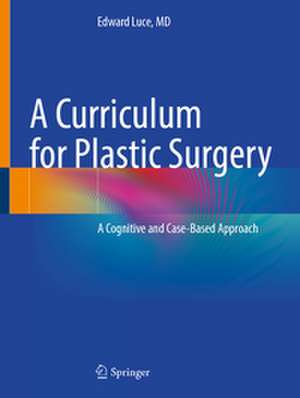
A Curriculum for Plastic Surgery
Autor Edward Luceen Limba Engleză Hardback – 28 mai 2025
Suntem de părere că utilitatea practică a volumului A Curriculum for Plastic Surgery rezidă în capacitatea sa de a transforma teoria vastă în competențe decizionale imediate. Clinicianul nu primește doar informație, ci un sistem de antrenament: după parcurgerea modulelor, acesta va putea aborda cazuri complexe de reconstrucție sau estetică folosind o metodologie de rezolvare a problemelor bazată pe dovezi și pe experiența de 40 de ani a autorului Edward Luce. Apreciem în mod deosebit structura riguroasă a celor 1412 pagini, unde progresia este logică, pornind de la principiile generale ale vindecării plăgilor și fiziologia lambourilor, până la anomalii congenitale craniofaciale și tehnici avansate de microchirurgie. Fiecare dintre cele peste 100 de module este conceput ca o unitate de învățare autonomă. Credem că includerea seturilor de întrebări cu răspuns multiplu, însoțite de explicații detaliate pentru variantele corecte și incorecte, oferă un instrument de autoevaluare indispensabil în pregătirea pentru examenele de specialitate. Spre deosebire de Plastic and Reconstructive Surgery Fundamentals de Daniel De-Luna-Gallardo, care oferă o privire de ansamblu practică asupra specialității, lucrarea de față completează literatura de profil cu un format interactiv, axat pe discuții de tip conferință și analize de caz aprofundate. De asemenea, dacă Essentials of Plastic Surgery: Q&A Companion se concentrează pe testarea cunoștințelor, A Curriculum for Plastic Surgery adaugă acestor teste un context clinic vast, transformând fiecare întrebare într-o oportunitate de învățare prin scenarii reale. Organizarea pe 13 categorii generale asigură o acoperire enciclopedică, dar facilă, transformând acest hardback într-o referință de bază pentru orice departament de chirurgie plastică.
Preț: 1392.17 lei
Preț vechi: 1465.44 lei
-5%
Carte tipărită la comandă
Livrare economică 17-23 noiembrie
Specificații
ISBN-10: 3031620860
Pagini: 1412
Ilustrații: Approx. 700 p. 463 illus., 400 illus. in color.
Dimensiuni: 215 x 285 x 82 mm
Greutate: 4.3 kg
Ediția:2024
Editura: Springer
Locul publicării:Cham, Switzerland
V-ar putea interesa
-
 Plastic Surgery Secrets PlusJeffrey Weinzweig-21%Preț: 333.80 lei420.15 lei
 -
 Flaps and Reconstructive SurgeryFu-Chan Wei-28%Preț: 1737.46 lei2418.93 lei
 -
 Core Procedures in Plastic SurgeryPeter C. Neligan-5%Preț: 889.23 lei936.03 lei
 -
 Plastic Surgery - Principles and PracticeRostam Farhadieh-28%Preț: 1676.64 lei2327.49 lei
 -
 Plastic Surgery: Volume 6: Hand and Upper LimbJames Chang-5%Preț: 1605.06 lei1689.54 lei
 -
 -23%Preț: 1382.79 lei1803.10 lei
 -
 Plastic Surgery for Trauma: The Essential Survival GuideDorian Hobday-5%Preț: 427.43 lei449.93 lei
 -
 -5%Preț: 689.48 lei725.76 lei
 -
 Sabiston Textbook of Surgery: The Biological Basis of Modern Surgical PracticeDouglas Scott Tyler-29%Preț: 1167.99 lei1644.95 leiRecomandat
 -
 Plastic Surgery: Volume 1: Principles (Expert Consult Online and Print)Geoffrey C Gurtner-23%Preț: 1178.01 lei1533.71 lei
 -
 -24%Preț: 1161.81 lei1523.38 lei
 -
 Plastic Surgery: Volume 4: Trunk and Lower ExtremityDavid H Song-24%Preț: 1155.31 lei1519.22 lei
 -
 Plastic Surgery: Volume 5: Breast (Expert Consult Online and Print)James C Grotting-24%Preț: 1161.70 lei1523.31 lei
 -
 Essentials of Plastic SurgeryJeffrey Janis-5%Preț: 1171.43 lei1233.08 lei
 -
 Essentials of Plastic Surgery: Q&A CompanionAlex Jones-10%Preț: 1145.55 lei1272.84 lei
 -
 Principles of Facial ReconstructionWayne F. Larrabee-5%Preț: 1339.71 lei1410.22 lei
 -
 Multiple Choice Questions in Plastic SurgeryKayvan Shokrollahi-25%Preț: 198.48 lei265.68 lei
 -
 Grabb and Smith's Plastic Surgery: Print + eBook with MultimediaKevin C Chung M.D.-23%Preț: 1305.98 lei1702.83 lei
 -
 Reconstructive Facial Plastic SurgeryHilko Weerda-5%Preț: 957.81 lei1008.22 lei
De ce să citești această carte
Recomandăm această lucrare rezidenților și specialiștilor care doresc un curriculum structurat, nu doar un tratat pasiv. Cititorul câștigă o metodă de lucru clară pentru 13 domenii majore ale chirurgiei plastice, beneficiind de cele 463 de ilustrații tehnice care clarifică pașii operatori. Este instrumentul ideal pentru pregătirea prezentărilor de caz și pentru consolidarea cunoștințelor teoretice prin aplicare clinică directă.
Despre autor
Edward Luce este un autor cu o carieră prodigioasă, a cărui expertiză în chirurgie plastică este dublată de o vastă experiență academică de peste patru decenii. Deși în spațiul public este cunoscut și pentru analizele sale politice și economice din lucrări precum The Retreat of Western Liberalism sau Time To Start Thinking, în domeniul medical, Luce rămâne o autoritate în educația chirurgicală. Lucrarea sa, A Curriculum for Plastic Surgery, reprezintă chintezența activității sale de mentorat, fiind concepută pentru a facilita transferul de cunoștințe către noile generații de chirurgi prin metode pedagogice moderne.
Cuprins
Notă biografică
University of South Carolina School of Medicine
Adjunct professor of Surgery
Colombia, SC
USA
Textul de pe ultima copertă
A Curriculum for Plastic Surgery provides an encyclopedic yet facile vehicle to deliver a comprehensive, contemporary, and interactive curriculum. The work is intended for Plastic Surgery faculty, residents and fellows, Board candidates, and practitioners. The curriculum reflects the author’s four decade long career in academic practice and teaching within this field.