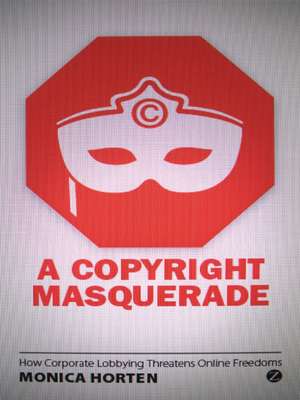
A Copyright Masquerade: How Corporate Lobbying Threatens Online Freedoms
Autor Monica Hortenen Limba Engleză Hardback – 8 aug 2013
This highly original analysis of three attempts to bring in new laws to defend copyright on the Internet - ACTA, Ley Sinde and the Digital Economy Act - investigates the dance of influence between lobbyists and their political proxies and unmasks the sophistry of their arguments. Copyright expert Monica Horten outlines the myriad ways that lobbyists contrived to bypass democratic process and persuade politicians to take up their cause in imposing an American corporate agenda. In doing so, she argues the case for stronger transparency in copyright policy-making.
A Copyright Masquerade is essential reading for anyone who cares about copyright and the Internet, and to those who care about freedom of speech and good government.
Preț: 523.73 lei
Preț vechi: 704.11 lei
-26%
Puncte Express: 786
Preț estimativ în valută:
92.69€ • 108.32$ • 80.47£
92.69€ • 108.32$ • 80.47£
Carte tipărită la comandă
Livrare economică 20 februarie-06 martie
Preluare comenzi: 021 569.72.76
Specificații
ISBN-13: 9781780326412
ISBN-10: 1780326416
Pagini: 304
Dimensiuni: 138 x 216 x 30 mm
Greutate: 0.5 kg
Ediția:New.
Editura: Bloomsbury Publishing
Colecția Zed Books
Locul publicării:London, United Kingdom
ISBN-10: 1780326416
Pagini: 304
Dimensiuni: 138 x 216 x 30 mm
Greutate: 0.5 kg
Ediția:New.
Editura: Bloomsbury Publishing
Colecția Zed Books
Locul publicării:London, United Kingdom
Cuprins
Introduction
Part I: Internet, entertainment and copyright: a political perspective
1. Copyright politics and the Internet: an introduction
2. Copyright and the Internet: what is at stake?
Part II: The American influence: America, ACTA and Special 301
3. Entertaining American objectives
4. A secret copyright treaty
5. Brussels copyfights
6. The EU masquerade
7. Special 301 for Spain
8. Ley Sinde
Part III: The politics of music: Britain and the Digital Economy Act
9. A memorandum with no understanding
10. Ministerial manoeuvres
11. Looking behind the myth
12. Musical lawyers
13. Obstacles in the Lords
14. A cowed Parliament
15. Lifting the masks
Part I: Internet, entertainment and copyright: a political perspective
1. Copyright politics and the Internet: an introduction
2. Copyright and the Internet: what is at stake?
Part II: The American influence: America, ACTA and Special 301
3. Entertaining American objectives
4. A secret copyright treaty
5. Brussels copyfights
6. The EU masquerade
7. Special 301 for Spain
8. Ley Sinde
Part III: The politics of music: Britain and the Digital Economy Act
9. A memorandum with no understanding
10. Ministerial manoeuvres
11. Looking behind the myth
12. Musical lawyers
13. Obstacles in the Lords
14. A cowed Parliament
15. Lifting the masks
Recenzii
A Copyright Masquerade can verge on academic, but it remains engaging. At times, the legislative history (and the scandal involved) even has elements of intrigue. But most importantly, it's extremely informative and demystifying, right from the first page's handy table of common acronyms. For those interested in the structures that influence copyright policy around the world, Horten's book will prove a valuable resource.
In this timely and well judged analysis, Horten demonstrates that the Internet age, far from transforming corporate politics has merely shifted the concerns of policy-makers and powerful private sectors interests. If there has been a change, as she establishes, it is in the inability of copyright politics to continue to be conducted in smoke-filled back rooms. This book allows us to be guardedly optimistic about the ability of political process to properly balance the legitimate rights of consumers and copyright holding corporations.
This brilliant exposé shows how corporations and industry lobbyists manipulate the governance of digital networks to their own advantage. Behind the rhetoric about "free markets" and the "openness" of the net lurks a power politics reminiscent of the opium wars. Horten provides a detailed, beautifully written case study of the way neo-liberalism routinely and cynically cancels out the very rights and freedoms - privacy, due process - its legitimacy depends upon, as soon as they threaten to impede the pursuit of profit. A must read for anyone interested in how the contemporary mediascape has been prestructured to favour corporations over individuals.
A Copyright Masquerade is an intriguing narrative about the ways that the copyright debate in the UK has been shaped by key stakeholders in their own interests to the point where it threatens online freedoms. This book is a compelling read for lawyers and others interested in the development of intellectual property law and it will stimulate important debates for years to come.
Anyone interested in the future of copyright law in the European Union and the role lobbyists and corporations play in shaping legislation should read this timely and provocative book.
In this timely and well judged analysis, Horten demonstrates that the Internet age, far from transforming corporate politics has merely shifted the concerns of policy-makers and powerful private sectors interests. If there has been a change, as she establishes, it is in the inability of copyright politics to continue to be conducted in smoke-filled back rooms. This book allows us to be guardedly optimistic about the ability of political process to properly balance the legitimate rights of consumers and copyright holding corporations.
This brilliant exposé shows how corporations and industry lobbyists manipulate the governance of digital networks to their own advantage. Behind the rhetoric about "free markets" and the "openness" of the net lurks a power politics reminiscent of the opium wars. Horten provides a detailed, beautifully written case study of the way neo-liberalism routinely and cynically cancels out the very rights and freedoms - privacy, due process - its legitimacy depends upon, as soon as they threaten to impede the pursuit of profit. A must read for anyone interested in how the contemporary mediascape has been prestructured to favour corporations over individuals.
A Copyright Masquerade is an intriguing narrative about the ways that the copyright debate in the UK has been shaped by key stakeholders in their own interests to the point where it threatens online freedoms. This book is a compelling read for lawyers and others interested in the development of intellectual property law and it will stimulate important debates for years to come.
Anyone interested in the future of copyright law in the European Union and the role lobbyists and corporations play in shaping legislation should read this timely and provocative book.