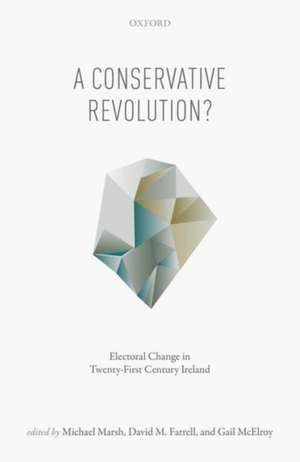
A Conservative Revolution?: Electoral Change in Twenty-First Century Ireland
Editat de Michael Marsh, David M. Farrell, Gail McElroyen Limba Engleză Hardback – 9 mar 2017
Preț: 710.17 lei
Preț vechi: 1030.65 lei
-31%
Puncte Express: 1065
Carte tipărită la comandă
Livrare economică 03-09 decembrie
Livrare prin curier în România Termenul estimat este afișat lângă disponibilitate.
Transport gratuit pentru acest produs Plată online sau ramburs, în funcție de opțiunile comenzii.
Retur gratuit în 14 zile Comandă securizată și suport în română.
Specificații
ISBN-13: 9780198744030
ISBN-10: 019874403X
Pagini: 276
Dimensiuni: 177 x 241 x 24 mm
Greutate: 0.55 kg
Editura: OUP OXFORD
Colecția OUP Oxford
Locul publicării:Oxford, United Kingdom
ISBN-10: 019874403X
Pagini: 276
Dimensiuni: 177 x 241 x 24 mm
Greutate: 0.55 kg
Editura: OUP OXFORD
Colecția OUP Oxford
Locul publicării:Oxford, United Kingdom
V-ar putea interesa
-
 NationalismJohn Hutchinson-12%Preț: 381.64 lei434.42 lei
 -
 The End of DaysGershom GorenbergPreț: 135.82 lei
 -
 -28%Preț: 451.34 lei630.96 lei
 -
 A New Handbook of Political ScienceRobert E. Goodin-30%Preț: 661.92 lei947.10 lei
 -
 -21%Preț: 506.53 lei643.61 lei
 -
 -28%Preț: 400.53 lei557.75 lei
 -
 Human Rights in Criminal ProceedingsStefan Trechsel-17%Preț: 736.90 lei883.19 lei
 -
 Autonomy and Rights: The Moral Foundations of LiberalismHoracio Spector-24%Preț: 212.27 lei280.95 lei
 -
 Political Parties and Democratic Linkage: How Parties Organize DemocracyRussell J. Dalton-11%Preț: 351.97 lei397.26 lei
 -
 -16%Preț: 206.77 lei247.34 lei
 -
 Electoral Systems: A Comparative IntroductionDavid M. Farrell-22%Preț: 278.78 lei356.29 lei
 -
 The Radical Imagination: Social Movement Research in the Age of AusterityDoctor Alex Khasnabish-22%Preț: 140.32 lei180.72 lei
 -
 How Ireland Voted 2016Michael GallagherPreț: 255.81 lei
 -
 Das Kapital im 21. JahrhundertThomas PikettyPreț: 260.17 lei
Notă biografică
Michael Marsh is a Member of the Royal Irish Academy and Emeritus Professor of Political Science in Trinity College University of Dublin. He has published over 100 professional articles and book chapters on parties, elections and public opinion, and was principal investigator for the 2002, 2007 and 2011 Irish National Election Studies, co-author of The Irish Voter (2008), as well as the last five books in the How Ireland Voted series, including How Ireland Voted 2016.David Farrell is a Member of the Royal Irish Academy and holds the Chair of Politics at University College Dublin. He was the co-investigator of the 2011 Irish National Election Study. His primary research interests are in the fields of party politics and electoral systems, with a recent interest in the politics of deliberation. His most recent books include: the award winning Political Parties and Democratic Linkage (2011) and The Act of Voting (2016). He is currently working on the third edition of Electoral Systems.Gail McElroy is Professor of Political Science and Head of the School of Social Sciences and Philosophy at Trinity College, Dublin. Primary research interests are in the fields of legislative behaviour and party politics. She is also actively involved in the Irish National Election Study and the Irish Candidates Study and recent published work in this area explores the continued under-representation of women in Irish politics. Her current work examines the differences in political ambition amongst Irish men and women and also the policy emphasis of men and women in the Dáil, as revealed in speeches.