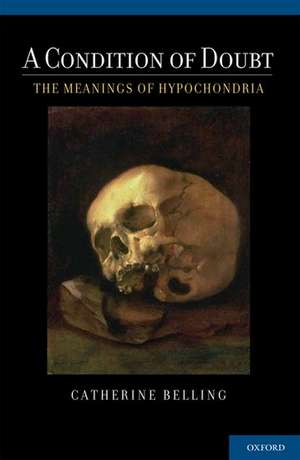
A Condition of Doubt: The Meanings of Hypochondria
Autor Catherine Bellingen Limba Engleză Hardback – 28 iun 2012
Preț: 703.90 lei
Preț vechi: 951.19 lei
-26%
Puncte Express: 1056
Carte tipărită la comandă
Livrare economică 27 noiembrie-08 decembrie
Livrare prin curier în România Termenul estimat este afișat lângă disponibilitate.
Transport gratuit pentru acest produs Plată online sau ramburs, în funcție de opțiunile comenzii.
Retur gratuit în 14 zile Comandă securizată și suport în română.
Specificații
ISBN-13: 9780199892365
ISBN-10: 0199892369
Pagini: 304
Dimensiuni: 157 x 236 x 25 mm
Greutate: 0.57 kg
Editura: Oxford University Press
Colecția OUP USA
Locul publicării:New York, United States
ISBN-10: 0199892369
Pagini: 304
Dimensiuni: 157 x 236 x 25 mm
Greutate: 0.57 kg
Editura: Oxford University Press
Colecția OUP USA
Locul publicării:New York, United States
V-ar putea interesa
-
 It's Probably NothingNaga Munchetty-5%Preț: 171.43 lei180.45 lei
 -
 ITS PROBABLY NOTHING EXAIIE PBNaga MunchettyPreț: 139.58 lei
 -
 Care and Cure: An Introduction to Philosophy of MedicineJacob Stegenga-5%Preț: 223.89 lei235.68 lei
 -
 Culture, Health and Illness, Fifth editionCecil G. Helman-5%Preț: 515.35 lei542.48 lei
 -
 Kumar and Clark's Clinical MedicineDavid Randall-26%Preț: 487.97 lei658.70 leiRecomandat
 -
 An Exercise in UncertaintyJonathan GluckPreț: 159.74 lei
 -
 The Divided MindJohn E. Sarno-17%Preț: 102.87 lei124.33 lei
 -
 -5%Preț: 360.45 lei379.42 lei
 -
 Unheard: The Medical Practice of Silencing, for fans of Elinor Cleghorn and Tilly RoseDr Rageshri Dhairyawan-30%Preț: 65.67 lei93.60 lei
 -
 -29%Preț: 86.91 lei123.03 lei
 -
 Making the Cut: How to Heal Modern MedicineAaron KheriatyPreț: 190.52 lei
 -
 HypochondriaWill ReesPreț: 100.40 lei
 -
 The Good Doctor: Why Medical Uncertainty MattersKenneth Brigham-23%Preț: 108.11 lei141.09 lei
 -
 The Imaginary PatientJules MontaguePreț: 77.93 lei
 -
 A Body Made of GlassCaroline Crampton-5%Preț: 75.34 lei79.30 lei
 -
 Blind SpotsMarty Makary-20%Preț: 96.21 lei120.59 lei
 -
 Preț: 157.41 lei
 -
 Doc or Quack: Science and Anti-Science in Modern MedicineSander L. Gilman-5%Preț: 140.44 lei147.83 lei
 -
 A Pragmatic Approach to Conceptualization of Health and DiseaseMaartje SchermerPreț: 339.26 lei
Recenzii
Belling draws on a wide range of references from medicine, philosophy and the arts in order to challenge the common belief that the condition is one of overcautious or catastrophic neuroticism.
Notă biografică
Born in South Africa, Catherine Belling came to the United States on a Fulbright grant to complete her PhD in English at Stony Brook University, New York, focusing on representations of medicine and the body in Renaissance drama. On graduating, she joined the medical school faculty at Stony Brook, as Associate Director of the Institute for Medicine in Contemporary Society, and in 2007 moved to Chicago to take up a position in the Medical Humanities and Bioethics program at Northwestern University's Feinberg School of Medicine in Chicago.