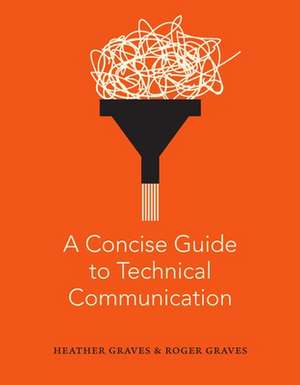
A Concise Guide to Technical Communication
Autor Heather Graves, Roger Gravesen Limba Engleză Paperback – 30 noi 2020
Preț: 380.90 lei
Puncte Express: 571
Carte disponibilă
Livrare economică 17 noiembrie-01 decembrie
Livrare express 03-07 noiembrie pentru 33.06 lei
Livrare prin curier în România Termenul estimat este afișat lângă disponibilitate.
Transport gratuit de la 400.00 lei Plată online sau ramburs, în funcție de opțiunile comenzii.
Retur gratuit în 14 zile Comandă securizată și suport în română.
Specificații
ISBN-13: 9781554815487
ISBN-10: 1554815487
Pagini: 176
Ilustrații: 10 illustrations
Dimensiuni: 178 x 229 x 10 mm
Greutate: 0.35 kg
Editura: BROADVIEW PR
Colecția Broadview Press
Locul publicării:Peterborough, Canada
ISBN-10: 1554815487
Pagini: 176
Ilustrații: 10 illustrations
Dimensiuni: 178 x 229 x 10 mm
Greutate: 0.35 kg
Editura: BROADVIEW PR
Colecția Broadview Press
Locul publicării:Peterborough, Canada
V-ar putea interesa
-
 Viral Marketing: The Science of SharingKaren Nelson-FieldPreț: 206.94 lei
 -
 -15%Preț: 665.80 lei783.29 lei
 -
 Rumors: Uses, Interpretation and NecessityJean-Noël KapfererPreț: 461.37 lei
 -
 Communicative Cities in the 21st CenturyMatthew D. Matsaganis-27%Preț: 1103.25 lei1511.31 lei
 -
 Preț: 379.66 lei
 -
 -26%Preț: 633.31 lei856.96 lei
 -
 Writing Assignments Across University DisciplinesRoger GravesPreț: 143.63 lei
 -
 -25%Preț: 468.84 lei624.57 lei
 -
 -25%Preț: 468.46 lei624.34 lei
 -
 Tell It Like It IsMary Eleanor TriecePreț: 200.32 lei
 -
 The Coordinated Management of Meaning: A Festschrift in Honor of W. Barnett PearceStephen W. Littlejohn-37%Preț: 660.78 lei1054.48 lei
 -
 Talk TalkMavis KleinPreț: 68.04 lei
 -
 CRACKLE AND FIZZBrul Caroline van DenPreț: 165.76 lei
 -
 European MeetingsAnna Sybilla BidwellPreț: 410.40 lei
 -
 Preț: 353.72 lei
 -
 Beziehungstraining: Ein Seminardesign für PR-PraktikerInnenJoachim E. WaldPreț: 358.42 lei
 -
 Preț: 416.68 lei
 -
 Preț: 216.86 lei
 -
 Preț: 219.18 lei
 -
 Preț: 285.50 lei
 -
 Online PR im Zeitalter von Social MediaKatharina WimmerPreț: 218.63 lei
 -
 Preț: 216.43 lei
 -
 Preț: 285.50 lei
 -
 Geschickt Platziert: Product Placement ALS WerbeformDanielle SprengnagelPreț: 291.15 lei
 -
 Die Krimiserie: Spannung Und Entspannung Zugleich?Danielle SprengnagelPreț: 242.60 lei
 -
 Preț: 398.01 lei
Recenzii
This compact but complete guide shows that less is more—with fewer extraneous details getting in the way of students trying to learn on the run, it allows them to focus on the most important principles of effective technical communication. The Concise Guide takes a rhetorical approach to technical communication; instead of setting up a list of rules that should be applied uniformly to all writing situations, it introduces students to the bigger picture of how the words they write can affect the people intended to read them. Assignments and exercises are integrated throughout to reinforce and test knowledge.
“A Concise Guide to Technical Communication packs so much into so few pages. The ten-chapter organization is perfect for courses on the quarter system or as a secondary text in STEM courses. The text covers all of the fundamentals, including visual and online communication and presentations. I like that both the concise and original texts put ethics up front in chapter 2. This concise edition has a visually clean page layout, making it easy to navigate the series of in-class exercises. Graves and Graves have written a clear and concise text, modeling the excellent writing techniques they present.” — Kelly A. Harrison, Stanford University
“Your concise format includes exactly the level of involvement my introductory Technical Communication course needs. Other textbooks have been of high quality, but it was challenging to fit so much material into a 15-week semester. Now, I can easily choose what to highlight within my timeframe—I'm picking from the best, most important elements. With 100 students, that is the incisiveness I NEED! Chapter PowerPoints and test questions save me so much time. With the supplemental blog and author's lively podcast, I feel like I have a private tutor guiding me through the text.” — Lane Rhodes, English Department, UNC Charlotte
“A Concise Guide to Technical Communication packs so much into so few pages. The ten-chapter organization is perfect for courses on the quarter system or as a secondary text in STEM courses. The text covers all of the fundamentals, including visual and online communication and presentations. I like that both the concise and original texts put ethics up front in chapter 2. This concise edition has a visually clean page layout, making it easy to navigate the series of in-class exercises. Graves and Graves have written a clear and concise text, modeling the excellent writing techniques they present.” — Kelly A. Harrison, Stanford University
“Your concise format includes exactly the level of involvement my introductory Technical Communication course needs. Other textbooks have been of high quality, but it was challenging to fit so much material into a 15-week semester. Now, I can easily choose what to highlight within my timeframe—I'm picking from the best, most important elements. With 100 students, that is the incisiveness I NEED! Chapter PowerPoints and test questions save me so much time. With the supplemental blog and author's lively podcast, I feel like I have a private tutor guiding me through the text.” — Lane Rhodes, English Department, UNC Charlotte
Cuprins
Preface
Note to Instructors
Note to Students
Acknowledgments
Chapter One: Audience, Purpose, Genre, and Medium
Note to Instructors
Note to Students
Acknowledgments
Chapter One: Audience, Purpose, Genre, and Medium
- What Is Technical Communication?
- How Does Technical Communication Differ from Other Types of Communication?
- Medium: When Does the Media Used for Communication Change It Substantially?
- Audience
- Purpose: Why Are You Writing?
- What Is Genre?
- Why Does Genre Matter?
- What Are Genre Sets?
- Ethics Frameworks
- Ethics for Students
- How Is Ethics Related to Technical Communication?
- Writing Ethically
- Primary Research: Interviewing
- Primary Research: Conducting Surveys
- Secondary Research: Libraries and Other Online Sources
- Summarizing and Citing Researched Sources
- Clarity, Cohesion, Concision
- Defining, Describing, and Explaining
- Using Visuals to Communicate Effectively
- Audience: Who Are Your Readers?
- Purpose: Goals for Workplace Communication
- Genre: Writing Short Messages (Email, Memos, Letters)
- Writing Messages
- Status or Progress Reports
- White Papers or Information Reports
- Recommendation Reports
- The Laboratory Report
- Use Structured Documentation
- Converting Documents to Portable Document File (PDF) Format
- Sharing Documents Electronically
- Shared Folders and Documents Posted Online
- Writing and Digital Media: Online Documents, Video, Screencasts, and Podcasts
- Common Speaking Occasions
- Common speaking occasions
- Small group presentations
- Formal speaking engagements
- Presentation slide that shows an example
- Guidelines for Preparing Presentations
- Guidelines for Creating Slides
- Guidelines for Giving Presentations