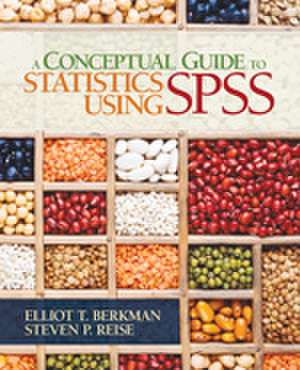
A Conceptual Guide to Statistics Using SPSS
Autor Elliot T. Berkman, Steven P. Reiseen Limba Engleză Paperback – 12 apr 2011
Putem afirma că A Conceptual Guide to Statistics Using SPSS reprezintă o resursă pedagogică rară, scrisă de Elliot T. Berkman și Steven P. Reise, experți cu o vastă experiență în predarea statisticii la nivel universitar. Elliot T. Berkman, laureat al premiului UCLA Distinguished Teaching Award, își fundamentează abordarea pe nevoia studenților de a înțelege nu doar „cum” să ruleze un test, ci și mecanismul conceptual din spatele numerelor afișate de software. Apreciem în mod deosebit modul în care lucrarea transformă procesul de învățare dintr-o simplă memorare de formule într-o înțelegere intuitivă a datelor. Cartea completează perspectiva oferită de A Guide for Statistical Tests and Interpretations with SPSS de Arshia U. Zaidi, adăugând o profunzime tehnică superioară prin capitolele despre algebra matriceală și utilizarea sintaxei pentru funcții avansate, elemente adesea omise în textele introductive. Structura este riguroasă și progresivă, pornind de la statistica descriptivă și testul Chi-pătrat, trecând prin corelații liniare și teste T, până la modele complexe precum ANOVA cu măsuri repetate (within-subject), modele mixte, MANOVA și ANCOVA. Un punct distinctiv este capitolul final dedicat contrastelor personalizate realizate prin sintaxă, oferind utilizatorului un control total asupra analizei. Credem că integrarea capturilor de ecran adnotate direct lângă explicațiile teoretice elimină confuzia frecventă generată de interpretarea output-ului SPSS, transformând acest manual într-un instrument de lucru indispensabil pentru cursuri de licență avansată și masterat.
Preț: 622.50 lei
Preț vechi: 732.36 lei
-15%
Carte tipărită la comandă
Livrare economică 03-17 decembrie
Specificații
ISBN-10: 1412974062
Pagini: 312
Dimensiuni: 191 x 235 x 17 mm
Greutate: 0.59 kg
Ediția:1
Editura: Sage Publications, Inc
Locul publicării:Thousand Oaks, United States
V-ar putea interesa
-
 Preț: 377.64 lei
 -
 InfluenceRobert CialdiniPreț: 374.96 lei
 -
 -29%Preț: 506.54 lei715.87 lei
 -
 -15%Preț: 456.37 lei536.90 lei
 -
 -5%Preț: 734.59 lei773.25 lei
 -
 -5%Preț: 725.30 lei763.47 lei
 -
 Handbook of Professional Ethics for PsychologistsWilliam O'Donohue-18%Preț: 946.13 lei1153.82 lei
 -
 Understanding and Using Statistics in PsychologyJeremy Miles-14%Preț: 688.71 lei800.83 lei
 -
 Item Response Theory for PsychologistsSusan E. Embretson-15%Preț: 479.39 lei563.98 lei
 -
 Diary MethodsJohn B. Nezlek-15%Preț: 634.82 lei746.85 lei
 -
 Research Methods and Design in PsychologyPaul RichardsonPreț: 302.06 lei
 -
 -5%Preț: 442.15 lei465.41 lei
De ce să citești această carte
Această carte se adresează studenților și cercetătorilor din științele sociale care doresc să stăpânească SPSS dincolo de interfața grafică. Cititorul câștigă o înțelegere conceptuală solidă a testelor statistice, învățând să interpreteze corect rezultatele și să utilizeze funcții avansate de sintaxă. Este alegerea ideală pentru cei care vor să facă tranziția de la simplul utilizator de software la un analist de date riguros.
Despre autor
Elliot T. Berkman este profesor asistent de psihologie și director al Laboratorului de Neuroștiințe Sociale și Afective de la Universitatea din Oregon. Cu o experiență de peste șase ani în predarea statisticii aplicate în SPSS pentru studenții de la nivel de studii aprofundate, Berkman a fost recunoscut pentru excelența sa pedagogică prin UCLA Distinguished Teaching Award și Arthur J. Woodward Peer Mentoring Award. Cercetările sale, publicate pe scară largă, explorează procesele neurale implicate în urmărirea obiectivelor, expertiza sa în metodologie fiind direct reflectată în claritatea și rigoarea acestui ghid conceptual.
Descriere scurtă
Sections explain the conceptual machinery underlying the statistical tests. In contrast to merely presenting the equations for computing the statistic, these sections describe the idea behind each test in plain language and help students make the connection between the ideas and SPSS procedures. These include extensive treatment of custom hypothesis testing in ANOVA, MANOVA, ANCOVA, and regression, and an entire chapter on the advanced matrix algebra functions available only through syntax in SPSS.
The book will be appropriate for both advanced undergraduate and graduate level courses in statistics.
Recenzii
“I think the tone is excellent and like the way that the author explained the concepts in an efficient way. The main advantage of this book over its competitors is its scope and coverage of both “point and click” and syntax methods for using SPSS. I do prefer this style to the texts I’ve used in the past, but I find it easier to write my own lab guides and post them on the course’s e-learning page.”
"In my view the text is written in a user friendly language and illustrates concepts that would otherwise be confusing to beginning students and those with limited computer skills. Increasingly there are non-traditional students who are entering the education pipelines who need precise resources to guide them in accomplishing the tasks they need to without going through.”
“I think the single most impressive aspect is the bridge between the practical and conceptual/theoretical. The author has done a nice job with this. I also like some of the things he mentions (“tidbits”) that are normally not mentioned in texts like this. I believe these two things distinguish it from other like texts. Adopt: Very likely. As I said earlier, I’ve been looking for something like this. So, it would definitely go further than any other book I know in fulfilling that need.”
Cuprins
2. Descriptive Statistics
3. Chi-Squared Test
4. Linear Correlation
5. One- and Two Sample T-Tests
6. One-way ANOVA
7. Two- and Higher-way ANOVA
8. Within-subject ANOVA
9. Mixed-model ANOVA
10. MANOVA
11. Regression
12. ANCOVA
13. Factor and Components Analysis
14. Psychometrics
15. Non-parametric Tests
16. Matrix Algebra
17. Appendix on the General Formulation of Custom Contrasts using Syntax