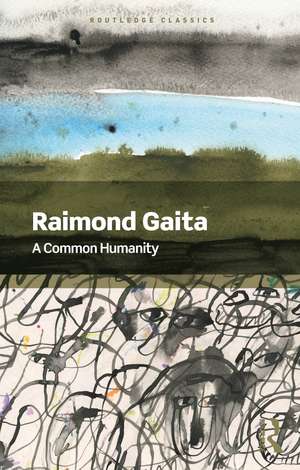
A Common Humanity: Thinking About Love and Truth and Justice: Routledge Classics
Autor Raimond Gaitaen Limba Engleză Paperback – 15 sep 2025
Gaita asserts that our conception of humanity cannot be based upon the thin language of individual rights when it is our shared feelings of grief, hope, love, guilt, shame and remorse that offer a more potent foundation for common understanding.
Drawing on the work of Hannah Arendt, Simone Weil, Primo Levi and Iris Murdoch, amongst others, Gaita creates a beautifully written and provocative new picture of our common humanity.
This Routledge Classics edition includes a new Preface and a substantial Afterword by the author, in which he revisits some of the main themes of A Common Humanity and engages with responses to it since it was first published.
| Toate formatele și edițiile | Preț | Express |
|---|---|---|
| Paperback (1) | 370.53 lei 3-5 săpt. | |
| Taylor & Francis – 18 ian 2002 | 370.53 lei 3-5 săpt. | |
| Paperback (1) | 120.42 lei 3-5 săpt. | +0.00 lei 6-12 zile |
| Taylor & Francis – 15 sep 2025 | 120.42 lei 3-5 săpt. | +0.00 lei 6-12 zile |
| Hardback (1) | 1017.53 lei 3-5 săpt. | |
| Taylor & Francis – 25 aug 2000 | 1017.53 lei 3-5 săpt. |
Din seria Routledge Classics
-
 Preț: 151.38 lei
 - 17%
 Preț: 106.07 lei
 - 18%
 Preț: 91.51 lei
 - 18%
 Preț: 91.11 lei
 - 29%
 Preț: 561.53 lei
 - 29%
 Preț: 815.61 lei
 - 18%
 Preț: 90.69 lei
 - 18%
 Preț: 91.42 lei
 - 23%
 Preț: 91.45 lei
 - 14%
 Preț: 156.29 lei
 - 29%
 Preț: 546.00 lei
 - 29%
 Preț: 541.77 lei
 - 18%
 Preț: 103.40 lei
 - 29%
 Preț: 560.25 lei
 - 29%
 Preț: 555.69 lei
 - 22%
 Preț: 120.83 lei
 - 29%
 Preț: 560.61 lei
 - 29%
 Preț: 557.84 lei
 - 18%
 Preț: 83.88 lei
 - 18%
 Preț: 103.97 lei
 - 29%
 Preț: 547.30 lei
 - 29%
 Preț: 551.37 lei
 - 29%
 Preț: 556.37 lei
 - 16%
 Preț: 121.47 lei
 - 29%
 Preț: 557.84 lei
 - 29%
 Preț: 609.62 lei
 - 29%
 Preț: 573.08 lei
 - 17%
 Preț: 132.51 lei
 - 29%
 Preț: 557.28 lei
 - 29%
 Preț: 560.61 lei
 - 17%
 Preț: 120.96 lei
 - 29%
 Preț: 679.55 lei
 - 29%
 Preț: 545.09 lei
 - 19%
 Preț: 82.52 lei
 - 29%
 Preț: 556.51 lei
 - 18%
 Preț: 117.13 lei
 - 29%
 Preț: 558.40 lei
 - 18%
 Preț: 116.93 lei
 - 28%
 Preț: 577.58 lei
 - 18%
 Preț: 104.80 lei
 - 29%
 Preț: 570.26 lei
 - 29%
 Preț: 560.05 lei
 - 29%
 Preț: 560.61 lei
 - 24%
 Preț: 89.12 lei
 - 18%
 Preț: 89.78 lei
 - 29%
 Preț: 616.45 lei
 - 17%
 Preț: 146.40 lei
Preț: 120.42 lei
Preț vechi: 144.59 lei
-17%
Puncte Express: 181
Preț estimativ în valută:
21.31€ • 24.91$ • 18.50£
21.31€ • 24.91$ • 18.50£
Carte disponibilă
Livrare economică 30 ianuarie-13 februarie
Livrare express 15-21 ianuarie pentru 173.29 lei
Preluare comenzi: 021 569.72.76
Specificații
ISBN-13: 9781032912295
ISBN-10: 1032912294
Pagini: 388
Dimensiuni: 129 x 198 x 21 mm
Greutate: 0.42 kg
Ediția:1
Editura: Taylor & Francis
Colecția Routledge
Seria Routledge Classics
Locul publicării:Oxford, United Kingdom
ISBN-10: 1032912294
Pagini: 388
Dimensiuni: 129 x 198 x 21 mm
Greutate: 0.42 kg
Ediția:1
Editura: Taylor & Francis
Colecția Routledge
Seria Routledge Classics
Locul publicării:Oxford, United Kingdom
V-ar putea interesa
-
 Understanding Human AgencyErasmus Mayr-22%Preț: 661.16 lei845.27 lei
 -
 -21%Preț: 394.49 lei500.47 lei
 -
 Reflections On How We LiveAnnette BaierPreț: 315.06 lei
 -
 Practical Intelligence and the VirtuesDaniel C. RussellPreț: 354.32 lei
 -
 Sidgwickian EthicsDavid Phillips-14%Preț: 626.99 lei729.06 lei
 -
 Moral Responsibility in Collective ContextsTracy Isaacs-7%Preț: 626.17 lei675.68 lei
 -
 Preț: 324.59 lei
 -
 Gadamer in ConversationHans-Georg GadamerPreț: 229.76 lei
 -
 -37%Preț: 1902.78 lei3011.81 lei
 -
 -34%Preț: 351.93 lei534.24 lei
 -
 Living Philosophy: An Introduction to Moral ThoughtRay Billington-29%Preț: 271.86 lei380.27 lei
 -
 Good and Evil: An Absolute ConceptionRaimond Gaita-20%Preț: 273.30 lei340.33 lei
 -
 -30%Preț: 1672.15 lei2376.33 lei
 -
 Arguing about MetaethicsAndrew Fisher-15%Preț: 315.35 lei368.92 lei
 -
 Ethical Issues in PsychologyPhilip Banyard-20%Preț: 197.00 lei245.69 lei
 -
 Ethics and War in the 21st CenturyChristopher Coker-17%Preț: 306.30 lei368.72 lei
 -
 Ethics: Essential Readings in Moral TheoryGeorge Sher-25%Preț: 513.22 lei683.44 lei
Public țintă
General, Postgraduate, Undergraduate Advanced, and Undergraduate CoreCuprins
Preface to the Routledge Classics Edition Acknowledgements Preface 1. Introduction 2. Goodness beyond Virtue 3. Evil beyond Vice 4. Racism 5. Justice beyond Fairness 6. Guilt, Shame and Community 7. Genocide and 'The Stolen Generations' 8. Genocide and the Holocaust 9. Forms of the Unthinkable 10. Truth and the Responsibility of Intellectuals 11. Goodness and Truth 12. Truth As a Need of the Soul 13. A Common Humanity. Postscript to the Routledge Classics Edition Bibliography Index
Recenzii
'An exploration of how people make moral and ethical judgments by a controversial Autralian moral philosopher. Raimond Gaita's insights are original and his prose is as eloquent as it is affecting.' - The Economist, Books of the Year, 2000
'Gaita's genius ... is his ability to weigh the soul on a scale, and to show how goodness and justice might yet prevail.' - The Scotsman
'Profound and original ... his humane and wise book offers a view on life which deserves to be taken seriously.' - The Times Literary Supplement
'Gaita's gait bedazzles. In both writing and content, there appear senstivity, significance and feeling ... Wittgenstein advises 'Take your time'. I advise such with the issues of this book.' - The Philosophers' Magazine
'A striking and revelatory read ... I warmly recommend it.' - Timothy Chapell, Mind
'Distinctive and very interesting.' - The Tablet
'A Rare and distinguished contribution to our public life.' - Australian Review
'This Philosophy for the educated public is philosophy at its most profound' - Jean Curthoys, Australian Book Review
'The reflections in it are first hand: the author does not follow the beaten tracks and he is someone who has something to say. His book is one of the rare books in philosophy which has both breadth and depth at one and the same time' - Ilham Dilman, Philosophical Investigations
'The trenchant beauty of the discussion, the courage and independence of the mind at work, are a magnificent accomplishment.' - Andrew Gleeson, Philosophical Books
'An absorbing read from beginning to end ... A quite exceptional work.' - Tim Crane, Central European University, Austria
'A wise and beautifully written book. It is a wonderful example of how philosophy can still speak without any condescension to the educated reader.' - Simon Critchley, New School for Social Research, USA
'A wonderful piece of writing. The disciplined individuality of Gaita's voice shows how a humanly serious practice of philosophy might make a decisive contribution to our public culture.' - Stephen Mulhall, University of Oxford, UK
'An exploration of how people make moral and ethical judgments by a controversial Australian moral philosopher. Raimond Gaita's insights are original and his prose is as eloquent as it is affecting.' - The Economist, Books of the Year, 2000
'Gaita's genius ... is his ability to weigh the soul on a scale, and to show how goodness and justice might yet prevail.' - The Scotsman
'Profound and original ... his humane and wise book offers a view on life which deserves to be taken seriously.' —The Times Literary Supplement
'Gaita's gait bedazzles. In both writing and content, there appear sensitivity, significance and feeling ... Wittgenstein advises "Take your time". I advise such with the issues of this book.' —The Philosophers' Magazine
'A striking and revelatory read ... I warmly recommend it.' —Sophie Grace Chappell, Mind
'Even now, fifty years after the holocaust, it is still rare to find a philosopher prepared to engage deeply with the question of serious evil, and indeed of serious goodness … [Gaita's essays] are large and elegant constructions … illuminated by a sensitive and patient scrutiny, and inspired by a passionate intensity. Moral philosophy is at last beginning to recover its centre.' —E.M. Atkins, New Blackfriars
'A rare and distinguished contribution to our public life.' —Australian Review
'This philosophy for the educated public is philosophy at its most profound' —Jean Curthoys, Australian Book Review
'The reflections in it are first hand: the author does not follow the beaten tracks and he is someone who has something to say. His book is one of the rare books in philosophy which has both breadth and depth at one and the same time' —Ilham Dilman, Philosophical Investigations
'The trenchant beauty of the discussion, the courage and independence of the mind at work, are a magnificent accomplishment.' —Andrew Gleeson, Philosophical Books
'An absorbing read from beginning to end ... A quite exceptional work.' —Tim Crane, Central European University, Austria
'A wise and beautifully written book. It is a wonderful example of how philosophy can still speak without any condescension to the educated reader.' —Simon Critchley, New School for Social Research, USA
'A wonderful piece of writing. The disciplined individuality of Gaita's voice shows how a humanly serious practice of philosophy might make a decisive contribution to our public culture.'
—Stephen Mulhall, University of Oxford, UK
'In these elegantly constructed essays … Gaita’s reflections [show] deep sensitivity to moral life, or, as I would like to say, but Gaita would not, to the nature and deliverances of an informed and sensitive moral phenomenology. For … this and for much else in this engrossing and provocative book, Gaita deserves our thanks.' —Australasian Journal of Philosophy
'Gaita's genius ... is his ability to weigh the soul on a scale, and to show how goodness and justice might yet prevail.' - The Scotsman
'Profound and original ... his humane and wise book offers a view on life which deserves to be taken seriously.' - The Times Literary Supplement
'Gaita's gait bedazzles. In both writing and content, there appear senstivity, significance and feeling ... Wittgenstein advises 'Take your time'. I advise such with the issues of this book.' - The Philosophers' Magazine
'A striking and revelatory read ... I warmly recommend it.' - Timothy Chapell, Mind
'Distinctive and very interesting.' - The Tablet
'A Rare and distinguished contribution to our public life.' - Australian Review
'This Philosophy for the educated public is philosophy at its most profound' - Jean Curthoys, Australian Book Review
'The reflections in it are first hand: the author does not follow the beaten tracks and he is someone who has something to say. His book is one of the rare books in philosophy which has both breadth and depth at one and the same time' - Ilham Dilman, Philosophical Investigations
'The trenchant beauty of the discussion, the courage and independence of the mind at work, are a magnificent accomplishment.' - Andrew Gleeson, Philosophical Books
'An absorbing read from beginning to end ... A quite exceptional work.' - Tim Crane, Central European University, Austria
'A wise and beautifully written book. It is a wonderful example of how philosophy can still speak without any condescension to the educated reader.' - Simon Critchley, New School for Social Research, USA
'A wonderful piece of writing. The disciplined individuality of Gaita's voice shows how a humanly serious practice of philosophy might make a decisive contribution to our public culture.' - Stephen Mulhall, University of Oxford, UK
'An exploration of how people make moral and ethical judgments by a controversial Australian moral philosopher. Raimond Gaita's insights are original and his prose is as eloquent as it is affecting.' - The Economist, Books of the Year, 2000
'Gaita's genius ... is his ability to weigh the soul on a scale, and to show how goodness and justice might yet prevail.' - The Scotsman
'Profound and original ... his humane and wise book offers a view on life which deserves to be taken seriously.' —The Times Literary Supplement
'Gaita's gait bedazzles. In both writing and content, there appear sensitivity, significance and feeling ... Wittgenstein advises "Take your time". I advise such with the issues of this book.' —The Philosophers' Magazine
'A striking and revelatory read ... I warmly recommend it.' —Sophie Grace Chappell, Mind
'Even now, fifty years after the holocaust, it is still rare to find a philosopher prepared to engage deeply with the question of serious evil, and indeed of serious goodness … [Gaita's essays] are large and elegant constructions … illuminated by a sensitive and patient scrutiny, and inspired by a passionate intensity. Moral philosophy is at last beginning to recover its centre.' —E.M. Atkins, New Blackfriars
'A rare and distinguished contribution to our public life.' —Australian Review
'This philosophy for the educated public is philosophy at its most profound' —Jean Curthoys, Australian Book Review
'The reflections in it are first hand: the author does not follow the beaten tracks and he is someone who has something to say. His book is one of the rare books in philosophy which has both breadth and depth at one and the same time' —Ilham Dilman, Philosophical Investigations
'The trenchant beauty of the discussion, the courage and independence of the mind at work, are a magnificent accomplishment.' —Andrew Gleeson, Philosophical Books
'An absorbing read from beginning to end ... A quite exceptional work.' —Tim Crane, Central European University, Austria
'A wise and beautifully written book. It is a wonderful example of how philosophy can still speak without any condescension to the educated reader.' —Simon Critchley, New School for Social Research, USA
'A wonderful piece of writing. The disciplined individuality of Gaita's voice shows how a humanly serious practice of philosophy might make a decisive contribution to our public culture.'
—Stephen Mulhall, University of Oxford, UK
'In these elegantly constructed essays … Gaita’s reflections [show] deep sensitivity to moral life, or, as I would like to say, but Gaita would not, to the nature and deliverances of an informed and sensitive moral phenomenology. For … this and for much else in this engrossing and provocative book, Gaita deserves our thanks.' —Australasian Journal of Philosophy
Notă biografică
Raimond Gaita is an Australian philosopher and writer. He is Professorial Fellow at the Melbourne Law School and Faculty of Arts, University of Melbourne, and Emeritus Professor of Moral Philosophy, King's College London. His books The Philosopher's Dog and Beyond Good and Evil: an Absolute Conception are both available from Routledge.
Descriere
Drawing on the work of Arendt, Weil, Primo Levi and Iris Murdoch, amongst others, Raimond Gaita creates a beautifully written and provocative new picture of our common humanity. This Routledge Classics edition includes a new Preface and a substantial Postscript by the author.