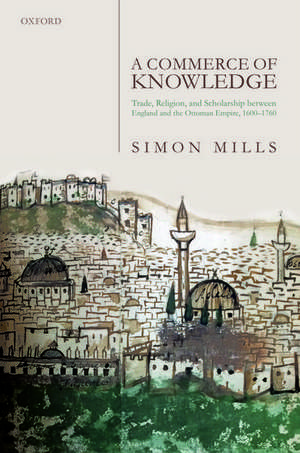
A Commerce of Knowledge: Trade, Religion, and Scholarship between England and the Ottoman Empire, 1600-1760
Autor Simon Millsen Limba Engleză Hardback – 20 ian 2020
Preț: 763.39 lei
Preț vechi: 1097.68 lei
-30%
Puncte Express: 1145
Carte tipărită la comandă
Livrare economică 04-15 decembrie
Livrare prin curier în România Termenul estimat este afișat lângă disponibilitate.
Transport gratuit pentru acest produs Plată online sau ramburs, în funcție de opțiunile comenzii.
Retur gratuit în 14 zile Comandă securizată și suport în română.
Specificații
ISBN-13: 9780198840336
ISBN-10: 0198840330
Pagini: 354
Ilustrații: 15 black and white figures/illustrations
Dimensiuni: 161 x 232 x 26 mm
Greutate: 0.69 kg
Editura: OUP OXFORD
Colecția OUP Oxford
Locul publicării:Oxford, United Kingdom
ISBN-10: 0198840330
Pagini: 354
Ilustrații: 15 black and white figures/illustrations
Dimensiuni: 161 x 232 x 26 mm
Greutate: 0.69 kg
Editura: OUP OXFORD
Colecția OUP Oxford
Locul publicării:Oxford, United Kingdom
V-ar putea interesa
-
 The Great SeaDavid Abulafia-21%Preț: 116.28 lei146.70 lei
 -
 Shakespeare: A LifePark Honan-18%Preț: 130.45 lei158.94 lei
 -
 Preț: 382.49 lei
 -
 The Republic of Arabic LettersAlexander Bevilacqua-13%Preț: 394.35 lei453.28 lei
 -
 The Unseen BritannicSimon MillsPreț: 193.81 lei
 -
 The Dictionary of Modern HerbalismSimon MillsPreț: 104.50 lei
 -
 Song of HiroshimaAtsuhiro OzakiPreț: 111.80 lei
 -
 The Higaonon Ethnohistory of Rogongon, Lanao del NorteCecilia TangianPreț: 96.02 lei
 -
 The Only CandleSayed Isaq RehaPreț: 98.42 lei
 -
 REALITIES OF AZERBAIJAN 1917-1920Anar IsgenderliPreț: 98.26 lei
 -
 Exploring the BritannicSimon Mills-28%Preț: 156.22 lei218.18 lei
 -
 -26%Preț: 162.60 lei220.91 lei
 -
 Six Covenants of the Prophet Muhammad with the Christians of His TimeMuhammad Ibn 'Abd AllahPreț: 75.22 lei
 -
 -29%Preț: 344.18 lei483.26 lei
 -
 Sustainable Cities: Inspirational Case StudiesSimon Mills-18%Preț: 1107.74 lei1350.89 lei
 -
 Du traité de LunévilleLouis-Auguste-Félix de BeaujourPreț: 79.76 lei
 -
 Paris-France et la frontière intérieureJoseph-Gabriel-Ma de Beaumont-RochemurePreț: 86.37 lei
 -
 Histoire authentique de la Commune de Paris en 1871, ses origines, son règne, sa chuteEdouard Ferdinand De La Beaumont-VassyPreț: 182.51 lei
 -
 Guerre de 1878-71. Les Dernières campagnes dans l'EstCharles BeauquierPreț: 162.28 lei
 -
 Preț: 72.65 lei
 -
 Des Constitutions de la France et du système politique de l'empereur NapoléonEdmond Petit BeauvergerPreț: 192.61 lei
 -
 Preț: 223.41 lei
 -
 Preț: 246.33 lei
 -
 Preț: 254.45 lei
 -
 Les mobilisés du NordColonel H BelPreț: 79.38 lei
 -
 L'Empire Et La Révolution (2e Édition)H -Marie MartinPreț: 79.38 lei
 -
 Discours Prononcé À La Société Des Amis de la ConstitutionCharles De PeyssonnelPreț: 79.38 lei
Recenzii
The book is a fascinating example of how the confluence of commercial, religious, and scholarly interests could utmostly sustain the creation of new knowledge on different cultures.
Written in clear prose, A Commerce of Knowledge offers an informative account of the scholarly pursuits of English orientalist scholars in Ottoman Aleppo by shedding light on ongoing commercial activities in the city. It is an important contribution to the history of early modern orientalism from an often neglected point of view ... an engrossing read, especially suitable for specialists working on humanist scholarship, early modern orientalism and the early English missions in the Middle East.
A Commerce of Knowledge provides a new basis from which the intellectual traditions and connections between England and the wider world can be understood, while placing local interests and actors in their rightful place in these narratives.
It is based on an astonishingly wide acquaintance with both primary and secondary sources, as a glance at the bibliography (277-315) will confirm, and these are faithfully recorded in the (often voluminous) footnotes...numerous and weighty contributions to our knowledge and understanding of the complex of trade, scholarship, missionary work, and exploration between Europe and the Ottoman Empire...Everyone with a serious interest in any of those aspects will learn much from this book.
This book is constructed around the careers at Aleppo of the chaplains to the Levant Company in that city from the late sixteenth to the later eighteenth centuries. However, it is not a series of biographies, but rather an attempt to place their activities in the context of the historical and social milieux, and to relate them to contemporary interests and aspirations. The 'Commerce' of the title is a key to the author's approach.
The book marshals a marvelously detailed series of individually important case studies in order to fill out traditional lines of inquiry in the historiography of European scholarship and religion. Even more importantly, the book lends empirical support to general arguments that have been recently made by historians who, like Mills, favor an approach to questions about humanistic scholarship between the late Renaissance and early Enlightenment that is grounded in the study of practices and institutions.
It is a work that I find inspiring and that I hope will serve as an inspiration to others.
Written in clear prose, A Commerce of Knowledge offers an informative account of the scholarly pursuits of English orientalist scholars in Ottoman Aleppo by shedding light on ongoing commercial activities in the city. It is an important contribution to the history of early modern orientalism from an often neglected point of view ... an engrossing read, especially suitable for specialists working on humanist scholarship, early modern orientalism and the early English missions in the Middle East.
A Commerce of Knowledge provides a new basis from which the intellectual traditions and connections between England and the wider world can be understood, while placing local interests and actors in their rightful place in these narratives.
It is based on an astonishingly wide acquaintance with both primary and secondary sources, as a glance at the bibliography (277-315) will confirm, and these are faithfully recorded in the (often voluminous) footnotes...numerous and weighty contributions to our knowledge and understanding of the complex of trade, scholarship, missionary work, and exploration between Europe and the Ottoman Empire...Everyone with a serious interest in any of those aspects will learn much from this book.
This book is constructed around the careers at Aleppo of the chaplains to the Levant Company in that city from the late sixteenth to the later eighteenth centuries. However, it is not a series of biographies, but rather an attempt to place their activities in the context of the historical and social milieux, and to relate them to contemporary interests and aspirations. The 'Commerce' of the title is a key to the author's approach.
The book marshals a marvelously detailed series of individually important case studies in order to fill out traditional lines of inquiry in the historiography of European scholarship and religion. Even more importantly, the book lends empirical support to general arguments that have been recently made by historians who, like Mills, favor an approach to questions about humanistic scholarship between the late Renaissance and early Enlightenment that is grounded in the study of practices and institutions.
It is a work that I find inspiring and that I hope will serve as an inspiration to others.
Notă biografică
Simon Mills is a Teaching Fellow in British and European History, 1500-1800 at Newcastle University. He received his PhD from Queen Mary University of London in 2009, and held a series of research fellowships at the Council for British Research in the Levant, Amman; the Centre for Research in the Arts, Social Sciences, and Humanities (CRASSH), University of Cambridge; and the Dahlem Humanities Centre, Freie Universität Berlin. Between 2014 and 2017, he was a Leverhulme Early Career Fellow at the University of Kent. His interests lie in the religious, cultural, and intellectual history of early modern Britain and Europe, with a particular focus on the relationship between Europe and the Ottoman Empire, the histories of biblical and oriental studies, and the history of philosophy.