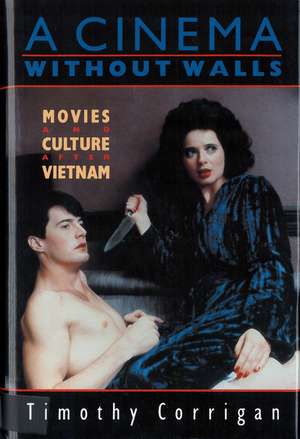
A Cinema Without Walls: Movies and Culture after Vietnam
Autor Professor Timothy Corriganen Limba Engleză Paperback – sep 1991
"One of the sharpest and most productive analyses of our contemporaneity and the place of cinema within it and of our new historical relations as spectators to the imaginary universe on the movie screen. This is a study that will be of intense interest to film theorists and historians, cultural critics, mass media analysts, and anyone concerned with the complicated place of culture in our world today."--Dana Polan, English and Film Studies, University of Pittsburgh
How have modern advertising techniques, the widespread use of VCRs, conglomerate takeovers of studios and film archives, cable TV, and media coverage of the Vietnam war changed the ways we watch movies? And how, in turn, have those different habits and patterns of viewing changed the ways in which films address their viewers? Drawing on a wide variety of American and European films and on many theoretical models, Timothy Corrigan investigates what he calls "a cinema without walls," taking a close look at particular films in order to see how we watch them differently in the post-Vietnam era. He examines cult audiences, narrative structure, genre films (road movies, in particular), and contemporary politics as they engage new models of film making and viewing. He thus provides a rare, serious attempt to deal with contemporary movies. Corrigan discusses filmmakers from a variety of backgrounds and cultures, including Martin Scorsese, Raoul Ruiz, Michael Cimino, Alexander Kluge, Francis Ford Coppola, Stephen Frears, and Wim Wenders. He offers detailed analyses of films such as Platoon; Full Metal Jacket; 9-1/2 Weeks; The Singing Detective; Choose Me; After Hours; Badlands; The King of Comedy; Paris, Texas; and My Beautiful Laundrette. Orchestrating this diversity, Corrigan provides a critical basis for making sense of contemporary film culture and its major achievements.
How have modern advertising techniques, the widespread use of VCRs, conglomerate takeovers of studios and film archives, cable TV, and media coverage of the Vietnam war changed the ways we watch movies? And how, in turn, have those different habits and patterns of viewing changed the ways in which films address their viewers? Drawing on a wide variety of American and European films and on many theoretical models, Timothy Corrigan investigates what he calls "a cinema without walls," taking a close look at particular films in order to see how we watch them differently in the post-Vietnam era. He examines cult audiences, narrative structure, genre films (road movies, in particular), and contemporary politics as they engage new models of film making and viewing. He thus provides a rare, serious attempt to deal with contemporary movies. Corrigan discusses filmmakers from a variety of backgrounds and cultures, including Martin Scorsese, Raoul Ruiz, Michael Cimino, Alexander Kluge, Francis Ford Coppola, Stephen Frears, and Wim Wenders. He offers detailed analyses of films such as Platoon; Full Metal Jacket; 9-1/2 Weeks; The Singing Detective; Choose Me; After Hours; Badlands; The King of Comedy; Paris, Texas; and My Beautiful Laundrette. Orchestrating this diversity, Corrigan provides a critical basis for making sense of contemporary film culture and its major achievements.
Preț: 303.16 lei
Puncte Express: 455
Carte tipărită la comandă
Livrare economică 03-17 decembrie
Livrare prin curier în România Termenul estimat este afișat lângă disponibilitate.
Transport gratuit de la 400.00 lei Plată online sau ramburs, în funcție de opțiunile comenzii.
Retur gratuit în 14 zile Comandă securizată și suport în română.
Specificații
ISBN-13: 9780813516684
ISBN-10: 0813516684
Pagini: 272
Dimensiuni: 152 x 222 x 18 mm
Greutate: 0.45 kg
Ediția:None
Editura: Rutgers University Press
Colecția Rutgers University Press
ISBN-10: 0813516684
Pagini: 272
Dimensiuni: 152 x 222 x 18 mm
Greutate: 0.45 kg
Ediția:None
Editura: Rutgers University Press
Colecția Rutgers University Press
V-ar putea interesa
-
 -25%Preț: 208.80 lei280.21 lei
 -
 The Essay Film: From Montaigne, After MarkerTimothy Corrigan-12%Preț: 364.59 lei413.43 lei
 -
 The Oxford Handbook of Dance and the Popular ScreenMelissa Blanco Borelli-14%Preț: 1049.52 lei1220.37 lei
 -
 Lady in the Dark – Iris Barry and the Art of FilmRobert SittonPreț: 374.20 lei
 -
 Preț: 261.98 lei
 -
 Designing Sound: Audiovisual Aesthetics in 1970s American CinemaProfessor Jay BeckPreț: 295.62 lei
 -
 Moment of Action: Riddles of Cinematic PerformanceMurray PomerancePreț: 278.92 lei
 -
 Preț: 290.76 lei
 -
 Preț: 280.06 lei
 -
 Coleridge, Language and CriticismTimothy CorriganPreț: 232.16 lei
 -
 Picture ThisMolly Bang-13%Preț: 121.41 lei139.76 lei
Recenzii
"One of the sharpest and most productive analyses of our contemporaneity and the place of cinema within it and of our new historical relations as spectators to the imaginary universe on the movie screen. This is a study that will be of intense interest to film theorists and historians, cultural critics, mass media analysts, and anyone concerned with the complicated place of culture in our world today."
Descriere
"One of the sharpest and most productive analyses of our contemporaneity and the place of cinema within it and of our new historical relations as spectators to the imaginary universe on the movie screen. This is a study that will be of intense interest to film theorists and historians, cultural critics, mass media analysts, and anyone concerned with the complicated place of culture in our world today."--Dana Polan, English and Film Studies, University of Pittsburgh How have modern advertising techniques, the widespread use of VCRs, conglomerate takeovers of studios and film archives, cable TV, and media coverage of the Vietnam war changed the ways we watch movies? And how, in turn, have those different habits and patterns of viewing changed the ways in which films address their viewers? Drawing on a wide variety of American and European films and on many theoretical models, Timothy Corrigan investigates what he calls "a cinema without walls," taking a close look at particular films in order to see how we watch them differently in the post-Vietnam era. He examines cult audiences, narrative structure, genre films (road movies, in particular), and contemporary politics as they engage new models of film making and viewing. He thus provides a rare, serious attempt to deal with contemporary movies. Corrigan discusses filmmakers from a variety of backgrounds and cultures, including Martin Scorsese, Raoul Ruiz, Michael Cimino, Alexander Kluge, Francis Ford Coppola, Stephen Frears, and Wim Wenders. He offers detailed analyses of films such as Platoon; Full Metal Jacket; 9-1/2 Weeks; The Singing Detective; Choose Me; After Hours; Badlands; The King of Comedy; Paris, Texas; and My Beautiful Laundrette. Orchestrating this diversity, Corrigan provides a critical basis for making sense of contemporary film culture and its major achievements. Timothy Corrigan is a professor of English and film at Temple University. He is the author of Writing about Film and New German Film: The Displaced Image, and editor of The Films of Werner Herzog: Between Mirage and History.