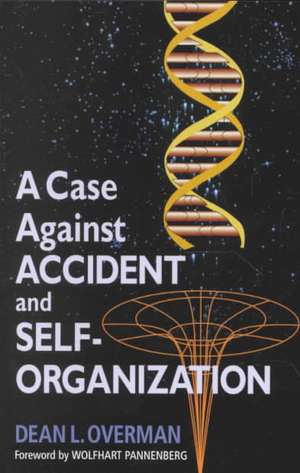
A Case Against Accident and Self-organization
Autor Dean L. Overmanen Limba Engleză Paperback – 11 apr 2001
Is it mathematically possible that accidental processes caused the formation of the first form of living matter from non-living matter? Could accidental processes have caused the formation of a universe compatible with life? Are current self-organization scenarios for the formation of the first living matter plausible? Overman reviews the influence of metaphysical assumptions in logical analysis, and discusses the principles of logic applicable to these questions, examining the limitations of verbal and mathematical logic. He proceeds to demonstrate that it is mathematically impossible that accidental processes produced the first living matter. The author also examines other issues related to the creation of the universe, including Stephen Hawking's no boundary proposal, the need for a Creator as the preserving cause of the universe, and the explanations offered by the weak and strong anthropic principles. Acclaimed by theologians and scientists alike as well-argued, coherent, and persuasive, A Case Against Accicdent and Self-Organization is a fascinating study of the origins of life and our universe.
Preț: 138.10 lei
Preț vechi: 187.13 lei
-26%
Puncte Express: 207
Carte indisponibilă temporar
Doresc să fiu notificat când acest titlu va fi disponibil:
Se trimite...
Specificații
ISBN-13: 9780742511675
ISBN-10: 0742511677
Pagini: 272
Ilustrații: bibliography, index
Dimensiuni: 137 x 214 x 15 mm
Greutate: 0.31 kg
Ediția:00272
Editura: Bloomsbury Publishing
Colecția Rowman & Littlefield
Locul publicării:New York, United States
ISBN-10: 0742511677
Pagini: 272
Ilustrații: bibliography, index
Dimensiuni: 137 x 214 x 15 mm
Greutate: 0.31 kg
Ediția:00272
Editura: Bloomsbury Publishing
Colecția Rowman & Littlefield
Locul publicării:New York, United States
Recenzii
Overman's 'brief' finds implausible the claims that life evolved from nonlife by chance and that the conditions for life in the universe are without cause. . . . As clear and straightforward an argument as one can find.
The author has provided an eminently readable and interesting book.
The writing is very clear, with hierarchic organization of numbered sections and subsections. Overman writes for the intelligent layperson, making this fine presentation of the argument for Design accessible to a wide audience.
Overman's Brilliant book A Case Against Accident and Self-Organization will demonstrate to any reader that the universe we know could hardly have arisen by chance.
For entertainment, Mr. Overman likes to ponder the origins of life on Earth, the mysteries of quantum mechanics and the nuances of particle physics. His mastery of these fields has earned him the respect and admiration of scholars from Cambridge to Harvard.
A valuable contribution to the discussion about the relationship between natural science and theology.
...impressive work.
The author has provided an eminently readable and interesting book.
The writing is very clear, with hierarchic organization of numbered sections and subsections. Overman writes for the intelligent layperson, making this fine presentation of the argument for Design accessible to a wide audience.
Overman's Brilliant book A Case Against Accident and Self-Organization will demonstrate to any reader that the universe we know could hardly have arisen by chance.
For entertainment, Mr. Overman likes to ponder the origins of life on Earth, the mysteries of quantum mechanics and the nuances of particle physics. His mastery of these fields has earned him the respect and admiration of scholars from Cambridge to Harvard.
A valuable contribution to the discussion about the relationship between natural science and theology.
...impressive work.