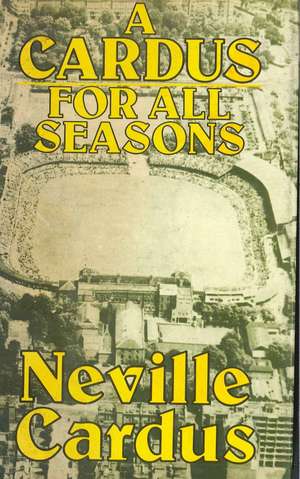
A Cardus for All Seasons
Autor Neville Cardusen Limba Engleză Paperback – 5 aug 2013
Preț: 133.74 lei
Puncte Express: 201
Carte indisponibilă temporar
Livrare prin curier în România Termenul estimat este afișat lângă disponibilitate.
Transport gratuit de la 400.00 lei Plată online sau ramburs, în funcție de opțiunile comenzii.
Retur gratuit în 14 zile Comandă securizată și suport în română.
Specificații
ISBN-13: 9780285642478
ISBN-10: 0285642472
Pagini: 238
Ilustrații: black & white illustrations
Dimensiuni: 130 x 205 x 12 mm
Greutate: 0.25 kg
Ediția:Main
Editura: Profile
Colecția Souvenir Press
Locul publicării:London, United Kingdom
ISBN-10: 0285642472
Pagini: 238
Ilustrații: black & white illustrations
Dimensiuni: 130 x 205 x 12 mm
Greutate: 0.25 kg
Ediția:Main
Editura: Profile
Colecția Souvenir Press
Locul publicării:London, United Kingdom
V-ar putea interesa
-
 The Last Flannelled FoolMichael SimkinsPreț: 110.21 lei
 -
 The Best XIGeoffrey BoycottPreț: 213.10 lei
 -
 A Fourth Innings with CardusNeville Cardus-35%Preț: 82.41 lei126.17 lei
 -
 Slipless In Settle: A Slow Turn Around Northern CricketHarry Pearson-29%Preț: 65.00 lei91.12 lei
 -
 And God Created CricketSimon Hughes-20%Preț: 67.51 lei83.90 lei
 -
 Not Dark YetMike HarfieldPreț: 65.63 lei
 -
 In the Firing LineEd CowanPreț: 195.69 lei
 -
 Following onDavid TossellPreț: 105.39 lei
Notă biografică
Sir John Frederick Neville Cardus, CBE (2 April 1888 - 28 February 1975) was an English writer and critic. From an impoverished home background, and mainly self-educated, he became The Manchester Guardian's cricket correspondent in 1919 and its chief music critic in 1927, holding the two posts simultaneously until 1940. His contributions to these two distinct fields in the years before the Second World War established his reputation as one of the foremost critics of his generation.