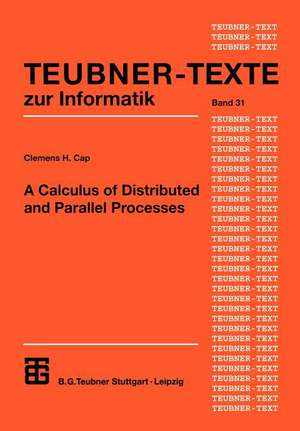
A Calculus of Distributed and Parallel Processes: Teubner Texte zur Informatik, cartea 31
Autor Clemens H. Capen Limba Engleză Paperback – 14 mar 2012
Din seria Teubner Texte zur Informatik
-
 Preț: 338.56 lei
 -
 Preț: 357.98 lei
 -
 Preț: 341.13 lei
 -
 Preț: 338.00 lei
 -
 Preț: 347.05 lei
 - 20%
 Preț: 412.65 lei
 - 20%
 Preț: 615.63 lei
 -
 Preț: 335.22 lei
 -
 Preț: 337.84 lei
 -
 Preț: 339.29 lei
 -
 Preț: 224.26 lei
 -
 Preț: 344.27 lei
 -
 Preț: 336.53 lei
 -
 Preț: 302.22 lei
 -
 Preț: 380.42 lei
 -
 Preț: 467.43 lei
 -
 Preț: 469.97 lei
 -
 Preț: 271.79 lei
 -
 Preț: 471.25 lei
 - 20%
 Preț: 460.93 lei
 -
 Preț: 267.53 lei
 -
 Preț: 282.56 lei
 -
 Preț: 283.72 lei
 -
 Preț: 274.76 lei
 -
 Preț: 406.62 lei
Preț: 619.61 lei
Preț vechi: 728.96 lei
-15%
Puncte Express: 929
Carte tipărită la comandă
Livrare economică 27 august-10 septembrie
Livrare prin curier în România Termenul estimat este afișat lângă disponibilitate.
Transport gratuit pentru acest produs Plată online sau ramburs, în funcție de opțiunile comenzii.
Retur gratuit în 14 zile Comandă securizată și suport în română.
Specificații
ISBN-13: 9783322867650
ISBN-10: 332286765X
Pagini: 332
Ilustrații: 320 p.
Dimensiuni: 170 x 244 x 17 mm
Greutate: 0.53 kg
Ediția:Softcover reprint of the original 1st ed. 2000
Editura: Vieweg+Teubner Verlag
Colecția Vieweg+Teubner Verlag
Seria Teubner Texte zur Informatik
Locul publicării:Wiesbaden, Germany
ISBN-10: 332286765X
Pagini: 332
Ilustrații: 320 p.
Dimensiuni: 170 x 244 x 17 mm
Greutate: 0.53 kg
Ediția:Softcover reprint of the original 1st ed. 2000
Editura: Vieweg+Teubner Verlag
Colecția Vieweg+Teubner Verlag
Seria Teubner Texte zur Informatik
Locul publicării:Wiesbaden, Germany
V-ar putea interesa
-
 Sensors for MechatronicsPaul P.L. Regtien-25%Preț: 445.64 lei595.52 lei
 -
 Engineering: A Very Short IntroductionDavid Blockley-21%Preț: 54.95 lei69.80 lei
 -
 -19%Preț: 463.04 lei571.65 lei
 -
 The Art of Systems ArchitectingMark W. Maier-20%Preț: 933.03 lei1166.29 lei
 -
 Carbon Footprint Analysis: Concepts, Methods, Implementation, and Case StudiesMatthew John Franchetti-18%Preț: 923.73 lei1126.49 lei
 -
 Preț: 367.01 lei
 -
 HochleistungsfaserverbundwerkstoffeLeif A. CarlssonPreț: 315.40 lei
 -
 Topografa de ObrasIgnacio Corral Manuel De VillenaPreț: 290.64 lei
Public țintă
ResearchCuprins
1 Introduction.- 1.1 What is a Process? — An Introduction.- 1.2 Process Theory as Research Area.- 1.3 Elements of Process Theory.- 1.4 Classification of Process Theories.- 1.5 How to Use This Book? — A Reading Guide.- 2 Transition Systems.- 2.1 Ordinary Transition Systems.- 2.2 Interpreting Transition Systems.- 2.3 Typed and Labeled Systems.- 2.4 Non-Determinism, Causality, and Behaviour.- 2.5 Sequential Composition.- 2.6 Fairness.- 3 Distributed Transition Systems.- 3.1 Motivation.- 3.2 Distributed Transition Systems.- 3.3 Non-Determinism, Causality, and Behaviour.- 3.4 Examples of Branching Structures.- 3.5 Branching Structure and Constructions.- 3.6 Branching Structure and Geometry.- 3.7 Confusion.- 3.8 First Order Transition Systems.- 3.9 Fairness.- 4 Higher Order Transition Systems.- 4.1 Motivation.- 4.2 Higher Order Transition Systems.- 4.3 Reversible and Invertible Transitions.- 4.4 Forgetting the Higher Order Structure.- 5 Process Specification Formalisms.- 5.1 Linear Logic and Transition Systems.- 5.2 Linear Logic Process Specification.- 5.3 Extensions of the Formalism.- 5.4 Equivalence and Abstraction for Processes.- 6 Examples.- 6.1 A Specification Language.- 6.2 The Stack.- 6.3 The Bag.- 6.4 Interrupts.- 6.5 Data Replication.- 6.6 The Alternating Bit Protocol.- 6.7 Workflow Management.- 6.8 Fibonacci Numbers.- 6.9 An Implementation.- 7 Categorical Interpretations.- 7.1 The Curry-Howard Correspondence.- 7.2 Transition Systems.- 7.3 Linear Logic.- 8 Conclusions, Challenges, and Opportunities.- 8.1 What Has Been Achieved?.- 8.2 Theoretical Problems.- 8.3 Practical Problems.- 8.4 Speculations.- 8.5 Final Remarks.- A Mathematical Prerequisites.- A.1 Order Structures.- A.2 Monoids.- B Linear Logic.- B.1 Universe of Discourse.- B.2 Motivations for LinearLogic.- B.3 Syntax and Natural Deduction.- B.4 Alternate Natural Deduction.- B.5 Sequent Calculus.- B.6 Syntactic Results.- B.7 Interpretation of Linear Formulae.- C Category Theory.- C.1 Category Theory for the Perplexed.- C.2 Basic Definitions.- C.3 Products, Coproducts, and Duality.- C.4 Functors.- C.5 Natural Transformations.- C.6 Properties of the Product Functor.- C.7 Representation of Categories.- C.8 Cartesian Closed Categories.- C.9 Symmetric Monoidal Closed Categories.- Symbols.
Textul de pe ultima copertă
This book introduces a process calculus for parallel, distributed and reactive systems. It describes the conceptual foundations as well as the mathematical theory behind a programming language, and a number of application examples. The chosen approach provides a framework for understanding the semantics of parallel and distributed systems. Moreover, it can be directly applied to practical problems.