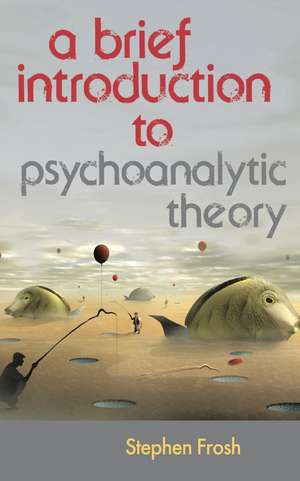
A Brief Introduction to Psychoanalytic Theory
Autor Stephen Froshen Limba Engleză Hardback – 25 mai 2012
- Explores the birth of psychoanalysis, taking the reader step by step through Freud's original ideas and how they developed and evolved
- Provides a clear account of fundamental psychoanalytic concepts
- Discusses the different schools of psychoanalysis that have emerged since Freud
- Illustrates the wider applications of psychoanalytic ideas across film, literature and politics
Written by a highly respected authority on psychoanalysis, this book is essential reading for trainees in counselling and psychotherapy, as well as for students across the arts, humanities and social sciences.
Preț: 554.36 lei
Preț vechi: 789.44 lei
-30%
Puncte Express: 832
Carte tipărită la comandă
Livrare economică 03-17 decembrie
Livrare prin curier în România Termenul estimat este afișat lângă disponibilitate.
Transport gratuit pentru acest produs Plată online sau ramburs, în funcție de opțiunile comenzii.
Retur gratuit în 14 zile Comandă securizată și suport în română.
Specificații
ISBN-13: 9780230369290
ISBN-10: 0230369294
Pagini: 276
Ilustrații: 1 figures, 1 b/w tables
Dimensiuni: 129 x 198 x 15 mm
Greutate: 0.34 kg
Ediția:2012
Editura: Bloomsbury Publishing
Colecția Red Globe Press
Locul publicării:London, United Kingdom
ISBN-10: 0230369294
Pagini: 276
Ilustrații: 1 figures, 1 b/w tables
Dimensiuni: 129 x 198 x 15 mm
Greutate: 0.34 kg
Ediția:2012
Editura: Bloomsbury Publishing
Colecția Red Globe Press
Locul publicării:London, United Kingdom
Cuprins
PART I: FREUDIAN THEORY
The Appeal of Psychoanalysis
A Family History of Psychoanalysis
What Freud was Trying to Do
The Freudian Unconscious
Sex, Aggression, Life and death
Repression and Other Defences
The Structure of the Mind: Id, Ego, Superego
Oedipus, Masculinity, Femininity
Psychopathology: What Makes Us Sad (and Mad)
PART II: DEVELOPMENTS IN PSYCHOANALYTIC THEORY
Psychoanalysts After Freud
Attachment and Mentalisation
The Principles of Object Relations Theory
Mourning, Melancholia, Depression and Loss
The Paranoid-Schizoid Position and Other Extremes
Projection and Projective Identification
Lacanian Psychoanalysis
Interpretation and Transference
Psychotherapeutic Relationships
PART III: WIDER APPLICATIONS
Psychoanalysis, Film and Literature
Politics and Society
Conclusion
Recommended Reading
The Appeal of Psychoanalysis
A Family History of Psychoanalysis
What Freud was Trying to Do
The Freudian Unconscious
Sex, Aggression, Life and death
Repression and Other Defences
The Structure of the Mind: Id, Ego, Superego
Oedipus, Masculinity, Femininity
Psychopathology: What Makes Us Sad (and Mad)
PART II: DEVELOPMENTS IN PSYCHOANALYTIC THEORY
Psychoanalysts After Freud
Attachment and Mentalisation
The Principles of Object Relations Theory
Mourning, Melancholia, Depression and Loss
The Paranoid-Schizoid Position and Other Extremes
Projection and Projective Identification
Lacanian Psychoanalysis
Interpretation and Transference
Psychotherapeutic Relationships
PART III: WIDER APPLICATIONS
Psychoanalysis, Film and Literature
Politics and Society
Conclusion
Recommended Reading
Recenzii
This most impressive book should be welcomed not only by all coming new to the detailed study of psychoanalysis but also by experienced clinicians and trainees from many psychotherapeutic approaches.
Stephen Frosh. has written an intelligent, informed and engaging book. .It is eloquent, clear without being simplistic, erudite without being pompous. Frosh understands his subject matter and has a facility for explanation.
Few can render psychoanalysis with such remarkable accessibility as Stephen Frosh. This introduction blends conceptual clarity and contemporary reflections, making a complex subject engaging for anyone wishing to explore it.
Stephen Frosh. has written an intelligent, informed and engaging book. .It is eloquent, clear without being simplistic, erudite without being pompous. Frosh understands his subject matter and has a facility for explanation.
Few can render psychoanalysis with such remarkable accessibility as Stephen Frosh. This introduction blends conceptual clarity and contemporary reflections, making a complex subject engaging for anyone wishing to explore it.
Notă biografică
Stephen Frosh is a Fellow of the Academy of Social Sciences, an Academic Associate of the British Psychoanalytical Society, a Founding Member of the Association of Psychosocial Studies, and an Honorary Member of the Institute of Group Analysis. He is Emeritus Professor in the Department of Psychosocial Studies at Birkbeck, University of London, UK, and was a Visiting Professor at the University of Witwatersrand, South Africa, and at the University of São Paulo, Brazil. He is the author of over 20 books on psychosocial studies and psychoanalysis, including A Brief Introduction to Psychoanalytic Theory; Psychoanalysis Outside the Clinic;
The Politics of Psychoanalysis; Hate and the Jewish Science: Anti-Semitism, Nazism and Psychoanalysis; Hauntings; Those Who Come After: Postmemory, Acknowledgement and Forgiveness and most recently, Antisemitism and Racism: Ethical Challenges for Psychoanalysis, published by Bloomsbury in 2023. He is co-editor of the Palgrave Handbook of Psychosocial Studies and the Routledge International Handbook of Psychoanalysis and Jewish Studies. His most recent book is How to be Real: A Survival Guide in Challenging Times.