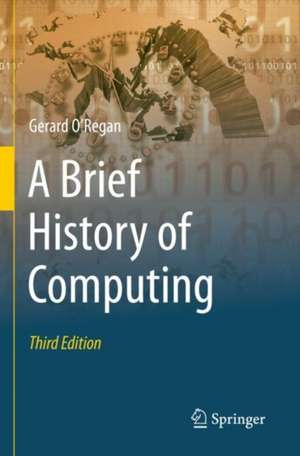
A Brief History of Computing
Autor Gerard O'Reganen Limba Engleză Paperback – 29 apr 2022
Apreciem modul în care Gerard O'Regan reușește să transforme o istorie tehnică aridă într-o narațiune fluidă, evidențiind caracterul profund interdisciplinar al domeniului. Lucrarea nu se limitează la evoluția hardware-ului, ci explorează intersecțiile critice dintre matematică, logică, inginerie software și sociologie. Această a patra ediție, publicată de Springer, este actualizată pentru a reflecta realitățile anului 2026, incluzând analize asupra impactului tehnologiei mobile și a provocărilor etice ridicate de fenomenul dezinformării online.
Subliniem rigoarea organizării conținutului: cele 24 de capitole urmează o progresie logică, de la bazele timpurii ale civilizațiilor antice și fundamentele matematice ale lui Boole, până la arhitectura mainframe-urilor IBM 360 și revoluția microprocesoarelor. Considerăm că forța acestui volum rezidă în echilibrul dintre biografiile pionierilor (Turing, Zuse, Von Neumann) și analiza sistemelor care au definit epoci, precum sistemele de operare și bazele de date. În contextul operei sale, A Brief History of Computing acționează ca un liant pentru temele explorate în Guide to Discrete Mathematics și Ethical and Legal Aspects of Computing, integrând fundamentele matematice cu responsabilitatea profesională într-o viziune de ansamblu.
Textul completează perspectiva oferită de The Computing Universe de Tony Hey, adăugând o structură pedagogică mult mai aplicată, cu exerciții și obiective de învățare clare, esențiale pentru mediul academic. Față de lucrări pur istorice, Gerard O'Regan insistă asupra evoluției ingineriei software ca disciplină de sine stătătoare, oferind cititorului instrumentele necesare pentru a înțelege nu doar cum au apărut computerele, ci și cum s-au transformat în fundamentul societății moderne.
Preț: 348.58 lei
Preț vechi: 435.73 lei
-20%
Carte tipărită la comandă
Livrare economică 02-08 iunie
Specificații
ISBN-10: 3030666018
Pagini: 388
Ilustrații: XXV, 359 p. 129 illus., 85 illus. in color.
Dimensiuni: 155 x 235 x 20 mm
Greutate: 0.66 kg
Ediția:Third Edition 2021
Editura: Springer
Locul publicării:Cham, Switzerland
De ce să citești această carte
Recomandăm această carte studenților și profesioniștilor care doresc să înțeleagă rădăcinile tehnologiei pe care o utilizează zilnic. Cititorul câștigă o perspectivă cronologică clară asupra inovațiilor majore, de la abac la calculul cuantic. Este o resursă esențială pentru curriculumul de informatică, oferind nu doar date istorice, ci și o analiză critică a responsabilităților etice și legale într-o lume dominată de algoritmi și inteligență artificială.
Despre autor
Gerard O'Regan este un autor respectat și specialist în informatică, cu o vastă experiență atât în mediul academic, cât și în cel industrial. A lucrat ca inginer software la Motorola în Irlanda, unde a coordonat programe de brevete, experiență care i-a fundamentat interesul pentru aspectele legale și etice ale tehnologiei. Opera sa cuprinde numeroase manuale publicate de Springer, acoperind teme diverse de la managementul proiectelor software și inginerie software, până la matematică discretă. Expertiza sa este definită de capacitatea de a explica concepte tehnice complexe într-un limbaj accesibil, punând mereu accent pe rigoarea matematică și pe responsabilitatea profesională a informaticianului.
Descriere scurtă
Cuprins
Recenzii
Textul de pe ultima copertă
This lively and fascinating text traces the key developments in computation – from 3000 B.C. to the present day – in an easy-to-follow and concise manner. Providing a comprehensive introduction to the most significant events and concepts in the history of computing, the book embarks upon a journey from ancient Egypt to modern times; taking in mechanical calculators, early digital computers, the first personal computers and mobile phones, to the history of software engineering, the evolution of programming languages and the invention of the World Wide Web, among other topics. This expanded and revised new edition also examines the birth of the software industry and the evolution of human-computer interaction, in addition to innovations such as Cloud computing, the Internet of Things, and Quantum Computing.
Topics and features:
· Ideal for self-study, offering many pedagogical features such as chapter-opening key topics, chapter introductions and summaries, exercises, and a glossary
· Presents detailed information on major figures in computing, such as Boole, Babbage, Shannon, Turing, Zuse and Von Neumann
· Discusses the earliest computers developed in the United States, Germany and Britain. · Discusses the development of the IBM 360 family of computers and its importance
· Discusses the birth of the software industry and the evolution of human-computer interaction
· Reviews the history of software engineering, programming languages, and operating systems
· Discusses the progress of the field of artificial intelligence
· Examines the impact on society of the introduction of the personal computer, the World Wide Web, and mobile phone technology
· Discusses a miscellany of innovations in computing such as cloud computing, the Internet of Things, and Quantum Computing· Discusses legal aspects of computing and professional responsibilities of computer professionals
This clearly written and broad-ranging text both gives the reader a flavour of the history and stimulates further study in the subject. As such, it will be of great benefit to students of computer science, while also capturing the interest of the more casual reader.
About the Author: Dr. Gerard O'Regan is a consultant with research interests including software quality and software process improvement, mathematical approaches to software quality, and the history of computing. He is the author of such Springer textbooks such as Concise Guide to Formal Methods, Concise Guide to Software Engineering, Mathematics in Computing, and Concise Guide to Software Testing.