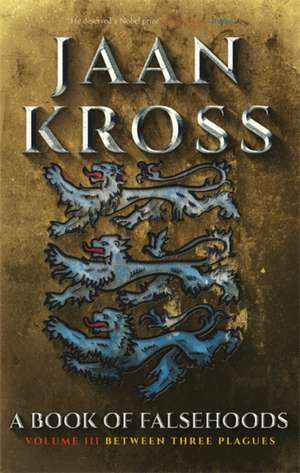
A Book of Falsehoods: Between Three Plagues Volume 3
Autor Jaan Kross Traducere de Merike Lepasaar Beecheren Limba Engleză Paperback – 4 aug 2022
The third part in an epic historical trilogy - The Estonian answer to Wolf Hall - by the nation's greatest modern writer
1578. A ship from Rostock arrives in Tallinn loaded with printed copies of Balthasar Russow's Chronicle - the culmination of our hero's life's work. But though it is an instant success, as it was in Rostock and numerous German cities, not everyone is happy to see it published. A group of local gentry denounce it to the town council as "a book of heinous falsehoods", and lobby for Balthasar to relieved as pastor of Holy Ghost Church.
But all is not lost. Balthasar may call on a powerful ally - if he is willing to pay the price.
In this final volume, fierce storms, along with famine, war and plague, continue to be loosed upon Livonia. Balthasar's personal life, too, is fraught with turbulence and loss, much of it stemming from his own jealousy and suspicion.
Preț: 103.44 lei
Preț vechi: 139.60 lei
-26%
Puncte Express: 155
Carte disponibilă
Livrare economică 18 mai-01 iunie
Livrare express 01-07 mai pentru 72.91 lei
Specificații
ISBN-13: 9780857055149
ISBN-10: 0857055143
Pagini: 496
Dimensiuni: 152 x 232 x 40 mm
Greutate: 0.6 kg
Editura: Quercus Books
Colecția MacLehose Press
Locul publicării:London, United Kingdom
ISBN-10: 0857055143
Pagini: 496
Dimensiuni: 152 x 232 x 40 mm
Greutate: 0.6 kg
Editura: Quercus Books
Colecția MacLehose Press
Locul publicării:London, United Kingdom
Recenzii
Hailed as the Estonian answer to Wolf Hall
He's a marvellous novelist - his scope and depth make him a world writer - and they should just hurry up and give him the Nobel.
He deserved a Nobel prize and would probably have got it had he written in any other language but Estonian.
He's almost alone in writing in the older European tradition of the large-scale historical novel. I'd argue that Kross is heir to the 'great' Russo-European 19th century novelists; his fiction has Tolstoyan sweep. On reading him, moreover, we rediscover that Estonia was always resolutely in Europe and not some obscure outpost this side of the Urals.
No stranger to oppression himself, Kross writes about it with a poignancy devoid of anger.
He's a marvellous novelist - his scope and depth make him a world writer - and they should just hurry up and give him the Nobel.
He deserved a Nobel prize and would probably have got it had he written in any other language but Estonian.
He's almost alone in writing in the older European tradition of the large-scale historical novel. I'd argue that Kross is heir to the 'great' Russo-European 19th century novelists; his fiction has Tolstoyan sweep. On reading him, moreover, we rediscover that Estonia was always resolutely in Europe and not some obscure outpost this side of the Urals.
No stranger to oppression himself, Kross writes about it with a poignancy devoid of anger.