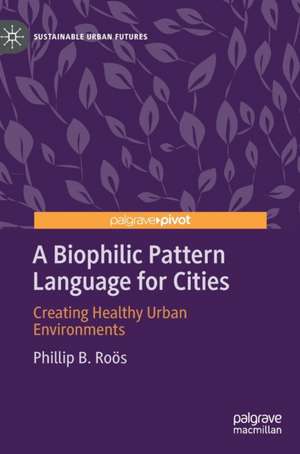
A Biophilic Pattern Language for Cities: Sustainable Urban Futures
Autor Phillip B. Ro¿sen Limba Engleză Hardback – 7 dec 2022
Din seria Sustainable Urban Futures
-
 Preț: 404.45 lei
 -
 Preț: 449.11 lei
 -
 Preț: 454.41 lei
 -
 Preț: 342.04 lei
 -
 Preț: 313.20 lei
 - nou
 Preț: 313.29 lei
Preț: 369.77 lei
Puncte Express: 555
Carte tipărită la comandă
Livrare economică 19 octombrie-02 noiembrie
Livrare prin curier în România Termenul estimat este afișat lângă disponibilitate.
Transport gratuit de la 400.00 lei Plată online sau ramburs, în funcție de opțiunile comenzii.
Retur gratuit în 14 zile Comandă securizată și suport în română.
Specificații
ISBN-13: 9783031190704
ISBN-10: 303119070X
Pagini: 132
Ilustrații: XV, 114 p. 34 illus.
Dimensiuni: 153 x 216 x 12 mm
Greutate: 0.29 kg
Ediția:1st ed. 2022
Editura: Springer
Colecția Sustainable Urban Futures
Seria Sustainable Urban Futures
Locul publicării:Cham, Switzerland
ISBN-10: 303119070X
Pagini: 132
Ilustrații: XV, 114 p. 34 illus.
Dimensiuni: 153 x 216 x 12 mm
Greutate: 0.29 kg
Ediția:1st ed. 2022
Editura: Springer
Colecția Sustainable Urban Futures
Seria Sustainable Urban Futures
Locul publicării:Cham, Switzerland
Cuprins
Chapter 1: A Biophilic Pattern Language for Cities.- Chapter 2: Beyond Sustainability: An Integral Framework.- Chapter 3: Direct Experience of Nature [Pattern 1].- Chapter 4: Indirect Experience of Nature [Pattern 2].- Chapter 5: Experience of Place, Space and Attachment [Pattern 3].- Chapter 6: Nature Patterns, Processes and Systems [Pattern 4].- Chapter 7: Embracing Biophilia: The Pathway to a Regenerative-Adaptive and Resilient Future.- Chapter 8: A Case Study: The Biophilic Corridor.
Textul de pe ultima copertă
“In this powerful book, Roös revisits and creatively reinvigorates the ground-breaking pattern language work of Christopher Alexander a half-century ago. This new design imperative moves nature from something simply desirable to something absolutely essential to a flourishing urban life and to achieving a sustainable future.”
– Timothy Beatley, PhD, Teresa Heinz Professor of Sustainable Communities, School of Architecture, University of Virginia.
“Roös branches out in his own original direction, applying patterns in a holistic manner tied directly to natural systems. His work thus complements other recent work on Biophilia and Patterns.”
– Nikos A. Salingaros, PhD, Professor of Mathematics and Architecture at the University of Texas at San Antonio.
This book presents a holistic integral sustainable design and planning method embedded in the hypothesis of biophilia, our innate connection to nature, used as a platform to chart a biophilic pattern language framework. In A Biophilic Pattern Language for Cities, the author positioned the innate human-nature connection as critical in biophilic design and sustainable city planning solutions.
– Timothy Beatley, PhD, Teresa Heinz Professor of Sustainable Communities, School of Architecture, University of Virginia.
“Roös branches out in his own original direction, applying patterns in a holistic manner tied directly to natural systems. His work thus complements other recent work on Biophilia and Patterns.”
– Nikos A. Salingaros, PhD, Professor of Mathematics and Architecture at the University of Texas at San Antonio.
This book presents a holistic integral sustainable design and planning method embedded in the hypothesis of biophilia, our innate connection to nature, used as a platform to chart a biophilic pattern language framework. In A Biophilic Pattern Language for Cities, the author positioned the innate human-nature connection as critical in biophilic design and sustainable city planning solutions.
Dr Phillip B. Roös is an academic and architect, designer, artist, writer and philosopher. His work spans a transdisciplinary discourse in the convergence of design, science, art, philosophy and environmental research. Deeply embedded in ecological consciousness, he investigates our innate affiliation to Nature – biophilia – through analysing the phenomena of living structures. His practice is positioned at the intersections of rigorous academic scholarship and applied real-world projects. As a transdisciplinary practitioner, he investigates questions of human consciousness as well as global social and environmental issues. He currently holds the position of Associate Professor in Architecture - Ecological Design at the School of Architecture and Built Environment and is the Director of the Deakin Biophilia Lab, Deakin University.
Caracteristici
Provides a sustainable design and planning method for biophilic cities Aligns the four domains of Integral Sustainable Design with the Sustainable Development Goals Offers a paradigmatic guide for the planning and design of our future cities