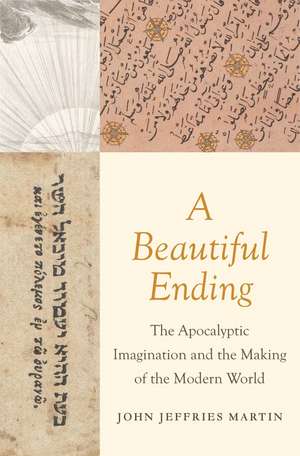
A Beautiful Ending: The Apocalyptic Imagination and the Making of the Modern World
Autor John Jeffries Martinen Limba Engleză Hardback – 3 mai 2022
“A masterful synthesis of the prognostications of faith, knowledge, and politics on a global stage. Martin’s book illuminates one of the enduring themes that shaped the medieval and early modern world.”—Paula E. Findlen, Stanford University
In this revelatory immersion into the apocalyptic, messianic, and millenarian ideas and movements that created the modern world, John Jeffries Martin performs a kind of empathic time travel, entering into the psyche, spirituality, and temporalities of a cast of historical actors in profound moments of discovery. He argues that religious faith—Christian, Jewish, and Muslim—did not oppose but rather fostered the making of a modern scientific spirit, buoyed along by a providential view of history and nature, and a deep conviction in the coming End of the World.
Through thoughtful attention to the primary sources, Martin re‑reads the Renaissance, excavating a religious foundation at the core of even the most radical empirical thinking. Familiar icons like Ibn Khaldūn, Columbus, Isaac Luria, and Francis Bacon emerge startlingly fresh and newly gleaned, agents of a history formerly untold and of a modern world made in the image of its imminent end.
Preț: 230.16 lei
Puncte Express: 345
Carte disponibilă
Livrare economică 09-23 noiembrie
Livrare express 23-29 octombrie pentru 36.95 lei
Livrare prin curier în România Termenul estimat este afișat lângă disponibilitate.
Transport gratuit de la 400.00 lei Plată online sau ramburs, în funcție de opțiunile comenzii.
Retur gratuit în 14 zile Comandă securizată și suport în română.
Specificații
ISBN-13: 9780300247329
ISBN-10: 030024732X
Pagini: 332
Ilustrații: 30 b-w illus.
Dimensiuni: 156 x 235 x 29 mm
Greutate: 0.62 kg
Editura: Yale University Press
Colecția Yale University Press
ISBN-10: 030024732X
Pagini: 332
Ilustrații: 30 b-w illus.
Dimensiuni: 156 x 235 x 29 mm
Greutate: 0.62 kg
Editura: Yale University Press
Colecția Yale University Press
Recenzii
“Martin’s case that the apocalypse is the midwife of modernity seems self-evidently right to me. My main frustration is that we need a second volume, on how the apocalypse has fared since 1800.”—Alec Ryrie, Financial Times
“[A] beautifully produced book. . . . Martin’s book ends beautifully as it begins, its apocalypse in the eternal now.”—Jonathan Locke Hart, Renaissance and Reformation
“Readers of A Beautiful Ending: The Apocalyptic Imagination and the Making of the Modern World, John Jeffries Martin’s arresting and wide-ranging new study of apocalypticism in the early modern period, will learn all kinds of new things about the beginning of the end of the world as we know it.”—Varad Mehta, Washington Examiner
“A Beautiful Ending is not only thought-provoking and enjoyable but highly convincing. . . . [A] marvelous, provocative, and genuinely original work of historical imagination.”—Ethan H. Shagan, Journal of Modern History
“In this fascinating and landmark study, John Jeffries Martin . . . gives us a fresh look at the notions of the Last Judgment in Europe. . . . Rethinking the history we ‘know’ is perhaps one of the hardest of all intellectual endeavors. Martin has laid out here, in this essential book, the roadmap for doing just that.”—Cliff Cunningham, Sun News Austin (blog)
“[Martin’s] engaging prose . . . reminds us that, while millenarian visions of the future could inspire violence, rebellion, and fear of ‘outsiders’ . . . the longing for the end also generated optimism, egalitarianism, and an ecumenical spirit.”—Brett Edward Whalen, Journal of Interdisciplinary History
“Martin makes a robust case for hope as central to the ‘apocalyptic imagination’ in laying the foundations for modernity. . . . Wide-ranging, richly illustrated, and, most importantly, eminently readable.”—Ian Boxall, Church History
“A captivating and profoundly original account of how apocalyptic thought shaped the cultural, religious, and political landscapes of the early modern world. . . . Erudite and engaging.”—Andrej Kapcár, Religious Studies Review
The fifth winner of the Pelikan Award, chosen by a group of Yale faculty, sponsored by Yale University Press
“What does it mean to live near the end of time and await the world’s rebirth, as generations of Jews, Christians and Muslims did? A Beautiful Ending is a masterful synthesis of the prognostications of faith, knowledge, and politics on a global stage. Martin’s book illuminates one of the enduring themes that shaped the medieval and early modern world.”—Paula E. Findlen, Stanford University
“In his elegantly braided analysis of the apocalyptic imagination among Christian, Muslim, and Jewish thinkers, John Jeffries Martin recasts the world-making events of the late medieval and early modern periods. A Beautiful Ending is a beautiful book.”—Alan Mikhail, author of God’s Shadow: Sultan Selim, His Ottoman Empire, and the Making of the Modern World
“Martin’s masterful and wide-ranging study places ideas about the end of the world in their historical context, demonstrating how the apocalyptic imagination allowed historical actors to confront difficult and often frightening circumstances. Their experiences inform our own contemporary historical moment.”—Elizabeth Horodowich, New Mexico State University
“A sweeping history of early modern apocalyptic and millenarian thought among Christians, Muslims, and Jews, when the end of history brought expectations of a golden age of peace. Martin provides a powerful history of the hopes and horrors produced by these apocalyptic fantasies with an eye to their continuity into our own times. Few books make early modern history more relevant to the present.”—Stuart Schwartz, Yale University
“In his richly detailed new book, John Jeffries Martin advances the striking hypothesis that apocalyptic thinking not only did not go away with the advent of modernity; it was one of the key forces that gave us our modern world. If he’s right, much of what we thought we knew bears rethinking.”—Benjamin M. Friedman, author of Religion and the Rise of Capitalism
“Engaging and profoundly original, A Beautiful Ending treats Christian, Jewish, and Muslim thought about End Times as a source of modernity. Martin’s deft argument convinces that the proverbial rise of modern secularism is a myth.”—Edward Muir, Northwestern University
“[A] beautifully produced book. . . . Martin’s book ends beautifully as it begins, its apocalypse in the eternal now.”—Jonathan Locke Hart, Renaissance and Reformation
“Readers of A Beautiful Ending: The Apocalyptic Imagination and the Making of the Modern World, John Jeffries Martin’s arresting and wide-ranging new study of apocalypticism in the early modern period, will learn all kinds of new things about the beginning of the end of the world as we know it.”—Varad Mehta, Washington Examiner
“A Beautiful Ending is not only thought-provoking and enjoyable but highly convincing. . . . [A] marvelous, provocative, and genuinely original work of historical imagination.”—Ethan H. Shagan, Journal of Modern History
“In this fascinating and landmark study, John Jeffries Martin . . . gives us a fresh look at the notions of the Last Judgment in Europe. . . . Rethinking the history we ‘know’ is perhaps one of the hardest of all intellectual endeavors. Martin has laid out here, in this essential book, the roadmap for doing just that.”—Cliff Cunningham, Sun News Austin (blog)
“[Martin’s] engaging prose . . . reminds us that, while millenarian visions of the future could inspire violence, rebellion, and fear of ‘outsiders’ . . . the longing for the end also generated optimism, egalitarianism, and an ecumenical spirit.”—Brett Edward Whalen, Journal of Interdisciplinary History
“Martin makes a robust case for hope as central to the ‘apocalyptic imagination’ in laying the foundations for modernity. . . . Wide-ranging, richly illustrated, and, most importantly, eminently readable.”—Ian Boxall, Church History
“A captivating and profoundly original account of how apocalyptic thought shaped the cultural, religious, and political landscapes of the early modern world. . . . Erudite and engaging.”—Andrej Kapcár, Religious Studies Review
The fifth winner of the Pelikan Award, chosen by a group of Yale faculty, sponsored by Yale University Press
“What does it mean to live near the end of time and await the world’s rebirth, as generations of Jews, Christians and Muslims did? A Beautiful Ending is a masterful synthesis of the prognostications of faith, knowledge, and politics on a global stage. Martin’s book illuminates one of the enduring themes that shaped the medieval and early modern world.”—Paula E. Findlen, Stanford University
“In his elegantly braided analysis of the apocalyptic imagination among Christian, Muslim, and Jewish thinkers, John Jeffries Martin recasts the world-making events of the late medieval and early modern periods. A Beautiful Ending is a beautiful book.”—Alan Mikhail, author of God’s Shadow: Sultan Selim, His Ottoman Empire, and the Making of the Modern World
“Martin’s masterful and wide-ranging study places ideas about the end of the world in their historical context, demonstrating how the apocalyptic imagination allowed historical actors to confront difficult and often frightening circumstances. Their experiences inform our own contemporary historical moment.”—Elizabeth Horodowich, New Mexico State University
“A sweeping history of early modern apocalyptic and millenarian thought among Christians, Muslims, and Jews, when the end of history brought expectations of a golden age of peace. Martin provides a powerful history of the hopes and horrors produced by these apocalyptic fantasies with an eye to their continuity into our own times. Few books make early modern history more relevant to the present.”—Stuart Schwartz, Yale University
“In his richly detailed new book, John Jeffries Martin advances the striking hypothesis that apocalyptic thinking not only did not go away with the advent of modernity; it was one of the key forces that gave us our modern world. If he’s right, much of what we thought we knew bears rethinking.”—Benjamin M. Friedman, author of Religion and the Rise of Capitalism
“Engaging and profoundly original, A Beautiful Ending treats Christian, Jewish, and Muslim thought about End Times as a source of modernity. Martin’s deft argument convinces that the proverbial rise of modern secularism is a myth.”—Edward Muir, Northwestern University
Notă biografică
John Jeffries Martin is professor and former chair of the Department of History at Duke University. His books include Venice’s Hidden Enemies and Myths of Renaissance Individualism. He lives in Hillsborough, NC.