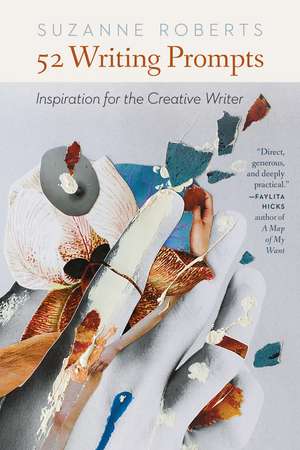
52 Writing Prompts: Inspiration for the Creative Writer
Autor Suzanne Robertsen Limba Engleză Paperback – oct 2026
Drawing from more than thirty years of creative writing teaching experience, Suzanne Roberts offers down-to-earth, witty, and wise straight talk about writing and the writing life, accessible craft discussions, and thought-provoking twenty-minute genre-crossing writing prompts. This multi-genre approach is arranged by theme, including memory, family and friends, writing the body, love and lust, death and grief, nature and the environment, stories of shame, and magic and myth, along with discussions of revision and editing, building writing community, and publishing. The chapters offer a short discussion of each theme, friendly pep talks, accessible craft tips, a selection of thirty-five poems, stories, and essays from a diverse array of contemporary writers, and, of course, the writing prompts.
Featured authors include Camille T. Dungy, Carolyn Forché, Gina Frangello, Linda LeGarde Grover, Lisa Lee Herrick, Major Jackson, Rebecca Makkai, Eva Saulitis, Patricia Smith, Stacey Waite, Lidia Yuknavitch, among many others, with writing advice of their own. 52 Writing Prompts will encourage and motivate both aspiring and established writers.
Preț: 152.48 lei
Nou
Puncte Express: 229
Carte disponibilă
Livrare economică 07-21 noiembrie
Livrare express 27-31 octombrie pentru 43.27 lei
Livrare prin curier în România Termenul estimat este afișat lângă disponibilitate.
Transport gratuit de la 400.00 lei Plată online sau ramburs, în funcție de opțiunile comenzii.
Retur gratuit în 14 zile Comandă securizată și suport în română.
Specificații
ISBN-13: 9781496239563
ISBN-10: 1496239563
Pagini: 286
Ilustrații: 1 appendix, index
Dimensiuni: 152 x 229 mm
Greutate: 0.42 kg
Editura: Nebraska
Colecția University of Nebraska Press
Locul publicării:United States
ISBN-10: 1496239563
Pagini: 286
Ilustrații: 1 appendix, index
Dimensiuni: 152 x 229 mm
Greutate: 0.42 kg
Editura: Nebraska
Colecția University of Nebraska Press
Locul publicării:United States
Notă biografică
Suzanne Roberts is the author of Animal Bodies: On Death, Desire, and Other Difficulties (Nebraska, 2022), longlisted for the 2023 PEN/Diamonstein-Spielvogel Award; Bad Tourist: Misadventures in Love and Travel (Nebraska, 2020); and Almost Somewhere: Twenty-Eight Days on the John Muir Trail (Bison Books, 2012), winner of the 2012 National Outdoor Book Award; as well as four collections of poetry. Visit her website at www.suzanneroberts.net.
Extras
1 Dig Deep and Interrogate
Writing from Memory
Flannery O’Connor writes, “The fact is that anybody who has survived his
childhood has enough information about life to last him the rest of his days.”
Certainly, O’Connor drew on her past and her memories of a childhood in
the American South in order to create outlandish, memorable characters in
settings full of local color. Likewise, most writers draw on their own memories
when writing, relying on that well-worn adage: Write what you know.
In this chapter, we’re going to rely on memory to create new work. Because
our memories are always fallible, we’re going to worry less about what actually
happened and lean more on our sense of past events. Anyone who has
siblings knows that if you ask each sibling to tell a shared childhood story,
you will end up with as many different accounts as there are siblings. Each
of us remembers things differently because of the varied ways we focused
on what was important to us in the moment.
Because we remember things more vividly when they are coupled with
strong emotions, whether that be fear, sadness, anger, bliss, or something
else, we’re able to recount these instances much more easily than memories
that did not elicit strong feelings. The stress hormones epinephrine and cortisol
consolidate memory. From an evolutionary standpoint, this response
helps us remember a scary experience, so we can avoid it in the future. That
saber-toothed tiger tried to eat you? It’s best to remember that and run like
hell if you see her stalking toward you again. Epinephrine also signals our
bodies to release endorphins, or the feel-good hormone. Anyone who has
experienced a “runner’s high” or the joys of “type 2 fun” knows about this.
It’s also why you feel so damn good after you escape a dangerous situation.
These chemical responses mean you’re consolidating the event to memory,
whether that memory was harrowing and terrible or extremely joyful.
The writer David James Duncan likened these emotionally resonant
memories to river teeth, or tree knots (the places where branches attach to
the trunk) that remain at the bottom of a river after the rest of the tree has
decayed. Like the most durable parts of the tree, Duncan calls our memories
that remain “river teeth.” As writers, these emotionally resonant moments,
these memories, are a good place to begin, whether we’re writing poetry,
nonfiction, or fiction. When working on a short story or novel, we often
give some part of our own experience to our characters. We can also get to
know our fictional characters better if we create memories for them. And
certainly, if we’re writing memoir, the very name implies that the piece of
writing comes directly from memory.
Pep Talk: Memoir and Memory
In fiction and poetry, it’s absolutely fine to write about half-remembered
events, filling in the blanks as you need to. In fact, it’s better to invent things
to help create a strong narrative arc. Writing fiction is both harder and easier
than writing creative nonfiction or memoir. It’s more difficult because you
have to make things up, and the possibilities are limitless. But that also makes
it easier to create a story with lots of conflict and a strong narrative arc.
If you’re writing memoir or creative nonfiction, though, the contract with
the reader is such that you cannot make things up to create a more interesting
story. Some writers have gotten into very big trouble for inventing life events
in memoirs. However, no one remembers things exactly as they happened,
so the reader understands that you’re telling the truth according to your own
memory, which is never exact. If you really aren’t sure what happened, you can
start a scene by saying something like this: The sequence of events may have
happened in this order, but I’m not sure. Or She said something like this. It’s
okay to use disclaimers, and many writers use them at the beginning of their
memoirs or essay collections. This is the disclaimer I used at the beginning of
my memoir-in-essays Animal Bodies: “This is a work of nonfiction, sourced
from my own fallible memory, which is to say that while I have adhered to
the truth of my own memories, others may have differing memories of the
same events.” What’s important is that you stay true to your memory. And
remember: You have every right to your own memories.
In creative nonfiction and memoir, it’s fine to recreate dialogue, as long as
you keep it true to your memory. Unless you’re a journalist, reporting for a
news source, no one expects you to have recorded what people in your past
said word for word. However, I do recommend allowing the people you write
about to read the pages in which they appear before publication, but don’t do
this until you’re in the final stretch, editing your manuscript because it’s being
published. Then you have to decide whether or not you’ll make the changes
they request. If the people in question are no longer in your life, you’re in no
way obligated to let them read your work. You should, however, change their
names and any distinguishing characteristics so they cannot be identified.
Writing from Memory
Flannery O’Connor writes, “The fact is that anybody who has survived his
childhood has enough information about life to last him the rest of his days.”
Certainly, O’Connor drew on her past and her memories of a childhood in
the American South in order to create outlandish, memorable characters in
settings full of local color. Likewise, most writers draw on their own memories
when writing, relying on that well-worn adage: Write what you know.
In this chapter, we’re going to rely on memory to create new work. Because
our memories are always fallible, we’re going to worry less about what actually
happened and lean more on our sense of past events. Anyone who has
siblings knows that if you ask each sibling to tell a shared childhood story,
you will end up with as many different accounts as there are siblings. Each
of us remembers things differently because of the varied ways we focused
on what was important to us in the moment.
Because we remember things more vividly when they are coupled with
strong emotions, whether that be fear, sadness, anger, bliss, or something
else, we’re able to recount these instances much more easily than memories
that did not elicit strong feelings. The stress hormones epinephrine and cortisol
consolidate memory. From an evolutionary standpoint, this response
helps us remember a scary experience, so we can avoid it in the future. That
saber-toothed tiger tried to eat you? It’s best to remember that and run like
hell if you see her stalking toward you again. Epinephrine also signals our
bodies to release endorphins, or the feel-good hormone. Anyone who has
experienced a “runner’s high” or the joys of “type 2 fun” knows about this.
It’s also why you feel so damn good after you escape a dangerous situation.
These chemical responses mean you’re consolidating the event to memory,
whether that memory was harrowing and terrible or extremely joyful.
The writer David James Duncan likened these emotionally resonant
memories to river teeth, or tree knots (the places where branches attach to
the trunk) that remain at the bottom of a river after the rest of the tree has
decayed. Like the most durable parts of the tree, Duncan calls our memories
that remain “river teeth.” As writers, these emotionally resonant moments,
these memories, are a good place to begin, whether we’re writing poetry,
nonfiction, or fiction. When working on a short story or novel, we often
give some part of our own experience to our characters. We can also get to
know our fictional characters better if we create memories for them. And
certainly, if we’re writing memoir, the very name implies that the piece of
writing comes directly from memory.
Pep Talk: Memoir and Memory
In fiction and poetry, it’s absolutely fine to write about half-remembered
events, filling in the blanks as you need to. In fact, it’s better to invent things
to help create a strong narrative arc. Writing fiction is both harder and easier
than writing creative nonfiction or memoir. It’s more difficult because you
have to make things up, and the possibilities are limitless. But that also makes
it easier to create a story with lots of conflict and a strong narrative arc.
If you’re writing memoir or creative nonfiction, though, the contract with
the reader is such that you cannot make things up to create a more interesting
story. Some writers have gotten into very big trouble for inventing life events
in memoirs. However, no one remembers things exactly as they happened,
so the reader understands that you’re telling the truth according to your own
memory, which is never exact. If you really aren’t sure what happened, you can
start a scene by saying something like this: The sequence of events may have
happened in this order, but I’m not sure. Or She said something like this. It’s
okay to use disclaimers, and many writers use them at the beginning of their
memoirs or essay collections. This is the disclaimer I used at the beginning of
my memoir-in-essays Animal Bodies: “This is a work of nonfiction, sourced
from my own fallible memory, which is to say that while I have adhered to
the truth of my own memories, others may have differing memories of the
same events.” What’s important is that you stay true to your memory. And
remember: You have every right to your own memories.
In creative nonfiction and memoir, it’s fine to recreate dialogue, as long as
you keep it true to your memory. Unless you’re a journalist, reporting for a
news source, no one expects you to have recorded what people in your past
said word for word. However, I do recommend allowing the people you write
about to read the pages in which they appear before publication, but don’t do
this until you’re in the final stretch, editing your manuscript because it’s being
published. Then you have to decide whether or not you’ll make the changes
they request. If the people in question are no longer in your life, you’re in no
way obligated to let them read your work. You should, however, change their
names and any distinguishing characteristics so they cannot be identified.
Cuprins
Introduction: Getting Started
How to Use this Book
A Note on Craft
Pep Talk: Overcoming Writers’ Block
Craft Tip: Getting Started
Writing Prompt #1: Getting Unstuck
Readings
“The Lovers” by Brian Turner
Writing Advice from Brian Turner
Writing Prompt #2: Imitation Exercise
“The Woman Who Was a House” by Sarah Layden
Writing Advice from Sarah Layden
Writing Prompt #3: Imitation Exercise
[This is my letter to the World] by Emily Dickinson
Writing Advice from Emily Dickinson
How to Use this Book
A Note on Craft
Pep Talk: Overcoming Writers’ Block
Craft Tip: Getting Started
Writing Prompt #1: Getting Unstuck
Readings
“The Lovers” by Brian Turner
Writing Advice from Brian Turner
Writing Prompt #2: Imitation Exercise
“The Woman Who Was a House” by Sarah Layden
Writing Advice from Sarah Layden
Writing Prompt #3: Imitation Exercise
[This is my letter to the World] by Emily Dickinson
Writing Advice from Emily Dickinson
Recenzii
“In spirit, 52 Writing Prompts sits somewhere between the warmth of Anne Lamott’s Bird by Bird and the cross-genre anthology instinct of Janet Burroway’s Imaginative Writing in which the choir of voices keeps any single aesthetic from dominating.”—Helene Kiser, Hippocampus Magazine
“52 Writing Prompts contains much more than writing prompts. In engagingly written and occasionally confessional prose, Suzanne Roberts offers a comprehensive launch pad for writing in essay, fiction, and poetic forms. There are examples from contemporary writers both familiar and new; quotations about writing from the Marquis de Sade to Rebecca Makkai; tips, pep talks, and, yes, prompts, cleanly based on the examples. These cover every aspect of life from childhood and memory to death and shame, not avoiding race, gender, lust, grief, injustice, or AI, sometimes in blunt or colorful language. It would make a great look-up, dip-in, learn-from companion to Imaginative Writing, and I’ll be sure to use it myself.”—Janet Burroway, author of Simone in Pieces and Imaginative Writing
“Packed with tips, exercises, and beautiful writing examples, this book feels like a crash course in creative writing that works for any genre. As a former student of the author, I could hear her voice throughout 52 Writing Prompts—a voice that is encouraging and funny but also insightful and demanding. She wants every writer to dig deep, to work hard at their craft, and to discover their best writer selves by looking both inward and outward. No matter where you are in your writing journey, this book can help you do just that: discover the best you can be at your craft.”—Clare Frank, author of Burnt: A Memoir of Fighting Fire
“I’ve learned a lot from Suzanne Roberts’s work and real-world lessons over the years, and 52 Writing Prompts carries the same steady brilliance I’ve come to trust—direct, generous, and deeply practical. At that tender stage of drafting new work, when you’re deciding what to include, what to leave out, and how to tell if the work has found its meaning—these prompts don’t just spark pages, they shape them. Each chapter braids craft guidance with examples, imitation exercises, and honest talk about revision and the writer’s life, including the parts nobody glamorizes: rejection and persistence. Whether you’re writing prose or poetry, developing a play, or sharpening your criticism, this book will move you toward the page—and keep you there. A must-have for any writer in progress!”—Faylita Hicks, author of A Map of My Want
“Witty, emotionally insightful, and encouraging, Suzanne Roberts disarmingly shares examples from her own challenges as a writer. Throughout these prompts she feels like a personal guide—a wise and trustworthy writing buddy.”—Elizabeth Dodd, nonfiction editor at Terrain.org and author of Horizon’s Lens
“This book offers generous, brilliant writing prompts—a whole year’s worth! A wide range of authors share advice as well as essays, stories, and poems to propel you through your current writing project, and beyond. The solitary nature of writing is tough. However, with all the inspiring voices in this book, you won’t be writing alone. This is an essential addition to any writer’s toolbox.”—Sue William Silverman, author of Selected Misdemeanors: Essays at the Mercy of the Reader
“Suzanne Roberts has a rare talent for helping writers craft our stories, shape our messages, and discover our voices.”—Bridey Thelen-Heidel, author of Bright Eyes: A Memoir
“This wise, compassionate guide invites writers of all levels to experiment with craft and genre. Filled with readings to support the content and a variety of fun, craft-based exercises, this book will be a valuable resource for both writers and teachers. The perfect blend of creative process and craft!”—Laraine Herring, author of A Constellation of Ghosts: A Speculative Memoir with Ravens
“52 Writing Prompts contains much more than writing prompts. In engagingly written and occasionally confessional prose, Suzanne Roberts offers a comprehensive launch pad for writing in essay, fiction, and poetic forms. There are examples from contemporary writers both familiar and new; quotations about writing from the Marquis de Sade to Rebecca Makkai; tips, pep talks, and, yes, prompts, cleanly based on the examples. These cover every aspect of life from childhood and memory to death and shame, not avoiding race, gender, lust, grief, injustice, or AI, sometimes in blunt or colorful language. It would make a great look-up, dip-in, learn-from companion to Imaginative Writing, and I’ll be sure to use it myself.”—Janet Burroway, author of Simone in Pieces and Imaginative Writing
“Packed with tips, exercises, and beautiful writing examples, this book feels like a crash course in creative writing that works for any genre. As a former student of the author, I could hear her voice throughout 52 Writing Prompts—a voice that is encouraging and funny but also insightful and demanding. She wants every writer to dig deep, to work hard at their craft, and to discover their best writer selves by looking both inward and outward. No matter where you are in your writing journey, this book can help you do just that: discover the best you can be at your craft.”—Clare Frank, author of Burnt: A Memoir of Fighting Fire
“I’ve learned a lot from Suzanne Roberts’s work and real-world lessons over the years, and 52 Writing Prompts carries the same steady brilliance I’ve come to trust—direct, generous, and deeply practical. At that tender stage of drafting new work, when you’re deciding what to include, what to leave out, and how to tell if the work has found its meaning—these prompts don’t just spark pages, they shape them. Each chapter braids craft guidance with examples, imitation exercises, and honest talk about revision and the writer’s life, including the parts nobody glamorizes: rejection and persistence. Whether you’re writing prose or poetry, developing a play, or sharpening your criticism, this book will move you toward the page—and keep you there. A must-have for any writer in progress!”—Faylita Hicks, author of A Map of My Want
“Witty, emotionally insightful, and encouraging, Suzanne Roberts disarmingly shares examples from her own challenges as a writer. Throughout these prompts she feels like a personal guide—a wise and trustworthy writing buddy.”—Elizabeth Dodd, nonfiction editor at Terrain.org and author of Horizon’s Lens
“This book offers generous, brilliant writing prompts—a whole year’s worth! A wide range of authors share advice as well as essays, stories, and poems to propel you through your current writing project, and beyond. The solitary nature of writing is tough. However, with all the inspiring voices in this book, you won’t be writing alone. This is an essential addition to any writer’s toolbox.”—Sue William Silverman, author of Selected Misdemeanors: Essays at the Mercy of the Reader
“Suzanne Roberts has a rare talent for helping writers craft our stories, shape our messages, and discover our voices.”—Bridey Thelen-Heidel, author of Bright Eyes: A Memoir
“This wise, compassionate guide invites writers of all levels to experiment with craft and genre. Filled with readings to support the content and a variety of fun, craft-based exercises, this book will be a valuable resource for both writers and teachers. The perfect blend of creative process and craft!”—Laraine Herring, author of A Constellation of Ghosts: A Speculative Memoir with Ravens
Descriere
Drawing from more than thirty years of creative writing teaching experience, Suzanne Roberts offers the writer down-to-earth, witty, and wise straight talk about writing and the writing life, accessible craft discussions, and thought-provoking twenty-minute genre-crossing writing prompts.