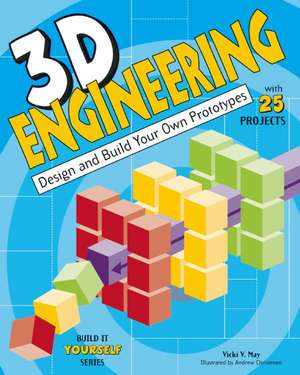
3-D Engineering
Autor Vicki V May Ilustrat de Andrew Christensenen Limba Engleză Hardback – 17 noi 2015 – vârsta până la 12 ani
Subliniem adesea importanța curiozității practice, iar 3-D Engineering de Vicki V May este, în esență, un ghid de transformare a ideilor abstracte în realitate tangibilă. Făcând parte din cunoscuta serie Build It Yourself, acest volum aduce un element inovator: accentul nu cade doar pe rezultat, ci pe prototipare ca etapă esențială de învățare. Credem că este instrumentul ideal pentru copiii care se întreabă constant cum funcționează lumea, de la zgârie-nori la elicoptere. Atmosfera amintește de Engineered! de Shannon Hunt, unde sunt prezentate soluții pentru probleme reale, dar în timp ce acea lucrare se concentrează pe studii de caz istorice, 3-D Engineering mizează pe implicarea directă a cititorului prin proiecte practice. Structura cărții este gândită să ghideze micul inginer printr-un parcurs logic: începe cu bazele stabilității în „Strong, Stiff, and Stable”, trece prin dinamica fluidelor și reacții chimice, și culminează cu generarea de energie și designul propriu. Putem afirma că experiența de lectură este una activă. Cele 128 de pagini în limba engleză sunt bogat ilustrate cu diagrame și tabele care simplifică noțiuni complexe de matematică și fizică. Proiectele, cum ar fi realizarea unui prototip de scaun din carton sau a unor instrumente muzicale, sunt concepute pentru a învăța copiii să eșueze controlat, să testeze și să re-proiecteze — inima procesului de inginerie. Este o resursă valoroasă care nu doar explică tehnologia, ci îi încurajează pe tineri să devină creatori ai acesteia.
Preț: 129.86 lei
Carte disponibilă
Livrare economică 09-23 noiembrie
Specificații
ISBN-10: 1619303116
Pagini: 128
Ilustrații: Color illustrations throughout, charts throughout, tables throughout
Dimensiuni: 208 x 259 x 10 mm
Greutate: 0.45 kg
Editura: Nomad Press (VT)
Locul publicării:Canada
V-ar putea interesa
-
 Preț: 93.12 lei
 -
 SloydGustaf LarssonPreț: 97.44 lei
 -
 Preț: 123.08 lei
 -
 -5%Preț: 95.16 lei100.17 lei
 -
 -21%Preț: 76.20 lei97.03 lei
 -
 Canals and DamsDonna LathamPreț: 95.13 lei
 -
 GarbageDonna LathamPreț: 102.22 lei
 -
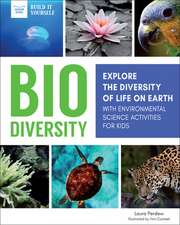 BiodiversityLaura PerdewPreț: 95.53 lei
 -
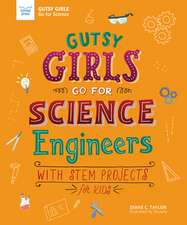 Gutsy Girls Go for Science: EngineersDiane TaylorPreț: 86.38 lei
 -
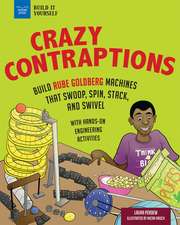 Preț: 100.26 lei
 -
 Roundy and Friends - RussiaAndres VarelaPreț: 126.25 lei
De ce să citești această carte
Recomandăm această carte părinților care doresc să cultive gândirea critică și abilitățile STEM la copiii de 9-12 ani. Prin proiecte de tip „design and build”, cititorul câștigă încredere în propria capacitate de a rezolva probleme tehnice. Este un manual practic care transformă timpul liber într-o aventură inginerească, oferind satisfacția imediată a construirii unui prototip funcțional.
Descriere scurtă
In 3D Engineering: Design and Build Your Own Prototypes, young readers tackle real-life engineering problems by figuring out real-life solutions. Kids apply science and math skills to create prototypes for bridges, instruments, alarms, and more. Prototypes are preliminary models used by engineers—and kids—to evaluate ideas and to better understand how things work.
Engineering design starts with an idea. How do we get to the other side of the river? How do we travel long distances in short periods of time? Using a structured engineering design process, kids learn how to brainstorm, build a prototype, test a prototype, evaluate, and re-design. Projects include designing a cardboard chair to understand the stiffness of structural systems and designing and building a set of pan pipes to experiment with pitch and volume.
Creating prototypes is a key step in the engineering design process and prototyping early in the design process generally results in better processes and products. 3D Engineering gives kids a chance to figure out many different prototypes, empowering them to discover the mechanics of the world we know.
Cuprins
Chapter 1: Strong, Stiff, and Stable
Chapter 2: Everything is Spinning
Chapter 3: Staying Afloat and Staying Aloft
Chapter 4: Prototypes That Use Chemical Reactions
Chapter 5: Prototypes That Produce Music
Chapter 6: Prototypes That Produce Light and Sound
Chapter 7: Prototypes That Generate Energy
Chapter 8: Design Prototypes of Your Own
Glossary
Resources
Index
Recenzii
School Library Connection, April 2016
“Author Vicky V. May has produced a procedural book for the 21st century. . . Recommended”
Booklist Online Exclusive: November 12, 2015
". . . . Part of the Build It Yourself series, this book will prove useful to middle-school science teachers."
Joseph J. Helble, dean, Thayer School of Engineering, professor of engineering, Dartmouth College
“3-D Engineering does a wonderful job of conveying the creative discovery and invention that are such important parts of engineering. The author nicely addresses the need for an engineer to not only use the tools of math and science to solve problems, but to experiment, tinker, and discover as a way to develop creative solutions to some of our most pressing problems.”
Amanda Burns, fifth-grade teacher
“This book brings engineering to the classroom in such a clear and concise way. Children and teachers learn about the many facets of the engineering world while engaging in fun, hands-on activities. This book provides an excellent overview of what it takes to think like an engineer. Every teacher interested in bringing STEM into the classroom needs a resource like this.”
Matt Buck, fifth-grade teacher
“This book nails it! A wonderful resource for the individuals in my classroom who want to take their learning a step further, and I can also use it with my whole class as we explore particular aspects of engineering. 3-D Engineering is engaging with its text and numerous opportunities for building and designing projects. A positive and engaging use of technology to link the learner to ‘Primary Source’ material!”
Praise for other books in the series:
Cities: Discover How They Work with 25 Projects
Winner of a 2014 Silver Moonbeam Award
School Library Journal
“According to the 2010 Census, 80% of Americans live in urban areas. But do they know what it takes to make a city run? From this well-organized and engaging text, readers will learn how cities developed and grew. . . this is a worthy title for any library collection.”
Booklist
“Propounding the emerging interdisciplinary paradigm of STEAM (science, technology, engineering, art and design, and mathematics), this hands-on informational book discusses how cities’ complex structures and systems function together in an interdependent way. Through appealing illustrations, reader-friendly text, and fun hands-on experiments suitable for home and classroom, Reilly helps foster an appreciation for the way that cities function almost as organisms with vibrant systems and interdependent structures.”
Bridges and Tunnels: Investigate Feats of Engineering with 25 Projects
Winner of a 2012 Gold Moonbeam Award
National Science Teachers Association Recommends
"This book is a treasure trove of information, experiments, and building challenges, and is an excellent, exciting, and easy way to incorporate STEM education into your classroom, science fair, or after school engineering club."
Skyscrapers: Investigate Feats of Engineering with 25 Projects
National Science Teachers Association Recommends
“. . . Skyscrapers would make an excellent resource for the history or science teacher desiring to try a project based learning (PBL) unit. With its timeline, glossary, and interesting prose, the teacher could challenge students with the question, ‘Would a skyscraper make a good school?’ In fact, this book would make a good springboard for a number of short engineering units. Skyscrapers is a terrific book, especially for elementary teachers looking for ideas to inject more engineering into their classroom.”
School Library Journal
“Large font and an open layout make this title accessible to reluctant readers . . . A useful title to supplement lessons on architecture, mathematics, or physics for classroom teachers or homeschoolers, and it’s an appealing initiation to the subject.”
Kristine E. Barnes, PE, Structural Engineer
“Skyscrapers is a fantastic introduction to the world of civil/structural engineering and the history of some really big projects and tall buildings. The projects help reinforce ideas and give kids a wonderful hands-on learning experience.”
Kenton D. Wesby, Art Specialist & STEAM Educator, SECME Master Teacher
“This book is awesome. Skyscrapers effectively navigates the basic principles of STEM, at the same time making connections with language arts, social studies, and visual arts. A must have for any teachers’ professional library.”