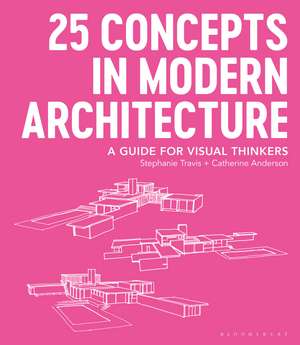
25 Concepts in Modern Architecture: A Guide for Visual Thinkers
Autor Stephanie Travis, Catherine Andersonen Limba Engleză Paperback – 23 sep 2021
Twenty-five concepts - each of which are key to architectural design thinking - are accessibly explained by examining twenty-five different masterworks of modern architecture. For example, the concept of 'movement' in architectural design is explained through a close look at a Le Corbusier building; 'transparency' is examined in Philip Johnson's seminal Glass House; 'asymmetry' is understood through the work of Zaha Hadid - and so on, through twenty-five core concepts and twenty-five of the most significant buildings of the modern era.
Taking a highly-visual approach, this simple yet visually-powerful guide is an essential companion in the design studio and to introductory courses in modern architecture, interior architecture, and interior design.
Understanding these concepts will provide a key to demystifying the greatest works in modern architectural history, inspire new ways to think about new design projects, and reveal how drawing and sketching are used as tools for the visual analysis of architecture.
Preț: 218.97 lei
Preț vechi: 284.47 lei
-23%
Puncte Express: 328
Carte disponibilă
Livrare economică 16-30 noiembrie
Livrare express 31 octombrie-06 noiembrie pentru 108.85 lei
Livrare prin curier în România Termenul estimat este afișat lângă disponibilitate.
Transport gratuit de la 400.00 lei Plată online sau ramburs, în funcție de opțiunile comenzii.
Retur gratuit în 14 zile Comandă securizată și suport în română.
Specificații
ISBN-13: 9781350055605
ISBN-10: 1350055603
Pagini: 216
Ilustrații: 341 colour illus
Dimensiuni: 200 x 228 x 12 mm
Greutate: 0.67 kg
Editura: Bloomsbury Publishing
Colecția Bloomsbury Visual Arts
Locul publicării:London, United Kingdom
ISBN-10: 1350055603
Pagini: 216
Ilustrații: 341 colour illus
Dimensiuni: 200 x 228 x 12 mm
Greutate: 0.67 kg
Editura: Bloomsbury Publishing
Colecția Bloomsbury Visual Arts
Locul publicării:London, United Kingdom
Cuprins
Introduction
1. Rotating L-Shapes
Schindler Chace House, Rudolph Schindler 1922
2. Manipulating Volumes
Bauhaus Master Houses, Walter Gropius 1926
3. Sliding Planes
Barcelona Pavilion, Mies Van Der Rohe 1929
4. Shifting Space
Lovell Beach House, Rudolph Schindler 1929
5. Moving Perspectives
Villa Savoy, Le Corbusier 1931
6. Compressing Horizontals
Jacobs House, Frank Lloyd Wright 1936
7. Expanding Volumes
Fallingwater, Frank Lloyd Wright 1937
8. Extending Rectangles
Kaufmann House, Richard Neutra 1947
9. Splitting Zones
Eames House, Charles and Ray Eames 1949
10. Offsetting Interior/Exterior
Glass House, Philip Johnson 1949
11. Layering Planes
Farnsworth House, Mies Van Der Rohe 1951
12. Undulating Forms
House of Canoas, Oscar Niemeyer 1951
13. Manipulating Light
Ronchamp, Le Corbusier 1955
14. Interlocking Cubes
Trenton Bath House, Louis Kahn 1955
15. Connecting Forms
Miller House, Eero Saarinen 1957
16. Lengthening Views
Stahl House, Pierre Koenig 1960
17. Overlapping Circles
Pavilion for Pre-Columbian Art, Philip Johnson 1963
18. Rotating Blocks
Fisher House, Louis Kahn 1967
19. Embedding Components
Koshino House, Tadao Ando 1984
20. Clustering Objects
Winton Guest House, Frank Gehry 1987
21. Engaging Procession
Church on the Water, Tadao Ando 1988
22. Lifting Elements
Maison Bordeaux, Rem Koolhaas 1998
23. Branching Masses
Y House, Steven Holl 1999
24. Stacking Shapes
Tokyo Apartment House, Sou Fujimoto 2006
25. Nesting Rectangles
House N, Sou Fujimoto 2008
Bibliography
Index
1. Rotating L-Shapes
Schindler Chace House, Rudolph Schindler 1922
2. Manipulating Volumes
Bauhaus Master Houses, Walter Gropius 1926
3. Sliding Planes
Barcelona Pavilion, Mies Van Der Rohe 1929
4. Shifting Space
Lovell Beach House, Rudolph Schindler 1929
5. Moving Perspectives
Villa Savoy, Le Corbusier 1931
6. Compressing Horizontals
Jacobs House, Frank Lloyd Wright 1936
7. Expanding Volumes
Fallingwater, Frank Lloyd Wright 1937
8. Extending Rectangles
Kaufmann House, Richard Neutra 1947
9. Splitting Zones
Eames House, Charles and Ray Eames 1949
10. Offsetting Interior/Exterior
Glass House, Philip Johnson 1949
11. Layering Planes
Farnsworth House, Mies Van Der Rohe 1951
12. Undulating Forms
House of Canoas, Oscar Niemeyer 1951
13. Manipulating Light
Ronchamp, Le Corbusier 1955
14. Interlocking Cubes
Trenton Bath House, Louis Kahn 1955
15. Connecting Forms
Miller House, Eero Saarinen 1957
16. Lengthening Views
Stahl House, Pierre Koenig 1960
17. Overlapping Circles
Pavilion for Pre-Columbian Art, Philip Johnson 1963
18. Rotating Blocks
Fisher House, Louis Kahn 1967
19. Embedding Components
Koshino House, Tadao Ando 1984
20. Clustering Objects
Winton Guest House, Frank Gehry 1987
21. Engaging Procession
Church on the Water, Tadao Ando 1988
22. Lifting Elements
Maison Bordeaux, Rem Koolhaas 1998
23. Branching Masses
Y House, Steven Holl 1999
24. Stacking Shapes
Tokyo Apartment House, Sou Fujimoto 2006
25. Nesting Rectangles
House N, Sou Fujimoto 2008
Bibliography
Index
Recenzii
25 Concepts is essential reading for students as well as anyone interested in understanding the development of design. It illuminates the importance of conceptual framework as the foundation of architecture and indeed any creative endeavor.
Travis and Anderson have created an invaluable resource for understanding and interpreting modern architecture and its formal strategies. Pairing executed concepts and hand-drawn diagrams with design descriptions that are approachable and accessible, this book is ideal for architectural students, educators and enthusiasts.
This book illustrates and analyzes universal design principles in a clear and systematic way. The selection of acclaimed modern structures reveals the historical and theoretical impact these buildings have had within the architectural field.
Travis and Anderson have created an invaluable resource for understanding and interpreting modern architecture and its formal strategies. Pairing executed concepts and hand-drawn diagrams with design descriptions that are approachable and accessible, this book is ideal for architectural students, educators and enthusiasts.
This book illustrates and analyzes universal design principles in a clear and systematic way. The selection of acclaimed modern structures reveals the historical and theoretical impact these buildings have had within the architectural field.