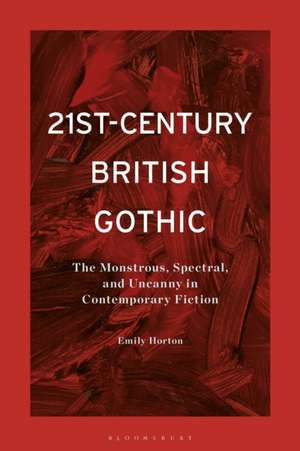
21st-Century British Gothic: The Monstrous, Spectral, and Uncanny in Contemporary Fiction
Autor Emily Hortonen Limba Engleză Paperback – 24 iul 2025
Marshalling new modes of diasporic and cross-disciplinary critical theory concerned with the violent dimensions of contemporary life, this book sets the Gothic aesthetics in such works as White is for Witching, Double Vision, Never Let Me Go, The Wasted Vigil and Ghost Wall against a backdrop of key events in the 21st-century. Drawing connections between moments of anxiety, such as 9/11, the wars in Afghanistan and Iraq, ecological disaster, the refugee crisis, Brexit, the pandemic, and the Gothic, Horton demonstrates how British literature mediates transnational experiences of trauma and horror, while also addressing local and national insecurities and preoccupations. As a result, 21st-Century British Gothic can tests geographical, psychological, cultural, and aesthetic borders to expose an often spectralised experience of human and planetary vulnerability and speaks back against the brutality of global capitalism.
Preț: 208.46 lei
Preț vechi: 279.52 lei
-25%
Puncte Express: 313
Carte tipărită la comandă
Livrare economică 02-16 decembrie
Livrare prin curier în România Termenul estimat este afișat lângă disponibilitate.
Transport gratuit de la 400.00 lei Plată online sau ramburs, în funcție de opțiunile comenzii.
Retur gratuit în 14 zile Comandă securizată și suport în română.
Specificații
ISBN-13: 9781350286603
ISBN-10: 1350286605
Pagini: 272
Dimensiuni: 152 x 232 x 18 mm
Greutate: 0.42 kg
Editura: Bloomsbury Publishing
Colecția Bloomsbury Academic
Locul publicării:London, United Kingdom
ISBN-10: 1350286605
Pagini: 272
Dimensiuni: 152 x 232 x 18 mm
Greutate: 0.42 kg
Editura: Bloomsbury Publishing
Colecția Bloomsbury Academic
Locul publicării:London, United Kingdom
Cuprins
INTRODUCTION: 21st-Century British Gothic: The Monstrous, Spectral, and Uncanny in Contemporary Fiction
CHAPTER 1: Post-9/11 Gothic: The Uncanny and Contemporary Trauma in Pat Barker's Double Vision and Patrick McGrath's Ghost Town
CHAPTER 2: Decolonial Gothic: Tropical Terrors and Subterranean Ghosts in Tash Aw's The Harmony Silk Factory and Nadeem Aslam's The Wasted Vigil
CHAPTER 3: Gothic Inheritance: Imperial Witchcraft and Haunted Houses in Helen Oyeyemi's White is for Witching and Sarah Waters' The Little Stranger
CHAPTER 4: Digital Gothic: Digital Technology, Migration, and the Gothic in Hari Kunzru's Transmission and Mohsin Hamid's Exit West
CHAPTER 5: Gothic Homelessness: Spectral Inhabitants and Uncanny Spaces in Ali Smith's Hotel World, Trezza Azzopardi's Remember Me, and Brian Chikwava's Harare North
CHAPTER 6: The Gothic City: Uncanny spaces, historical spectres, and monstrous urbanity in Louise Welsh's The Cutting Room and Chloe Aridjis's Book of Clouds
CHAPTER 7: Brexit Gothic: Spectral Illusions and Affect Memories in Sarah Moss's Ghost Wall and Niall Griffith's Broken Ghost
CHAPTER 8: Pandemic Gothic: Childhood Terror and Monstrous Illness in the Fiction of Kazuo Ishiguro and M.R. Carey
CHAPTER 9: Wet Gothic: Ecofeminism and Horror in Julie Armfield's Our Wives Under the Sea, Daisy Johnson's Fen, and Zoe Gilbert's Folk
Bibliography
Index
CHAPTER 1: Post-9/11 Gothic: The Uncanny and Contemporary Trauma in Pat Barker's Double Vision and Patrick McGrath's Ghost Town
CHAPTER 2: Decolonial Gothic: Tropical Terrors and Subterranean Ghosts in Tash Aw's The Harmony Silk Factory and Nadeem Aslam's The Wasted Vigil
CHAPTER 3: Gothic Inheritance: Imperial Witchcraft and Haunted Houses in Helen Oyeyemi's White is for Witching and Sarah Waters' The Little Stranger
CHAPTER 4: Digital Gothic: Digital Technology, Migration, and the Gothic in Hari Kunzru's Transmission and Mohsin Hamid's Exit West
CHAPTER 5: Gothic Homelessness: Spectral Inhabitants and Uncanny Spaces in Ali Smith's Hotel World, Trezza Azzopardi's Remember Me, and Brian Chikwava's Harare North
CHAPTER 6: The Gothic City: Uncanny spaces, historical spectres, and monstrous urbanity in Louise Welsh's The Cutting Room and Chloe Aridjis's Book of Clouds
CHAPTER 7: Brexit Gothic: Spectral Illusions and Affect Memories in Sarah Moss's Ghost Wall and Niall Griffith's Broken Ghost
CHAPTER 8: Pandemic Gothic: Childhood Terror and Monstrous Illness in the Fiction of Kazuo Ishiguro and M.R. Carey
CHAPTER 9: Wet Gothic: Ecofeminism and Horror in Julie Armfield's Our Wives Under the Sea, Daisy Johnson's Fen, and Zoe Gilbert's Folk
Bibliography
Index
Recenzii
Horton's 21st-Century British Gothic is a fresh reassessment of an infamously mutable mode, bringing recognition to the uncanny, substance to the spectral, and hope to the monstrous by focusing the critical conversation on justice.
Takes readers on a spirited tour through the real and metaphorical bogeymen of the past forty years.
Incisive, richly informed and beautifully written, this book is a major contribution to Gothic studies. It will be essential reading for anyone wanting to deepen their understanding of new directions in Gothic fiction in the twenty-first century. Highly recommended.
Takes readers on a spirited tour through the real and metaphorical bogeymen of the past forty years.
Incisive, richly informed and beautifully written, this book is a major contribution to Gothic studies. It will be essential reading for anyone wanting to deepen their understanding of new directions in Gothic fiction in the twenty-first century. Highly recommended.
Notă biografică
Emily Horton is Senior Lecturer in English at Brunel University, UK. Her research interests include contemporary world literature, specializing in trauma and affect theory, genre and popular fiction, and fictional explorations of globalization and transnationalism. Her monograph, Contemporary Crisis Fictions, was published in 2014, and she has also co-edited the following volumes: The 2010s: A Decade in Contemporary British Fiction, with Nick Bentley, Philip Tew and Nick Hubble (Bloomsbury, 2024); The 1980s: A Decade in Contemporary British Fiction, with Philip Tew and Leigh Wilson (Bloomsbury, 2014); and Ali Smith, with Monica Germanà (Bloomsbury, 2013).