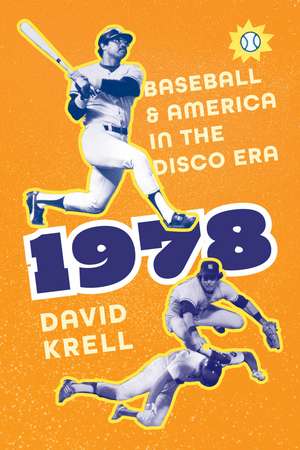
1978: Baseball and America in the Disco Era
Autor David Krellen Limba Engleză Hardback – apr 2025
From spring training to the World Series, 1978 gave baseball fans one of the sport’s greatest seasons, full of legendary moments like the battle between the New York Yankees and the Boston Red Sox for the American League East pennant, Gaylord Perry’s three thousandth strikeout, Tom Seaver’s only career no-hitter, Willie McCovey’s five hundredth home run, and Pete Rose’s marathon forty-four-game hitting streak. The 1978 season played out against a backdrop of disco music, bell-bottom pants, and gas-guzzling cars, while Hollywood answered a desperate longing for a simpler time with nostalgic offerings such as Grease, The Buddy Holly Story, American Hot Wax, Animal House, and Superman. Robin Williams became a household name with a guest appearance on the popular TV show Happy Days, Atlantic City debuted its first casino, and Jill Clayburgh symbolized the emerging independence of women in An Unmarried Woman.
In a memorable end to the baseball season, Reggie Jackson and Bucky Dent led the Yankees to their second consecutive World Series over the Dodgers after losing the first two games, then winning four in a row. With a month-by-month approach, David Krell breaks down major events in both baseball and American culture at large in 1978, chronicling in novelistic detail the notable achievements of some of the greatest players of the era, along with some of the national pastime’s quirkiest moments, to capture an extraordinary year in baseball.
Preț: 208.06 lei
Puncte Express: 312
Carte disponibilă
Livrare economică 03-17 noiembrie
Livrare prin curier în România Termenul estimat este afișat lângă disponibilitate.
Transport gratuit de la 400.00 lei Plată online sau ramburs, în funcție de opțiunile comenzii.
Retur gratuit în 14 zile Comandă securizată și suport în română.
Specificații
ISBN-13: 9781496239600
ISBN-10: 1496239601
Pagini: 224
Ilustrații: index
Dimensiuni: 152 x 229 mm
Greutate: 0.49 kg
Editura: Nebraska
Colecția University of Nebraska Press
Locul publicării:United States
ISBN-10: 1496239601
Pagini: 224
Ilustrații: index
Dimensiuni: 152 x 229 mm
Greutate: 0.49 kg
Editura: Nebraska
Colecția University of Nebraska Press
Locul publicării:United States
Notă biografică
David Krell is the author of 1962: Baseball and America in the Time of JFK (Nebraska, 2021), Do You Believe in Magic? Baseball and America in the Groundbreaking Year of 1966, and The Fenway Effect: A Cultural History of the Boston Red Sox (Nebraska, 2024).
Extras
1
THE BEST INTERESTS OF BASEBALL
JANUARY
Ellicott Creek Park look like it jumped off a Currier and Ives Christmas card.
Snow blanketed the Buffalo area, a typical occurrence during winter in
western New York. Saint Christopher Parish stood adjacent to the park
under gray skies, fulfilling its duty on this mid-January day in 1978 as a gath-
ering place to honor the life of a person who had recently passed.
Joseph Vincent McCarthy, Baseball Hall of Fame, class of 1957.
His death from pneumonia at the age of ninety triggered an outpouring
of nostalgia for eras when newspapers had evening editions, baseball teams
leaving their cities was a forbidden idea, and the designated hitter did not
exist. As mourners scouted for seating opportunities among the pews in the
brick-faced church on Niagara Falls Boulevard in Tonawanda, their thoughts
turned to bygone years, when the world seemed simpler, slower, and less
crowded for time.
Baseball notables were among the attendees. Hall of Famer Monte Irvin,
New York–Pennsylvania League president Vincent McNamara, Hall of Fame
director Ken Smith, New York Yankees vice president Marshall Samuel, and
former Yankees pr director Bob Fishel filed into Saint Chris along with others
paying their respects and preparing to take the legendary manager to his
final resting place at Mount Olivet Cemetery.
Unlike fiery Leo Durocher or colorful Casey Stengel, McCarthy had a
quieter way about him. “Joe McCarthy understood what good players could
do for a manager and never pushed too many buttons to inhibit the best
results,” Buffalo News sportswriter Franklyn Buell reminded readers.
His management style led to seven World Series titles in his eight Fall Classic
appearances with the Yankees, between 1932 and the early part of May 1946,
when he stepped down. McCarthy, a Philadelphia native, might not have chosen
baseball as an outlet when he was a kid except for a fateful shopping trip for a
new suit with his mother. There was an added incentive for ten-year-old Joe—a
bat and ball were part of the purchase at Snellenburg’s Department Store on
the corner of Twelfth and Market Streets. “Mother argued against buying it,”
recalled McCarthy in 1937. “I coaxed and finally won.” The New York Giants
were in town to play the Phillies; they walked by the store as Mrs. McCarthy
and her son walked out. “From that minute baseball became my life,” he said. “I
started to dream about the game—and have never stopped.”
THE BEST INTERESTS OF BASEBALL
JANUARY
Ellicott Creek Park look like it jumped off a Currier and Ives Christmas card.
Snow blanketed the Buffalo area, a typical occurrence during winter in
western New York. Saint Christopher Parish stood adjacent to the park
under gray skies, fulfilling its duty on this mid-January day in 1978 as a gath-
ering place to honor the life of a person who had recently passed.
Joseph Vincent McCarthy, Baseball Hall of Fame, class of 1957.
His death from pneumonia at the age of ninety triggered an outpouring
of nostalgia for eras when newspapers had evening editions, baseball teams
leaving their cities was a forbidden idea, and the designated hitter did not
exist. As mourners scouted for seating opportunities among the pews in the
brick-faced church on Niagara Falls Boulevard in Tonawanda, their thoughts
turned to bygone years, when the world seemed simpler, slower, and less
crowded for time.
Baseball notables were among the attendees. Hall of Famer Monte Irvin,
New York–Pennsylvania League president Vincent McNamara, Hall of Fame
director Ken Smith, New York Yankees vice president Marshall Samuel, and
former Yankees pr director Bob Fishel filed into Saint Chris along with others
paying their respects and preparing to take the legendary manager to his
final resting place at Mount Olivet Cemetery.
Unlike fiery Leo Durocher or colorful Casey Stengel, McCarthy had a
quieter way about him. “Joe McCarthy understood what good players could
do for a manager and never pushed too many buttons to inhibit the best
results,” Buffalo News sportswriter Franklyn Buell reminded readers.
His management style led to seven World Series titles in his eight Fall Classic
appearances with the Yankees, between 1932 and the early part of May 1946,
when he stepped down. McCarthy, a Philadelphia native, might not have chosen
baseball as an outlet when he was a kid except for a fateful shopping trip for a
new suit with his mother. There was an added incentive for ten-year-old Joe—a
bat and ball were part of the purchase at Snellenburg’s Department Store on
the corner of Twelfth and Market Streets. “Mother argued against buying it,”
recalled McCarthy in 1937. “I coaxed and finally won.” The New York Giants
were in town to play the Phillies; they walked by the store as Mrs. McCarthy
and her son walked out. “From that minute baseball became my life,” he said. “I
started to dream about the game—and have never stopped.”
Cuprins
Acknowledgments
1. The Best Interests of Baseball: January
2. “A Chance to Be Absolutely Unbelievable”: February
3. Goodbye Dark, My Old Friend: March
4. Move Over, Baby Ruth, Here Comes Reggie: April
5. Kingman’s Performance and Lasorda’s Outrage: May
6. Louisiana Lightning and Greased Lightning: June
7. Melodrama in the Bronx: July
8. A Rose by Any Other Game: August
9. The Boston Massacre: September
10. The World Series: October
11. A Tale of Two Sparkys: November
12. It’s a Bird . . . It’s a Plane . . . It’s a Blockbuster: December
Notes
Bibliography
Index
1. The Best Interests of Baseball: January
2. “A Chance to Be Absolutely Unbelievable”: February
3. Goodbye Dark, My Old Friend: March
4. Move Over, Baby Ruth, Here Comes Reggie: April
5. Kingman’s Performance and Lasorda’s Outrage: May
6. Louisiana Lightning and Greased Lightning: June
7. Melodrama in the Bronx: July
8. A Rose by Any Other Game: August
9. The Boston Massacre: September
10. The World Series: October
11. A Tale of Two Sparkys: November
12. It’s a Bird . . . It’s a Plane . . . It’s a Blockbuster: December
Notes
Bibliography
Index
Recenzii
“For anyone who views baseball through the lens of pop culture (or vice versa), Krell’s latest book will feel like a warm embrace.”—David Pegram, NINE
"An enjoyable and quick read for fans of the game in that time—the beginning of free agency, the re-emergence of the Yankee-Dodger rivalry and some other events that made that season memorable for many fans."—Guy Who Reviews Sports Books blog
“This was the year of baseball’s explosive pennant race, climaxed by the greatest playoff game ever and the most improbable game-winning home run of all time. Red Sox, Yankees, Tom Lasorda ranting, John Travolta dancing, Happy Days, the Sex Pistols, and Bucky effing Dent—David Krell captures it all brilliantly in 1978.”—Jerry Grillo, author of Big Cat: The Life of Baseball Hall of Famer Johnny Mize
“In 1978: Baseball and America in the Disco Era David Krell continues his exploration of the intersection of baseball and American popular culture. From the death of Hall of Fame manager Joe McCarthy in January through the rise of Herman Wouk’s epic novel War and Remembrance, Krell has fashioned a rollicking good tale, interweaving analysis of the movies and television shows people were watching with fascinating details of a memorable season that saw the Yankees and Dodgers win their leagues’ pennants and face off in the World Series.”—Steven Gietschier, author of Baseball: The Turbulent Midcentury Years
Descriere
David Krell chronicles in novelistic detail the notable achievements of some of baseball’s greatest players of 1978, along with some of the national pastime’s quirkiest moments, to capture an extraordinary year in baseball.