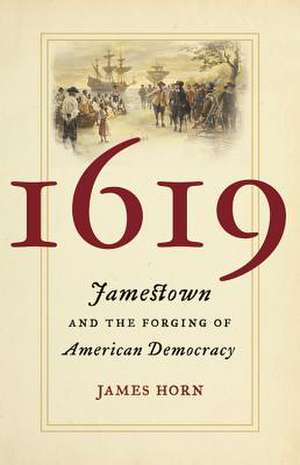
1619: Jamestown and the Forging of American Democracy
Autor James Hornen Limba Engleză Hardback – 15 noi 2018
After running Jamestown under martial law from 1610-1616, the Virginia Company turned toward representative government in an effort to provide settlers with more control over their own affairs and more incentive to invest further in the colony. Governor Edwin Sandys dreamed of creating a real commonwealth, to provide for the interests of settlers and Indians alike. Thus, in late July 1619, the newly-formed General Assembly gathered to introduce "just Laws for the happy guiding and governing of the people." It was the first legislature in America, and history has cast it as the foundation of American freedom and democracy. From that moment on, propertied white colonists became accustomed to freedoms that would have been unthinkable in England with its layers of customs and hierarchy of courts and regulations, and these expanding political and economic freedoms attracted countless British immigrants and other Europeans to Virginia and the American colonies.
But those very freedoms also permitted the wholesale and largely unchecked exploitation of poor white laborers and non-European peoples. More than nine-tenths of all those arriving in Virginia at this time were brought in some form of servitude or labor contract. In a cruel irony, 1619 also saw the arrival of the first African slaves in Virginia. The establishment of the General Assembly did nothing to ameliorate these disparities, but rather put ever more power in the hands of local grandees. Sandys's dream of creating a commonwealth in the interests of settlers and Indians proved short-lived. But the twin pillars of democracy-the rule of law and representative government based on the consent of the people-survived and flourished. It was his greatest legacy to America. What was lost was his steadfast conviction that serving the common good served all.
This is a pattern we recognize all too well in modern American society-opportunities are not shared, inequality is rampant, racism is systemic. We would like to think these are problems that can be solved by expanding representative democracy; Jamestown teaches us, instead, that these are problems have long been created and encouraged by American democracy. Casting a skeptical eye on deeply-cherished myths, 1619 will be essential reading for anyone struggling to understand the paradox of American freedom.
Preț: 129.50 lei
Preț vechi: 186.97 lei
-31%
Puncte Express: 194
Carte disponibilă
Livrare economică 02-16 noiembrie
Livrare prin curier în România Termenul estimat este afișat lângă disponibilitate.
Transport gratuit de la 400.00 lei Plată online sau ramburs, în funcție de opțiunile comenzii.
Retur gratuit în 14 zile Comandă securizată și suport în română.
Specificații
ISBN-13: 9780465064694
ISBN-10: 0465064698
Pagini: 288
Ilustrații: 4 Maps and 3 Illustrations, black & white
Dimensiuni: 156 x 238 x 32 mm
Greutate: 0.49 kg
Editura: Little Brown
Colecția Basic Books
Locul publicării:London, United Kingdom
ISBN-10: 0465064698
Pagini: 288
Ilustrații: 4 Maps and 3 Illustrations, black & white
Dimensiuni: 156 x 238 x 32 mm
Greutate: 0.49 kg
Editura: Little Brown
Colecția Basic Books
Locul publicării:London, United Kingdom