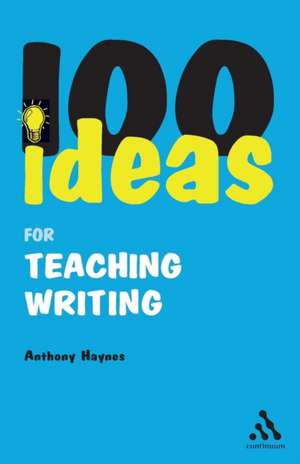
100 Ideas for Teaching Writing: Continuum One Hundreds
Autor Anthony Haynesen Limba Engleză Paperback – 10 mar 2007
- Can teach writing as part of the whole curriculum and as a component of pupils' linguistic development
- Can teach writing as a process rather than just a product - the process includes: finding ideas, designing briefs, drafting, revising, polishing and presenting
- Use assessment as part of a cycle to improve pupils' learning and the teacher's planning
The book is full of practical tips including instant lessons, effective resources, and lists of dos and don'ts. Emphasis is put on providing pupils with a sense of purpose, opportunities to write for real and varied audiences, and experience of real life types of writing.




Preț: 74.40 lei
Puncte Express: 112
Carte tipărită la comandă
Livrare economică 18 noiembrie-02 decembrie
Livrare prin curier în România Termenul estimat este afișat lângă disponibilitate.
Transport gratuit de la 400.00 lei Plată online sau ramburs, în funcție de opțiunile comenzii.
Retur gratuit în 14 zile Comandă securizată și suport în română.
Specificații
ISBN-13: 9780826483096
ISBN-10: 0826483097
Pagini: 128
Dimensiuni: 124 x 198 x 10 mm
Greutate: 0.14 kg
Editura: Bloomsbury Publishing
Colecția Continuum
Seria Continuum One Hundreds
Locul publicării:London, United Kingdom
ISBN-10: 0826483097
Pagini: 128
Dimensiuni: 124 x 198 x 10 mm
Greutate: 0.14 kg
Editura: Bloomsbury Publishing
Colecția Continuum
Seria Continuum One Hundreds
Locul publicării:London, United Kingdom
V-ar putea interesa
-
 English Homework for Key Stage 2: Activity-Based LearningAndrea McGowanPreț: 370.01 lei
 -
 Preț: 292.98 lei
 -
 Preț: 305.32 lei
 -
 The Trainee Primary Teacher's HandbookGererd Dixie-23%Preț: 276.23 lei359.20 lei
 -
 100 Ideas for Lesson PlanningAnthony Haynes-43%Preț: 79.90 lei140.84 lei
 -
 Primary Curriculum - Teaching the Foundation SubjectsRosemary Boys-11%Preț: 331.48 lei372.80 lei
 -
 101 Essential Lists for Primary TeachersFred Sedgwick-45%Preț: 69.55 lei127.24 lei
 -
 Teaching Foreign Languages in the Primary SchoolDr Claudine Kirsch-11%Preț: 331.97 lei373.07 lei
 -
 -41%Preț: 101.20 lei171.58 lei
 -
 -43%Preț: 161.88 lei283.68 lei
 -
 100 Ideas for Primary Teachers: Behaviour ManagementMolly Potter-42%Preț: 74.77 lei128.80 lei
 -
 Preț: 131.15 lei
 -
 100 Ideas for Developing Thinking in the Primary SchoolFred Sedgwick-42%Preț: 98.33 lei170.62 lei
 -
 100 Ideas for Teaching Primary MathematicsAlan Thwaites-45%Preț: 89.14 lei162.87 lei
 -
 -20%Preț: 174.47 lei218.70 lei
Cuprins
1. Thinking about writing eg
- place in curriculum
- the writing cycle
- progression (what to do when)
- common abuses
2. Teaching the writing process eg
- Writing roles: the composer and the secretary
- process and product: it's not either/or
- main stages in the process
- writing frames (David Wray)
3. Starting points
- getting ideas
- free-writing
- intensive writing (Margaret Langdon)
- stimuli
4. Drafting and redrafting eg
- Helping pupils to plan
- Responding to drafts
- Proofreading
- presentation
5. Forms and structures eg
- Essays
- Reports
- Narratives
- poetry
6. Writing for different audiences eg
- Who are we writing for? specifying the audience
- The key distinction: personal and impersonal audiences
- Writing for real audiences
- Writing for simulated audiences
7. Technology (handwriting, ICT) eg
- Pens
- physical factors (seating, posture, grip)
- ICT as a stimulus
- ICT and the drafting process: on not starting at the top
8. Spelling eg
- good practice
- bad practice (often well-intentioned and sadly all too common)
- whole school approaches
- children's spelling ages
9. Punctuation eg
- Teaching punctuation marks as road signs
- Showing how punctuation affects meaning
- Speech marks
- Apostrophes
10. Assessment and evaluation eg
- self-assessment by pupils
- establishing symbols for marking
- practical techniques for marking
- what to do with the results
11. Resources eg
- Dictionaries
- Objects in the classroom
- Websites for pupils
books for teacher
- place in curriculum
- the writing cycle
- progression (what to do when)
- common abuses
2. Teaching the writing process eg
- Writing roles: the composer and the secretary
- process and product: it's not either/or
- main stages in the process
- writing frames (David Wray)
3. Starting points
- getting ideas
- free-writing
- intensive writing (Margaret Langdon)
- stimuli
4. Drafting and redrafting eg
- Helping pupils to plan
- Responding to drafts
- Proofreading
- presentation
5. Forms and structures eg
- Essays
- Reports
- Narratives
- poetry
6. Writing for different audiences eg
- Who are we writing for? specifying the audience
- The key distinction: personal and impersonal audiences
- Writing for real audiences
- Writing for simulated audiences
7. Technology (handwriting, ICT) eg
- Pens
- physical factors (seating, posture, grip)
- ICT as a stimulus
- ICT and the drafting process: on not starting at the top
8. Spelling eg
- good practice
- bad practice (often well-intentioned and sadly all too common)
- whole school approaches
- children's spelling ages
9. Punctuation eg
- Teaching punctuation marks as road signs
- Showing how punctuation affects meaning
- Speech marks
- Apostrophes
10. Assessment and evaluation eg
- self-assessment by pupils
- establishing symbols for marking
- practical techniques for marking
- what to do with the results
11. Resources eg
- Dictionaries
- Objects in the classroom
- Websites for pupils
books for teacher