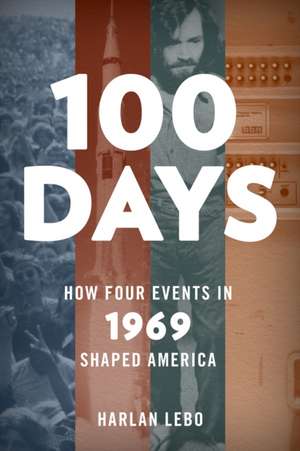
100 Days: How Four Events in 1969 Shaped America
Autor Harlan Leboen Limba Engleză Hardback – 28 iun 2019
Preț: 110.93 lei
Preț vechi: 178.38 lei
-38%
Puncte Express: 166
Carte disponibilă
Livrare economică 28 octombrie-11 noiembrie
Livrare prin curier în România Termenul estimat este afișat lângă disponibilitate.
Transport gratuit de la 400.00 lei Plată online sau ramburs, în funcție de opțiunile comenzii.
Retur gratuit în 14 zile Comandă securizată și suport în română.
Specificații
ISBN-13: 9781538125915
ISBN-10: 1538125919
Pagini: 368
Ilustrații: 12 BW Photos
Dimensiuni: 160 x 230 x 32 mm
Greutate: 0.74 kg
Editura: Bloomsbury Publishing
Colecția Rowman & Littlefield
Locul publicării:New York, United States
ISBN-10: 1538125919
Pagini: 368
Ilustrații: 12 BW Photos
Dimensiuni: 160 x 230 x 32 mm
Greutate: 0.74 kg
Editura: Bloomsbury Publishing
Colecția Rowman & Littlefield
Locul publicării:New York, United States
V-ar putea interesa
-
 The Horror ReaderKen GelderPreț: 410.57 lei
 -
 Preț: 414.14 lei
 -
 CasablancaHarlan LeboPreț: 126.12 lei
 -
 Simulation in Media and Culture: Believing the HypeRobin DeRosa-29%Preț: 344.47 lei483.42 lei
 -
 Media and Popular MusicPeter Mills-18%Preț: 170.14 lei207.13 lei
 -
 Writing the Dark Side of TravelJonathan SkinnerPreț: 262.57 lei
 -
 Cultures of ColourChris HorrocksPreț: 530.69 lei
 -
 Preț: 124.65 lei
 -
 -33%Preț: 613.23 lei910.42 lei
 -
 Nobody Expects the Spanish Inquisition: Cultural Contexts in Monty PythonTomasz Dobrogoszcz-32%Preț: 392.00 lei578.47 lei
 -
 The Function of Evil across Disciplinary ContextsMalcah Effron-27%Preț: 285.46 lei388.60 lei
 -
 -27%Preț: 262.65 lei359.40 lei
 -
 -27%Preț: 269.33 lei368.65 lei
 -
 -23%Preț: 259.38 lei336.65 lei
 -
 Organizational Culture & Identity: Sport, Symbols & SuccessAaron C. T. Smith-27%Preț: 1220.57 lei1661.54 lei
 -
 The American Way of Life: A Cultural HistoryLawrence R. Samuel-27%Preț: 261.74 lei358.92 lei
 -
 -32%Preț: 584.03 lei864.49 lei
 -
 -25%Preț: 180.20 lei241.65 lei
 -
 Mamma Mia! The Movie: Exploring a Cultural PhenomenonLouise FitzGerald-25%Preț: 187.87 lei251.14 lei
 -
 -5%Preț: 85.20 lei89.50 lei
 -
 -11%Preț: 80.84 lei90.99 lei
 -
 -19%Preț: 343.67 lei422.49 lei
Cuprins
Contents
Four events that shaped America, with only 100 days from first to last
Author's Note
Part I: Moon
Chapter 1: Challenging the Impossible
Chapter 2: More than Bold Predictions
Chapter 3: That Irresistible Charisma
Chapter 4: The Sight of Whizzing Flashes
Chapter 5: Beep
Chapter 6: A Dull Thud
Chapter 7: Three Steps ahead of a Pack of Hounds
Chapter 8: No Choice but to be Pioneers
Chapter 9: Go
Chapter 10: A Magnificent Sight
Chapter 11: A Sense of Possibilities
Counterculture
Part II: Manson
Chapter 12: Like Moths to a Flame
Chapter 13: Mesmerized
Chapter 14: A Carnival Ride to the Apocalypse
Part III: Woodstock
Chapter 15: Grasshoppers in the Grain Fields
Chapter 16: Overtaken by the Feeling
Chapter 17: Coming from a Dream
Part IV: Internet
Chapter 18: Color and Flash
Chapter 19: "LO"
Chapter 20: How to Move the World from the Right Place
Chapter 21: Gaining Momentum
Chapter 22: On Hold
Chapter 23: Pumpkins and Mice
Chapter 24: All the Heavy Lifting
Chapter 25: Dissolving Containers
Epilogue
Acknowledgements
Resources
Bibliography
Notes
About the Author
Four events that shaped America, with only 100 days from first to last
Author's Note
Part I: Moon
Chapter 1: Challenging the Impossible
Chapter 2: More than Bold Predictions
Chapter 3: That Irresistible Charisma
Chapter 4: The Sight of Whizzing Flashes
Chapter 5: Beep
Chapter 6: A Dull Thud
Chapter 7: Three Steps ahead of a Pack of Hounds
Chapter 8: No Choice but to be Pioneers
Chapter 9: Go
Chapter 10: A Magnificent Sight
Chapter 11: A Sense of Possibilities
Counterculture
Part II: Manson
Chapter 12: Like Moths to a Flame
Chapter 13: Mesmerized
Chapter 14: A Carnival Ride to the Apocalypse
Part III: Woodstock
Chapter 15: Grasshoppers in the Grain Fields
Chapter 16: Overtaken by the Feeling
Chapter 17: Coming from a Dream
Part IV: Internet
Chapter 18: Color and Flash
Chapter 19: "LO"
Chapter 20: How to Move the World from the Right Place
Chapter 21: Gaining Momentum
Chapter 22: On Hold
Chapter 23: Pumpkins and Mice
Chapter 24: All the Heavy Lifting
Chapter 25: Dissolving Containers
Epilogue
Acknowledgements
Resources
Bibliography
Notes
About the Author
Recenzii
Correlating a series of vignettes under four topical headings-"Moon," "Manson," "Woodstock," "Internet"-Lebo (cultural historian, USC Annenberg School for Communication and Journalism) attempts to reveal how four events "transformed the American experience." Looking at each event from a cultural historian's perspective, Lebo exposes the technological progress of a nation challenged, the greatest and worst of humanity, and the frightening yet exhilarating change new modes of socialization and e-commerce have wrought. What makes this narrative unique and worthy of study is the temporal setting in which all four events took place-a mere 100 days. More important than the exposure of four events is the exposure of cultural bases of the events. The connectivity is exemplified by bringing together various programs in response to a presidential challenge, an accomplishment that has become, as Lebo writes in chapter 11, "so commonplace that it is no longer noticed." Both the worst of individuals (Manson) and the best of gatherings (Woodstock) have become integral to the US vernacular and individualized iconic symbols. Such seemingly disconnected events reveal the necessity of returning to Crevecoeur's 18th-century question: What is an American?"
Lebo digs deeply into the context and history of each [event]: the political energy behind space exploration, Charles Manson's psychology, the lives and experiences of Woodstock attendees, and the internet's technical history and commercial influence. . . . [T]hose new to the period will find this account edifying.
Just as Neil Armstrong rocketed towards the moon in July of 1969, Lebo boldly bursts through the past into the present. . . . As [Lebo] leads the reader through these 100 days, the reader comes to recognize that the many conveniences and ills which impact us today can be traced back to those four historic moments.
What sets [100 Days] apart . . . is that Lebo looks closer at then-major names and at the everyman players, both who had pinky-fingers on what happened. These are the people who were almost headline-makers, who had remarkable front-row seats before slipping back into the crowd. History doesn't always recall those bit-players; Lebo does, and that's where readers will find the best parts of 100 Days. There's why you'll want to check this book on your list.
How can one author authoritatively and engagingly write about four such disparate events? Harlan Lebo tells the political, scientific, and popular story of how the United States came from behind to be the first nation to put footprints on the moon, then effortlessly shifts to true crime writer, describing how sociopath Charles Manson could suck lost young souls into his web of ultraviolence. Pivot again to Woodstock, the Baby Boom's symbol of the utopian society that might have been, and finally to-wait for it-the invention of the Internet. Lebo deals with technical subjects with deftness and in a style that is at once succinct and entertaining. And, believe it or not, he connects the dots of these world-changing events that all happened in a span of 100 days in 1969. Far out!
There have been a number of books focused on the Moon Landing, Woodstock, the Manson Murders and the beginning of the of the Internet. Only Harlan Lebo has weaved those stories together as a master story teller to look at the common themes and how they define the end of the 1960s. Through Lebo's eyes, these events, coming a year after the nation's political and social fabric was torn apart in 1968, represent the beginning of a new age. These events share more than a calendar year; they signify the opening of a new chapter in American history.
Lebo digs deeply into the context and history of each [event]: the political energy behind space exploration, Charles Manson's psychology, the lives and experiences of Woodstock attendees, and the internet's technical history and commercial influence. . . . [T]hose new to the period will find this account edifying.
Just as Neil Armstrong rocketed towards the moon in July of 1969, Lebo boldly bursts through the past into the present. . . . As [Lebo] leads the reader through these 100 days, the reader comes to recognize that the many conveniences and ills which impact us today can be traced back to those four historic moments.
What sets [100 Days] apart . . . is that Lebo looks closer at then-major names and at the everyman players, both who had pinky-fingers on what happened. These are the people who were almost headline-makers, who had remarkable front-row seats before slipping back into the crowd. History doesn't always recall those bit-players; Lebo does, and that's where readers will find the best parts of 100 Days. There's why you'll want to check this book on your list.
How can one author authoritatively and engagingly write about four such disparate events? Harlan Lebo tells the political, scientific, and popular story of how the United States came from behind to be the first nation to put footprints on the moon, then effortlessly shifts to true crime writer, describing how sociopath Charles Manson could suck lost young souls into his web of ultraviolence. Pivot again to Woodstock, the Baby Boom's symbol of the utopian society that might have been, and finally to-wait for it-the invention of the Internet. Lebo deals with technical subjects with deftness and in a style that is at once succinct and entertaining. And, believe it or not, he connects the dots of these world-changing events that all happened in a span of 100 days in 1969. Far out!
There have been a number of books focused on the Moon Landing, Woodstock, the Manson Murders and the beginning of the of the Internet. Only Harlan Lebo has weaved those stories together as a master story teller to look at the common themes and how they define the end of the 1960s. Through Lebo's eyes, these events, coming a year after the nation's political and social fabric was torn apart in 1968, represent the beginning of a new age. These events share more than a calendar year; they signify the opening of a new chapter in American history.