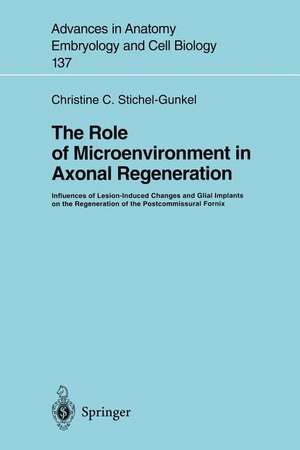
The Role of Microenvironment in Axonal Regeneration
Autor Christine C. Stichel-Gunkelen Limba Engleză Paperback – 19 iun 1997
Preț: 606.55 lei
Preț vechi: 713.59 lei
-15% Nou
Puncte Express: 910
Preț estimativ în valută:
107.32€ • 125.02$ • 93.71£
107.32€ • 125.02$ • 93.71£
Carte tipărită la comandă
Livrare economică 19 ianuarie-02 februarie 26
Preluare comenzi: 021 569.72.76
Specificații
ISBN-13: 9783540627876
ISBN-10: 3540627871
Pagini: 92
Ilustrații: VIII, 82 p. 18 illus.
Dimensiuni: 155 x 235 x 6 mm
Greutate: 0.15 kg
Ediția:Softcover reprint of the original 1st ed. 1997
Editura: Springer
Locul publicării:Berlin, Heidelberg, Germany
ISBN-10: 3540627871
Pagini: 92
Ilustrații: VIII, 82 p. 18 illus.
Dimensiuni: 155 x 235 x 6 mm
Greutate: 0.15 kg
Ediția:Softcover reprint of the original 1st ed. 1997
Editura: Springer
Locul publicării:Berlin, Heidelberg, Germany
V-ar putea interesa
-
 ThinkingJohn BrockmanPreț: 107.35 lei
 -
 The Woman who Changed Her BrainBarbara Arrowsmith-Young-20%Preț: 71.61 lei89.53 lei
 -
 How to Create a MindRay KurzweilPreț: 100.44 lei
 -
 -31%Preț: 358.42 lei521.79 lei
 -
 -37%Preț: 569.84 lei903.82 lei
 -
 Frazzetto, G: How We FeelGiovanni (Author) Frazzetto-20%Preț: 61.38 lei76.25 lei
 -
 Neuromarketing in Action – How to Talk and Sell to the BrainPatrick M GeorgesPreț: 251.78 lei
 -
 EEG Methods for the Psychological SciencesCheryl L Dickter-15%Preț: 475.11 lei558.95 lei
 -
 Metabolic Basis of ObesityRexford S. Ahima-5%Preț: 754.51 lei794.23 lei
 -
 -15%Preț: 631.23 lei742.62 lei
 -
 Picasso's BrainChristine Temple-27%Preț: 85.46 lei117.35 lei
 -
 -18%Preț: 1081.48 lei1318.88 lei
 -
 -18%Preț: 915.29 lei1116.22 lei
Public țintă
ResearchCuprins
1 Introduction.- 1.1 Axonal Regeneration in the Adult Mammalian CNS.- 1.2 Barriers and Inhibitors of Axonal Regeneration.- 1.3 Experimental Approaches to Foster Axonal Regeneration.- 1.4 Postcommissural Fornix — the Lesion and Implantation Model.- 2 Aims of the Study.- 3 Material and Methods.- 3.1 Cell Culture.- 3.2 Surgical Procedures.- 3.3 Tissue Processing.- 3.4 Histological Methods.- 3.5 Immunohistochemical Methods.- 3.6 In Situ Hybridisation.- 3.7 Data Analysis.- 4 Results.- 4.1 Unlesioned Postcommissural Fornix.- 4.2 Sequence of Cellular and Molecular Reactions to Axonal Transection.- 4.3 Glial Cell Implantations.- 5 Discussion.- 5.1 Role of Lesion-Induced Cellular and Molecular Changes in Degeneration and Regeneration Processes.- 5.2 The Impact of Glial Implants on Axonal Regeneration.- 6 Summary and Perspectives.- References.
Textul de pe ultima copertă
Since the pioneering studies of Ramon y Cajal the inability of lesioned adult CNS axons to regenerate has been well established. During the past years advancements in molecular, cellular and biochemical knowledge have provided new insights into the extrinsic mechanims underlying regeneration failure. The rapid progress in this field has already led to the development of new concepts for therapeutic manipulations. This book provides a comprehensive overview of structural and molecular changes induced by an invasive CNS lesion and their involvements in regeneration processes. Moreover, it demonstrates the strong growth-promoting actitivies of implanted glial cells. The data is discussed in relation to current knowledge on the mechanisms of axonal degeneration and regeneration and in terms of their relevance for the development of novel therapeutic strategies.