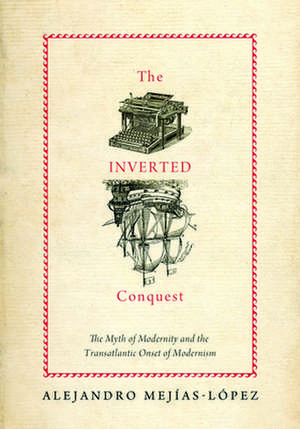
The Inverted Conquest: The Myth of Modernity and the Transatlantic Onset of Modernism
Autor Alejandro Mejias-Lopezen Limba Engleză Hardback – 9 feb 2010
Expanding Bourdieu's concepts of cultural field and symbolic capital beyond national boundaries, The Inverted Conquest shows how modernismo originated in Latin America and traveled to Spain, where it provoked a complete renovation of Spanish letters and contributed to a national identity crisis. In the process, described by Latin American writers as a reversal of colonial relations, modernismo wrested literary and cultural authority away from Spain, moving the cultural center of the Hispanic world to the Americas.
Mejias-Lopez further reveals how Spanish American modernistas confronted the racial supremacist claims and homogenizing force of an Anglo-American modernity that defined the Hispanic as un-modern. Constructing a new Hispanic genealogy, modernistas wrote Spain as the birthplace of modernity and themselves as the true bearers of the modern spirit, moved by the pursuit of knowledge, cosmopolitanism, and cultural miscegenation, rather than technology, consumption, and scientific theories of racial purity.
Bound by the intrinsic limits of neocolonial and postcolonial theories, scholarship has been unwilling or unable to explore modernismo's profound implications for our understanding of Western modernities.
Preț: 459.90 lei
Preț vechi: 597.27 lei
-23% Nou
Puncte Express: 690
Preț estimativ în valută:
81.40€ • 94.89$ • 71.19£
81.40€ • 94.89$ • 71.19£
Carte tipărită la comandă
Livrare economică 20 ianuarie-03 februarie 26
Preluare comenzi: 021 569.72.76
Specificații
ISBN-13: 9780826516770
ISBN-10: 0826516777
Pagini: 264
Dimensiuni: 157 x 236 x 30 mm
Greutate: 0.61 kg
Editura: Vanderbilt University Press
Colecția Vanderbilt University Press
ISBN-10: 0826516777
Pagini: 264
Dimensiuni: 157 x 236 x 30 mm
Greutate: 0.61 kg
Editura: Vanderbilt University Press
Colecția Vanderbilt University Press
Notă biografică
Alejandro Mejias-Lopez is an Associate Professor in the Department of Spanish and Portuguese at Indiana University.
Recenzii
Emphasizing the uneven modernity of the European countries themselves, Mejias-Lopez trenchantly makes the case for the existence of a Spanish American modernity at the turn of the nineteenth century and for the full incorporation of Spanish American modernismo into Anglo-American and European definitions of modernism. This impressive book will undoubtedly renew and enliven the debate about modernismo and modernity.
--Anibal Gonzalez, Professor of Modern Latin American Literature, Yale University
"A provocative, innovative approach to modernism. Highly recommended."
--CHOICE
A splendid book that forcefully presents an important and innovative argument about the cultural politics of a major Hispanic literary movement, modernismo. But it does more than this--it offers a stimulating alternative vision of the narrative of modernity and modernist expression that has long been centered in northern Europe and the U.S.
--Susan Kirkpatrick
In this impressively researched and well written book, Mejias-Lopez makes the convincing case that Latin American intellectuals were not mistaken in seeing their countries at the forefront of modernity. He argues, in fact, that the whole notion of a modern, homogeneous "West" in comparison to which the "peripheral" Latin America of the post-independence period would seem "incompletely" or "unevenly" modern is an anachronistic construct.
--Sebastiaan Faber
--Anibal Gonzalez, Professor of Modern Latin American Literature, Yale University
"A provocative, innovative approach to modernism. Highly recommended."
--CHOICE
A splendid book that forcefully presents an important and innovative argument about the cultural politics of a major Hispanic literary movement, modernismo. But it does more than this--it offers a stimulating alternative vision of the narrative of modernity and modernist expression that has long been centered in northern Europe and the U.S.
--Susan Kirkpatrick
In this impressively researched and well written book, Mejias-Lopez makes the convincing case that Latin American intellectuals were not mistaken in seeing their countries at the forefront of modernity. He argues, in fact, that the whole notion of a modern, homogeneous "West" in comparison to which the "peripheral" Latin America of the post-independence period would seem "incompletely" or "unevenly" modern is an anachronistic construct.
--Sebastiaan Faber