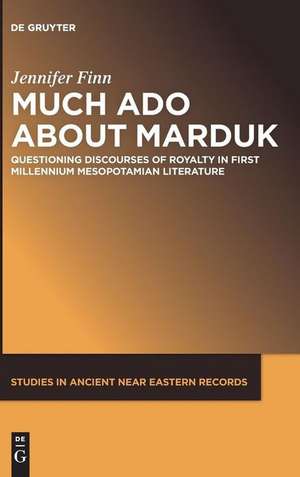
Much ADO about Marduk: Studies in Ancient Near Eastern Records (Saner), cartea 16
Autor Jennifer Finnen Limba Engleză Hardback – vârsta de la 22 ani
| Toate formatele și edițiile | Preț | Express |
|---|---|---|
| Hardback (1) | 813.30 lei 6-8 săpt. | |
| – | 813.30 lei 6-8 săpt. | |
| Electronic book text (1) | 636.31 lei Precomandă | |
| De Gruyter – 14 aug 2017 | 636.31 lei Precomandă |
Preț: 813.30 lei
Preț vechi: 1056.23 lei
-23%
Puncte Express: 1220
Preț estimativ în valută:
143.83€ • 170.21$ • 125.42£
143.83€ • 170.21$ • 125.42£
Carte tipărită la comandă
Livrare economică 03-17 aprilie
Specificații
ISBN-13: 9781501513855
ISBN-10: 1501513850
Pagini: 275
Greutate: 0.5 kg
Seria Studies in Ancient Near Eastern Records (Saner)
ISBN-10: 1501513850
Pagini: 275
Greutate: 0.5 kg
Seria Studies in Ancient Near Eastern Records (Saner)
V-ar putea interesa
-
 Language, Theology, and the Bible: Essays in Honour of James BarrSamuel E. Balentine-34%Preț: 707.67 lei1077.47 lei
 -
 -37%Preț: 1051.66 lei1667.74 lei
 -
 The Death of Scripture and the Rise of Biblical StudiesMichael C. LegaspiPreț: 313.32 lei
 -
 Lent for EveryoneTom WrightPreț: 68.21 lei
 -
 HeavenPaula GooderPreț: 75.08 lei
 -
 The Nail – Being Part Of The PassionStephen CottrellPreț: 73.76 lei
 -
 Finding God in the Psalms – Sing, Pray, LiveTom WrightPreț: 82.31 lei
 -
 Theological Wordbook of the Old TestamentR Laird HarrisPreț: 381.38 lei
 -
 Contextualization in the New TestamentDean FlemmingPreț: 204.12 lei
 -
 Thou Art That: Transforming Religious MetaphorJoseph CampbellPreț: 86.15 lei
Notă biografică
Jennifer Finn, Marquette University, Milwaukee, WI, U.S.A.
Descriere
Descriere de la o altă ediție sau format:
Scholars often assume that the nature of Mesopotamian kingship was such that questioning royal authority was impossible. This volume challenges that general assumption, by presenting an analysis of the motivations,methods, and motifs behind a scholarly discourse about kingship that arose in the final stages of the last Mesopotamian empires. The focus of the volume is the proliferation of a literature that problematizes authority in the Neo-Assyrian period, when texts first begin to specifically explore various modalities for critique of royalty. This development is symptomatic of a larger discourse about the limits of power that emerges after the repatriation of Marduk's statue to Babylon during the reign of Nebuchadnezzar I in the 12th century BCE. From this point onwards, public attitudes toward Marduk provide a framework for the definition of proper royal behavior, and become a point of contention between Assyria and Babylonia. It is in this historical and political context that several important Akkadian compositions are placed. The texts are analyzed from a new perspective that sheds light on their original milieux and intended functions.
Scholars often assume that the nature of Mesopotamian kingship was such that questioning royal authority was impossible. This volume challenges that general assumption, by presenting an analysis of the motivations,methods, and motifs behind a scholarly discourse about kingship that arose in the final stages of the last Mesopotamian empires. The focus of the volume is the proliferation of a literature that problematizes authority in the Neo-Assyrian period, when texts first begin to specifically explore various modalities for critique of royalty. This development is symptomatic of a larger discourse about the limits of power that emerges after the repatriation of Marduk's statue to Babylon during the reign of Nebuchadnezzar I in the 12th century BCE. From this point onwards, public attitudes toward Marduk provide a framework for the definition of proper royal behavior, and become a point of contention between Assyria and Babylonia. It is in this historical and political context that several important Akkadian compositions are placed. The texts are analyzed from a new perspective that sheds light on their original milieux and intended functions.