
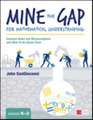
Mine the Gap for Mathematical Understanding, Grades 6-8: Common Holes and Misconceptions and What To Do About Them: Corwin Mathematics Series
Autor John J. SanGiovanni, Jennifer R. Novaken Limba Engleză Electronic book text – 25 sep 2017
Din seria Corwin Mathematics Series
-
 Preț: 293.30 lei
 -
 Preț: 263.48 lei
 -
 Preț: 256.04 lei
 -
 Preț: 260.05 lei
 -
 Preț: 278.20 lei
 -
 Preț: 238.47 lei
 -
 Preț: 267.07 lei
 -
 Preț: 325.23 lei
 -
 Preț: 296.49 lei
 -
 Preț: 241.43 lei
 -
 Preț: 265.68 lei
 -
 Preț: 273.55 lei
 -
 Preț: 265.69 lei
 -
 Preț: 244.36 lei
 -
 Preț: 266.62 lei
 -
 Preț: 271.67 lei
 -
 Preț: 280.26 lei
 -
 Preț: 269.83 lei
 -
 Preț: 294.18 lei
 -
 Preț: 255.98 lei
 -
 Preț: 295.43 lei
 -
 Preț: 294.49 lei
 -
 Preț: 293.79 lei
 -
 Preț: 291.24 lei
 -
 Preț: 251.13 lei
 -
 Preț: 293.46 lei
 -
 Preț: 263.85 lei
 -
 Preț: 297.16 lei
 -
 Preț: 268.45 lei
 -
![Mathematize It! [Grades 6-8]: Going Beyond Key Words to Make Sense of Word Problems, Grades 6-8](https://i3.books-express.ro/bs/9781506354484/mathematize-it-grades-6-8.jpg) Preț: 236.64 lei
Preț: 236.64 lei -
 Preț: 260.84 lei
 -
 Preț: 250.02 lei
 -
 Preț: 267.07 lei
 -
 Preț: 292.13 lei
 -
 Preț: 277.74 lei
 -
 Preț: 257.60 lei
 -
 Preț: 265.99 lei
 -
 Preț: 270.76 lei
 -
 Preț: 262.37 lei
 -
 Preț: 100.63 lei
 -
 Preț: 289.30 lei
 -
![Answers to Your Biggest Questions About Teaching Secondary Math: Five to Thrive [series]](https://i4.books-express.ro/bs/9781071870792/answers-to-your-biggest-questions-about-teaching-secondary-math.jpg) Preț: 292.05 lei
Preț: 292.05 lei -
 Preț: 291.83 lei
 -
 Preț: 239.74 lei
 -
 Preț: 285.39 lei
 -
 Preț: 293.92 lei
 -
![Mathematize It! [Grades K-2]: Going Beyond Key Words to Make Sense of Word Problems, Grades K-2](https://i0.books-express.ro/bs/9781544389851/mathematize-it-grades-k-2.jpg) Preț: 266.29 lei
Preț: 266.29 lei -
 Preț: 243.92 lei
 -
 Preț: 280.90 lei
 -
![Simplifying Stem [6-12]](https://i1.books-express.ro/bs/9781071917060/simplifying-stem-6-12.jpg) Preț: 257.56 lei
Preț: 257.56 lei
Preț: 191.34 lei
Nou
Puncte Express: 287
Preț estimativ în valută:
31.06€ • 36.18$ • 27.12£
31.06€ • 36.18$ • 27.12£
Indisponibil temporar
Doresc să fiu notificat când acest titlu va fi disponibil:
Se trimite...
Preluare comenzi: 021 569.72.76
Specificații
ISBN-13: 9781506379838
ISBN-10: 1506379834
Pagini: 408
Dimensiuni: 216 x 279 mm
Ediția:1
Editura: SAGE Publications
Colecția Corwin
Seria Corwin Mathematics Series
Locul publicării:Thousand Oaks, United States
ISBN-10: 1506379834
Pagini: 408
Dimensiuni: 216 x 279 mm
Ediția:1
Editura: SAGE Publications
Colecția Corwin
Seria Corwin Mathematics Series
Locul publicării:Thousand Oaks, United States
Recenzii
“Wow!
This
book
is
a
treasure
trove
for
middle
school
teachers
and
those
who
support
middle
level
mathematics
education.
The
tasks
presented
are
top
notch,
the
student
work
is
illustrative
of
classrooms,
and
the
suggestions
for
how
to
respond
are
incredible!
Each
of
these
three
would
make
a
great
resource—to
have
them
all
blended
together
is
outstanding.”
“Mine the Gap for Mathematical Understanding provides the framework and guidance teachers need to move beyond finding correct answers to dig deeply into the mine of student thinking, to analyze misconceptions and gaps in understanding, and to develop and implement specific strategies to support every student in deep mathematics learning. Every teacher of mathematics needs this amazing resource to learn to mine the gaps for each of their students!”
“This work does what other books only attempt to do. It combines instruction, assessment, and practice with open-ended and rich tasks that allow for teachers to not only immediately implement the ideas but also understand the content and pedagogy behind them. The tasks, which are immediately implementable and customizable, engage each and every learner. They are based on cutting-edge and research-based instructional frameworks and provide countless learning opportunities for students.”
“Mine the Gap is a great tool for teachers to use to grow their own understanding of student misconceptions and incomplete understandings and how to address them. This is an indispensable resource for all involved in supporting students’ growth in mathematics.”
“More than just a nice collection of problems, this book shares a road map for teachers looking to enhance the quality of the math tasks they use with students. Teachers will appreciate the examples of actual student work paired with tips for analysis and instruction.”
“This book helps navigate how to use student work to drive instruction with rich engaging tasks, which will help all students become better mathematicians. The authors have done an excellent job of helping teachers to carefully look at student work to identify how students solved math problems, using this evidence to identify those students who understand the targeted skill, along with the misconceptions or misunderstandings of other students, with suggestions of how to move all students forward in their thinking.”
“Mine the Gap for Mathematical Understanding provides the framework and guidance teachers need to move beyond finding correct answers to dig deeply into the mine of student thinking, to analyze misconceptions and gaps in understanding, and to develop and implement specific strategies to support every student in deep mathematics learning. Every teacher of mathematics needs this amazing resource to learn to mine the gaps for each of their students!”
“This work does what other books only attempt to do. It combines instruction, assessment, and practice with open-ended and rich tasks that allow for teachers to not only immediately implement the ideas but also understand the content and pedagogy behind them. The tasks, which are immediately implementable and customizable, engage each and every learner. They are based on cutting-edge and research-based instructional frameworks and provide countless learning opportunities for students.”
“Mine the Gap is a great tool for teachers to use to grow their own understanding of student misconceptions and incomplete understandings and how to address them. This is an indispensable resource for all involved in supporting students’ growth in mathematics.”
“More than just a nice collection of problems, this book shares a road map for teachers looking to enhance the quality of the math tasks they use with students. Teachers will appreciate the examples of actual student work paired with tips for analysis and instruction.”
“This book helps navigate how to use student work to drive instruction with rich engaging tasks, which will help all students become better mathematicians. The authors have done an excellent job of helping teachers to carefully look at student work to identify how students solved math problems, using this evidence to identify those students who understand the targeted skill, along with the misconceptions or misunderstandings of other students, with suggestions of how to move all students forward in their thinking.”
Cuprins
Big
Ideas
and
Tasks
at
a
Glance
Acknowledgments
About the Authors
Introduction
Chapter 1. Rich Mathematics Tasks, Student Misconceptions, Using Tasks
Prompts With Purpose: Using High-Quality Tasks
Using Quality Tasks
Reflecting on Chapter 1
Chapter 2. Number Systems
Big Ideas
1. Addition and Subtraction of Fractions
2. Multiplication and Division of Fractions
3. Reasoning About Addition and Subtraction of Fractions
4. Reasoning About Multiplication and Division of Fractions
5. Problem Solving With Fractions
6. Decimals as Numbers
7. Addition and Subtraction With Decimals
8. Multiplication and Division With Decimals
Chapter 3. Integers
Big Ideas
9. Representing Integers
10. Representing Integers on Number Lines
11. More Representing Integers on Number Lines
12. Comparing Integers
13. Addition With Integers
14. Subtraction With Integers
15. Multiplication With Integers
16. Division With Integers
Chapter 4. Ratio, Proportion, and Percent
Big Ideas
17. Representing Ratios
18. Equivalent Ratios
19. Unit Rates
20. Using Ratios to Solve Problems
21. Reasoning With Percents
22. Unit Rate as Slope
Chapter 5. Expressions, Equations, and Functions
Big Ideas
23. Writing Expressions
24. Evaluating Expressions
25. Equivalent Expressions
26. Writing Equations
27. Solving Equations
28. Inequalities
29. Function Tables
30. Reasoning About Graphing
31. Comparing Functions
32. Systems of Equations
Chapter 6. Geometry
Big Ideas
33. Area of Composite Figures
34. Nets and Three-Dimensional Figures
35. Surface Area and Volume
36. Volume of Cylinders and Cones
37. Angle Relationships
38. Transformations, Similarity, and Congruence
39. Distance and Pythagorean Theorem
Chapter 7. Statistics
Big Ideas
40. Univariate Categorical Data
41. Univariate Quantitative Data
42. Displays of Univariate Quantitative Data
43. Deviations From the Mean
44. Bivariate Categorical Data
45. Bivariate Quantitative Data
Chapter 8. What Do We Do Next?
References and Additional Resources
Acknowledgments
About the Authors
Introduction
Chapter 1. Rich Mathematics Tasks, Student Misconceptions, Using Tasks
Prompts With Purpose: Using High-Quality Tasks
Using Quality Tasks
Reflecting on Chapter 1
Chapter 2. Number Systems
Big Ideas
1. Addition and Subtraction of Fractions
2. Multiplication and Division of Fractions
3. Reasoning About Addition and Subtraction of Fractions
4. Reasoning About Multiplication and Division of Fractions
5. Problem Solving With Fractions
6. Decimals as Numbers
7. Addition and Subtraction With Decimals
8. Multiplication and Division With Decimals
Chapter 3. Integers
Big Ideas
9. Representing Integers
10. Representing Integers on Number Lines
11. More Representing Integers on Number Lines
12. Comparing Integers
13. Addition With Integers
14. Subtraction With Integers
15. Multiplication With Integers
16. Division With Integers
Chapter 4. Ratio, Proportion, and Percent
Big Ideas
17. Representing Ratios
18. Equivalent Ratios
19. Unit Rates
20. Using Ratios to Solve Problems
21. Reasoning With Percents
22. Unit Rate as Slope
Chapter 5. Expressions, Equations, and Functions
Big Ideas
23. Writing Expressions
24. Evaluating Expressions
25. Equivalent Expressions
26. Writing Equations
27. Solving Equations
28. Inequalities
29. Function Tables
30. Reasoning About Graphing
31. Comparing Functions
32. Systems of Equations
Chapter 6. Geometry
Big Ideas
33. Area of Composite Figures
34. Nets and Three-Dimensional Figures
35. Surface Area and Volume
36. Volume of Cylinders and Cones
37. Angle Relationships
38. Transformations, Similarity, and Congruence
39. Distance and Pythagorean Theorem
Chapter 7. Statistics
Big Ideas
40. Univariate Categorical Data
41. Univariate Quantitative Data
42. Displays of Univariate Quantitative Data
43. Deviations From the Mean
44. Bivariate Categorical Data
45. Bivariate Quantitative Data
Chapter 8. What Do We Do Next?
References and Additional Resources
Descriere
Discover
the
“why”
behind
students’
math
mistakes
with
this
bank
of
180
downloadable,
standards-aligned
math
tasks,
common
misunderstandings,
and
next
instructional
steps.