
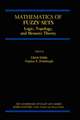
Mathematics of Fuzzy Sets: Logic, Topology, and Measure Theory: The Handbooks of Fuzzy Sets, cartea 3
Autor Ulrich Höhle, S. E. Rodabaughen Limba Engleză Paperback – 5 noi 2012
Chapter 1 deals with non-classical logics and their syntactic and semantic foundations. Chapter 2 details the lattice-theoretic foundations of image and preimage powerset operators. Chapters 3 and 4 lay down the axiomatic and categorical foundations of general topology using lattice-valued mappings as a fundamental tool. Chapter 3 focuses on the fixed-basis case, including a convergence theory demonstrating the utility of the underlying axioms. Chapter 4 focuses on the more general variable-basis case, providing a categorical unification of locales, fixed-basis topological spaces, and variable-basis compactifications.
Chapter 5 relates lattice-valued topologies to probabilistic topological spaces and fuzzy neighborhood spaces. Chapter 6 investigates the important role of separation axioms in lattice-valued topology from the perspective of space embedding and mapping extension problems, while Chapter 7 examines separation axioms from the perspective of Stone-Cech-compactification and Stone-representation theorems. Chapters 8 and 9 introduce the most important concepts and properties of uniformities, including the covering and entourage approaches and the basic theory of precompact or complete [0,1]-valued uniform spaces. Chapter 10 sets out the algebraic, topological, and uniform structures of the fundamentally important fuzzy real line and fuzzy unit interval.
Chapter 11 lays the foundations of generalized measure theory and representation by Markov kernels. Chapter 12 develops the important theory of conditioning operators with applications to measure-free conditioning. Chapter 13 presents elements of pseudo-analysis with applications to the Hamilton&endash;Jacobi equation and optimization problems. Chapter 14 surveys briefly the fundamentals of fuzzy random variables which are [0,1]-valued interpretations of random sets.
| Toate formatele și edițiile | Preț | Express |
|---|---|---|
| Paperback (1) | 2026.06 lei 43-57 zile | |
| Springer Us – 5 noi 2012 | 2026.06 lei 43-57 zile | |
| Hardback (1) | 1770.86 lei 43-57 zile | |
| Springer Us – 31 dec 1998 | 1770.86 lei 43-57 zile |


Preț: 2026.06 lei
Preț vechi: 2470.80 lei
-18% Nou
Puncte Express: 3039
Preț estimativ în valută:
358.47€ • 417.62$ • 313.03£
358.47€ • 417.62$ • 313.03£
Carte tipărită la comandă
Livrare economică 19 ianuarie-02 februarie 26
Preluare comenzi: 021 569.72.76
Specificații
ISBN-13: 9781461373100
ISBN-10: 1461373107
Pagini: 728
Ilustrații: XII, 716 p.
Dimensiuni: 155 x 235 x 38 mm
Greutate: 1 kg
Ediția:Softcover reprint of the original 1st ed. 1999
Editura: Springer Us
Colecția Springer
Seria The Handbooks of Fuzzy Sets
Locul publicării:New York, NY, United States
ISBN-10: 1461373107
Pagini: 728
Ilustrații: XII, 716 p.
Dimensiuni: 155 x 235 x 38 mm
Greutate: 1 kg
Ediția:Softcover reprint of the original 1st ed. 1999
Editura: Springer Us
Colecția Springer
Seria The Handbooks of Fuzzy Sets
Locul publicării:New York, NY, United States
V-ar putea interesa
-
 Simplicity TheoryByunghan Kim-27%Preț: 675.69 lei931.88 lei
 -
 In Defence of Objective BayesianismJon Williamson-14%Preț: 629.66 lei732.16 lei
 -
 Computing with Cells: Advances in Membrane ComputingPierluigi Frisco-34%Preț: 754.59 lei1137.62 lei
 -
 Not Exactly: In Praise of VaguenessKees van Deemter-16%Preț: 112.71 lei134.88 lei
 -
 Computability and RandomnessAndre Nies-22%Preț: 380.01 lei486.97 lei
 -
 Preț: 75.07 lei
 -
 Multiple ForcingT. JechPreț: 315.88 lei
 -
 Forcing with Random Variables and Proof ComplexityJan Krajíček-11%Preț: 405.08 lei455.14 lei
 -
 Lectures in Logic and Set Theory: Volume 1, Mathematical LogicGeorge TourlakisPreț: 417.72 lei
 -
 A Course in Model TheoryKatrin Tent-11%Preț: 462.80 lei520.00 lei
 -
 Lambda Calculus with TypesHenk Barendregt-11%Preț: 623.56 lei700.63 lei
 -
 Mathematical Logic for Computer ScienceMordechai Ben-Ari-20%Preț: 378.09 lei472.62 lei
 -
 Combinatorial Set Theory: With a Gentle Introduction to ForcingLorenz J. Halbeisen-19%Preț: 558.30 lei689.25 lei
 -
 -15%Preț: 421.53 lei495.93 lei
 -
 Preț: 475.01 lei
 -
 Sets, Logic and CategoriesPeter J. CameronPreț: 270.38 lei
 -
 -18%Preț: 1100.12 lei1341.61 lei
 -
 Lattice Theory: Special Topics and Applications: Volume 1George Grätzer-15%Preț: 627.62 lei738.37 lei
Public țintă
ResearchCuprins
1. Many-valued logic and fuzzy set theory.- 2. Powerset operator foundations for poslat fuzzy set theories and topologies.- Introductory notes to Chapter 3.- 3. Axiomatic foundations of fixed-basis fuzzy topology.- 4. Categorical foundations of variable-basis fuzzy topology.- 5. Characterization of L-topologies by L-valued neighborhoods.- 6. Separation axioms: Extension of mappings and embedding of spaces.- 7. Separation axioms: Representation theorems, compactness, and compactifications.- 8. Uniform spaces.- 9. Extensions of uniform space notions.- 10. Fuzzy real lines and dual real lines as poslat topological, uniform, and metric ordered semirings with unity.- 11. Fundamentals of generalized measure theory.- 12. On conditioning operators.- 13. Applications of decomposable measures.- 14. Fuzzy random variables revisited.