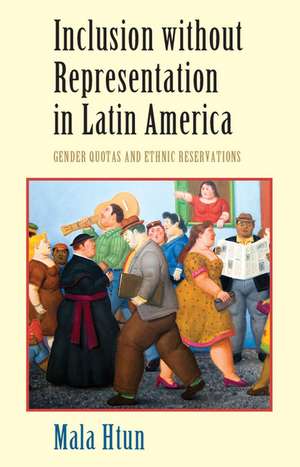
Inclusion without Representation in Latin America: Gender Quotas and Ethnic Reservations: Cambridge Studies in Gender and Politics
Autor Mala Htunen Limba Engleză Paperback – 13 ian 2016
| Toate formatele și edițiile | Preț | Express |
|---|---|---|
| Paperback (1) | 270.42 lei 3-5 săpt. | +19.52 lei 4-10 zile |
| Cambridge University Press – 13 ian 2016 | 270.42 lei 3-5 săpt. | +19.52 lei 4-10 zile |
| Hardback (1) | 520.63 lei 6-8 săpt. | |
| Cambridge University Press – 13 ian 2016 | 520.63 lei 6-8 săpt. |



Preț: 270.42 lei
Nou
Puncte Express: 406
Preț estimativ în valută:
47.86€ • 55.79$ • 41.86£
47.86€ • 55.79$ • 41.86£
Carte disponibilă
Livrare economică 30 decembrie 25 - 13 ianuarie 26
Livrare express 13-19 decembrie pentru 29.51 lei
Preluare comenzi: 021 569.72.76
Specificații
ISBN-13: 9780521690836
ISBN-10: 0521690838
Pagini: 256
Ilustrații: 10 b/w illus.
Dimensiuni: 152 x 228 x 13 mm
Greutate: 0.34 kg
Editura: Cambridge University Press
Colecția Cambridge University Press
Seria Cambridge Studies in Gender and Politics
Locul publicării:New York, United States
ISBN-10: 0521690838
Pagini: 256
Ilustrații: 10 b/w illus.
Dimensiuni: 152 x 228 x 13 mm
Greutate: 0.34 kg
Editura: Cambridge University Press
Colecția Cambridge University Press
Seria Cambridge Studies in Gender and Politics
Locul publicării:New York, United States
V-ar putea interesa
-
 On the Frontlines: Gender, War, and the Post-Conflict ProcessFionnuala Ní AoláinPreț: 345.05 lei
 -
 Preț: 281.93 lei
 -
 Women, Armies, and Warfare in Early Modern EuropeJohn A. Lynn IIPreț: 215.97 lei
 -
 Gender Equality: Dimensions of Women's Equal CitizenshipLinda C. McClainPreț: 453.25 lei
 -
 Incomplete Revolution: Adapting Welfare States to Women′s New RolesGosta Esping–AndersenPreț: 151.58 lei
 -
 Women and Poverty in 21st Century AmericaPaula vW DailPreț: 192.55 lei
 -
 -22%Preț: 73.88 lei94.48 lei
 -
 Does God Hate Women?Ophelia Benson-38%Preț: 206.62 lei335.73 lei
 -
 Gender and Timebound Commandments in JudaismElizabeth Shanks AlexanderPreț: 294.64 lei
 -
 Medieval WomenEileen PowerPreț: 134.79 lei
 -
 Bad Shoes: And the Women Who Love ThemLeora Tanenbaum-43%Preț: 49.34 lei86.25 lei
 -
 Mad, Bad And SadLisa Appignanesi-26%Preț: 77.56 lei104.84 lei
 -
 Passing Through Missing PagesFrances Clay Welwood-5%Preț: 104.68 lei110.48 lei
 -
 StrippedJennifer Hayashi DannsPreț: 62.22 lei
Cuprins
Preface and acknowledgements; 1. Introduction: politics of inclusion in Latin America; 2. Women, Afrodescendants, and indigenous peoples in elected office; 3. Gender quotas: why and how? 4. Indigenous reservations and gender parity in Bolivia with Juan Pablo Ossa; 5. The rise and fall of political inclusion in Colombia; 6. Brazil: combatting exclusion through quotas in higher education; 7. After quotas: women's presence and legislative behavior in Argentina with Marina Lacalle and Juan Pablo Micozzi; Conclusion; Appendix 1. List of research trips; Appendix 2. Mechanisms of inclusion.
Notă biografică
Descriere
This book analyzes how Latin American countries modified their institutions to promote the inclusion of women, Afrodescendants, and indigenous peoples.