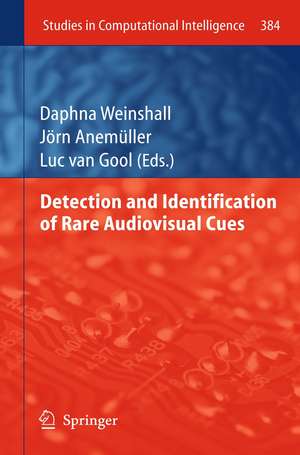
Detection and Identification of Rare Audio-visual Cues
Editat de Daphna Weinshall, Jörn Anemüller, Luc Van Goolen Limba Engleză Paperback – 30 noi 2013
The observation described above lead to the initiation of the DIRAC EC project in 2006. In 2010 a workshop was held, aimed to bring together researchers and students from different disciplines in order to present and discuss new approaches for identifying and reacting to unexpected events in information-rich environments. This book includes a summary of the achievements of the DIRAC project in chapter 1, and a collection of the papers presented in this workshop in the remaining parts.
Preț: 616.85 lei
Preț vechi: 771.06 lei
-20% Nou
Puncte Express: 925
Preț estimativ în valută:
109.14€ • 127.15$ • 95.30£
109.14€ • 127.15$ • 95.30£
Carte tipărită la comandă
Livrare economică 19 ianuarie-02 februarie 26
Preluare comenzi: 021 569.72.76
Specificații
ISBN-13: 9783642269721
ISBN-10: 3642269729
Pagini: 200
Ilustrații: VIII, 192 p.
Dimensiuni: 155 x 235 x 12 mm
Greutate: 0.31 kg
Ediția:2012
Editura: Springer
Locul publicării:Berlin, Heidelberg, Germany
ISBN-10: 3642269729
Pagini: 200
Ilustrații: VIII, 192 p.
Dimensiuni: 155 x 235 x 12 mm
Greutate: 0.31 kg
Ediția:2012
Editura: Springer
Locul publicării:Berlin, Heidelberg, Germany
V-ar putea interesa
-
 -21%Preț: 82.88 lei105.23 lei
 -
 Computer Vision: Models, Learning, and InferenceSimon J. D. Prince-20%Preț: 528.60 lei660.76 lei
 -
 -20%Preț: 349.98 lei437.48 lei
 -
 -20%Preț: 623.61 lei779.51 lei
 -
 Wavelet Neural NetworksAntonios K Alexandridis-20%Preț: 587.77 lei734.71 lei
 -
 A Practical Introduction to Computer Vision with OpenCV3K Dawson–Howe-23%Preț: 433.80 lei563.37 lei
 -
 Machine Learning: An Algorithmic Perspective, Second EditionStephen Marsland-20%Preț: 566.70 lei708.37 lei
 -
 -9%Preț: 945.32 lei1038.82 lei
 -
 -20%Preț: 326.42 lei408.02 lei
 -
 Foundations of Equational Logic ProgrammingSteffen Hölldobler-20%Preț: 220.77 lei275.96 lei
 -
 -20%Preț: 314.04 lei392.55 lei
 -
 -20%Preț: 312.92 lei391.15 lei
 -
 -20%Preț: 636.06 lei795.08 lei
 -
 -20%Preț: 321.17 lei401.46 lei
 -
 -20%Preț: 325.30 lei406.63 lei
 -
 The Logic of Information StructuresHeinrich Wansing-20%Preț: 314.22 lei392.77 lei
 -
 -20%Preț: 217.76 lei272.19 lei
 -
 -20%Preț: 324.45 lei405.57 lei
 -
 Believable Bots: Can Computers Play Like People?Philip Hingston-20%Preț: 628.32 lei785.39 lei
Public țintă
ResearchCuprins
Introduction.- The DIRAC project.- The detection of incongruent events, project survey and algorithms.- Alternative frameworks to detect meaningful novel events.- Dealing with meaningful novel events, what to do after detection.- How biological systems deal with novel and incongruent events.
Textul de pe ultima copertă
Machine learning builds models of the world using training data from the application domain and prior knowledge about the problem. The models are later applied to future data in order to estimate the current state of the world. An implied assumption is that the future is stochastically similar to the past. The approach fails when the system encounters situations that are not anticipated from the past experience. In contrast, successful natural organisms identify new unanticipated stimuli and situations and frequently generate appropriate responses.
The observation described above lead to the initiation of the DIRAC EC project in 2006. In 2010 a workshop was held, aimed to bring together researchers and students from different disciplines in order to present and discuss new approaches for identifying and reacting to unexpected events in information-rich environments. This book includes a summary of the achievements of the DIRAC project in chapter 1, and a collection of the papers presented in this workshop in the remaining parts.
The observation described above lead to the initiation of the DIRAC EC project in 2006. In 2010 a workshop was held, aimed to bring together researchers and students from different disciplines in order to present and discuss new approaches for identifying and reacting to unexpected events in information-rich environments. This book includes a summary of the achievements of the DIRAC project in chapter 1, and a collection of the papers presented in this workshop in the remaining parts.
Caracteristici
Recent research in Detection and Identification of Rare Audiovisual Cues Scientific outcome of the European project DIRAC (Detection and Identification of Rare Audio-visual Cues) Written by leading experts in the field